
PUBLIC PROTECTOR ACT: INDEX TO SUBSIDIARY LEGISLATION
Commission for Investigations (Witnesses’ Allowances and Expenses) Rules
COMMISSION FOR INVESTIGATIONS (WITNESSES’ ALLOWANCES AND EXPENSES) RULES
Arrangement of Rules
Rule
1. Title
2. Interpretation
3. Application
4. Persons entitled to allowance
5. Allowances
6. Payment of allowances to witnesses in Class A
7. Matters to be taken into account
8. No additional allowance
9. Increases and reductions
10. Travelling expenses
11. Claims to be submitted to Secretary
12. Commissioner to act in absence of Chairman
[Rules made by the Commission]
SI 152 of 1974,
Act 13 of 1994.
These Rules may be cited as the Commission for Investigations (Witnesses’ Allowances and Expenses) Rules.
In these Rules, unless the context otherwise requires—
“Chairman” means the Investigator-General;
“Commission” means the Commission for Investigations established by Article 117 of the Constitution;
“Commissioner” means a Member of the Commission other than the Investigator-General;
“Secretary” means the person appointed to be the Secretary of the Commission;
“witness” includes an interpreter.
These Rules shall apply to all witnesses summoned to appear before the Commission but shall not apply to any witness who is a public officer.
4. Persons entitled to allowance
A witness who has attended at or for the investigation at the instance of a party or the Commission shall be entitled to allowances unless the Commission shall for sufficient reason disallow the allowances of any such witness.
Subject as hereinafter provided, there shall be paid to any witness entitled thereto allowances calculated in accordance with the Schedule hereto.
6. Payment of allowances to witnesses in Class A
(1) The payment of allowances to any witness described in Class A of the Schedule hereto shall be subject to the provisions of this rule.
(2) Where a witness has lost no wages, earnings or other income by reason of attending at or for an investigation, the sum payable to any such witness shall not, unless otherwise ordered by the Chairman, exceed ten fee units per day.
(3) Where a witness has lost wages, earnings or other income by reason of attending at or for an investigation but the period in respect of which such loss has been incurred does not exceed four hours, the sum payable to any such witness shall not, unless otherwise ordered by the Chairman, exceed sixty fee units per day.
[Am by Act 13 of 1994.]
7. Matters to be taken into account
There shall be taken into account in calculating allowances payable to a witness any time during which such witness is necessarily detained for the purposes of an investigation, and any time reasonably occupied in travelling to the venue of an investigation.
No additional allowance will be paid merely because the witness attends in respect of more than one investigation on the same day.
If in the opinion of the Chairman a strict adherence to these Rules would result in hardship, he may in his discretion increase the amounts payable, and if in his opinion a reduction in any of the allowances provided for by these Rules is justified in any particular case, he may in his discretion reduce or disallow the amounts payable.
(1) In addition to any sum to which a witness may be entitled under these Rules, all witnesses shall also be entitled to be reimbursed in respect of any expenses actually and reasonably incurred in travelling to and from the venue of an investigation, and for necessary accommodation and subsistence.
(2) If in the opinion of the Chairman the sums expended and claimed exceed what is reasonable, he may in his discretion reduce or disallow the amounts payable.
(3) If any witness travels by his motor vehicle or motor cycle he may claim travelling expenses at the rate of one fee unit per kilometre and one fee unit per kilometre, respectively.
[Am by Act 13 of 1994.]
11. Claims to be submitted to Secretary
All claims for payment of allowances and expenses shall be submitted to the Secretary.
12. Commissioner to act in absence of Chairman
In the absence of the Chairman the powers and responsibilities vested in him by these Rules may be exercised or performed by a Commissioner.
SCHEDULE
[Rule 4]
[Am by Act 13 of 1994.]
WITNESSES’ ALLOWANCES
|
Class of Person |
Minimum Sum Payable |
Maximum Sum Payable |
|
A. Professional persons, owners, directors or managers of businesses and expert witnesses; clerks, artisans and persons of similar status |
60 |
160 |
|
B. Peasants, labourers and persons of similar status |
3 |
15 |
PUBLIC PROTECTOR RULES
[Section 42]
Arrangement of Rules
Rule
PART I
PRELIMINARY
1. Title
2. Interpretation
PART II
LODGING AND HANDLING OF COMPLAINTS
3. Lodging of complaint
4. Lodging and continuance of complaint on behalf of complainant
5. Submission and acknowledgment of receipt
6. Request for additional information
7. Admission or rejection of complaint
PART III
INVESTIGATIONS BY PUBLIC PROTECTOR
8. Preliminary investigation
9. Notice to investigate respondent
10. Search warrant
PART IV
HEARINGS
11. Holding of investigative hearing
12. Notice of hearing
13. Summon to witness and production of document
14. Consolidation of proceedings
15. Representation of party
16. Default of appearance
17. Proceedings at hearing
PART V
FINDINGS OF PUBLIC PROTECTOR
18. Close of matter
19. Report of Public Protector
PART VI
GENERAL PROVISIONS
20. Service of notices, documents, etc.
21. Change of address
22. Enforcement notice
23. Warrant of arrest
24. Experts and assessors
25. Appeals
26. Recording of proceedings
27. Revocation of S.I. No. 151 of 1974
SI 65 of 2022.
PART I
PRELIMINARY
These Rules may be cited as the Public Protector Rules.
In these Rules, unless the context otherwise requires—
“authorised officer” means an officer under the Office of the Public Protector authorised to carry out the functions of the Public Protector;
“complaint” means any information provided to, allegation made or matter reported to, and received by, the Public Protector for an investigation specified under the Constitution or the Act;
“complainant” means a person who lodges a complaint with the Public Protector under rules 3 and 4;
“Constitutional office holder” has the meaning assigned to the words in the Constitution;
“district investigations officer” means a person appointed as a district investigations officer under the Act;
“investigating officer” means an officer under the Office of the Public Protector authorised to carry out investigations of a complaint, and includes an expert or an assessor;
“legally disqualified” means the absence of legal capacity as provided in section 4 of the Mental Health Act, 2019;
“legal practitioner” has the meaning assigned to the word”practitioner” in the Legal Practitioners Act;
“provincial director” means a person appointed as provincial director under the Act;
“public officer” has the meaning assigned to the words in the Constitution;
“Public Protector” means a person appointed as Public Protector under the Constitution;
“Registrar” has the meaning assigned to the word in the Act;
“respondent” means a State institution, Constitutional office holder or public officer;
“search warrant” means a warrant issued by the Public Protector in respect of entry to search any premises for purposes of carrying out an investigation under Part III of these Rules; and
“State institution” has the meaning assigned to the words in the Constitution.
PART II
LODGING AND HANDLING OF COMPLAINTS
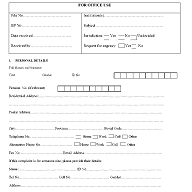
(1) A complainant may lodge a complaint with the Registrar, provincial director, district investigations officer or authorised officer of the area where the incident giving rise to the complaint occurred.
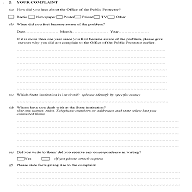
(2) A complaint may be made orally or in Form I set out in the Schedule.
(3) A complaint made in Form I set out in the Schedule may be lodged electronically.
(4) An authorised officer shall, where a complaint is made orally under sub-rule (2), reduce that complaint into writing.
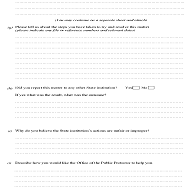
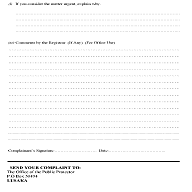
(5) A complaint referred to in sub-rule (2) shall—
(a) contain a detailed statement of facts relating to the incident complained of or circumstances giving rise to the complaint including particulars of the respondent who is involved in the matter;
(b) be accompanied by an affidavit in Form II set out in the Schedule; and
(c) bear a signature or thumb print of the complainant.
4. Lodging and continuance of complaint on behalf of complainant
Despite rule 3, a complaint may be made or continued by the complainant’s personal representative or a person legally appointed to represent the complainant where a complainant—
(a) dies after lodging a complaint;
(b) is legally disqualified; or
(c) is unable to act for oneself after lodging a complaint.
5. Submission and acknowledgment of receipt
(1) The provincial director, district investigations officer or any other authorised officer shall, within seven days of receipt of a complaint under these Rules, submit the complaint to the Registrar.
(2) The Registrar shall, within 14 days of receipt of a complaint under sub-rule (1)—
(a) submit the complaint to the Public Protector; and
(b) acknowledge receipt of the complaint, in writing, to the complainant.
6. Request for additional information
(1) The Registrar may, subject to the direction of the Public Protector, request a complainant to submit additional information in relation to the complaint in Form III set out in the Schedule.
(2) The Registrar shall, where a complainant fails to submit the information requested under sub-rule (1) within the period specified in Form III, reject the application.
(3) The Public Protector may, in exceptional circumstances and on application by a complainant, extend the time within which to submit additional information.
7. Admission or rejection of complaint
The Public Protector or an authorised officer shall, within 14 days of receipt of the complaint, where a complaint—
(a) discloses a prima facie case of maladministration, admit the complaint for investigation and notify the complainant in Form IV set out in the Schedule; or
(b) does not disclose a prima facie case that warrants an investigation, reject the complaint and inform the complainant, within seven days of making that decision, in Form V set out in the Schedule.
PART III
INVESTIGATIONS BY PUBLIC PROTECTOR
(1) The Public Protector shall, on admission of a complaint under rule 7(a), conduct a preliminary investigation within 14 days of admitting the complaint for investigation.
(2) The Public Protector may extend the period specified in sub-rule (1), once, for a period of five days where it is impracticable to conclude a preliminary investigation.
(3) The Public Protector shall, on conclusion of a preliminary investigation under this rule, prepare a preliminary report stating that—
(a) a formal investigation of the complaint be instituted;
(b) a matter be referred to alternative dispute resolution; or
(c) no further action is needed and the matter be closed.
9. Notice to investigate respondent
The Registrar or an authorised officer shall give notice to a respondent of its intention to conduct an investigation of that respondent in Form VI set out in the Schedule.
The Public Protector may, by warrant in Form VII set out in the Schedule, enter any premises and carry out any inspection for purposes of an investigation.
PART IV
HEARINGS
11. Holding of investigative hearing
The Public Protector may hold an investigative hearing of a matter within 90 days of receiving a complaint.
(1) The Registrar shall, at least 14 days before the hearing of a complaint by the Public Protector, cause a notice of the date, time and place of hearing of the complaint to be served on the parties to a hearing in Form VIII set out in the Schedule.
(2) A party served with a notice of hearing under sub-rule (1) may, before the date set for the hearing, apply to the Registrar to vary the date, time, place or mode of hearing.
(3) The Registrar shall not grant an application referred to under sub-rule (2) except in compelling and exceptional circumstances.
13. Summon to witness and production of document
The Public Protector shall issue summons for attendance of a witness or for the production of a book, document, record or other thing in Form IX set out in the Schedule.
14. Consolidation of proceedings
The Public Protector may, where more than one complaint is made by different complainants in respect of the same matter, on its own motion or on an application by a party, order that the complaints be consolidated.
(1) A party may attend a hearing in person or be represented by a legal practitioner.
(2) A legal practitioner appointed to represent a party shall file a notice of appointment.
(3) A legal practitioner appointed to represent a party may, at any stage of the proceedings, withdraw from representing that party.
(4) A legal practitioner who withdraws from representing a party shall file a notice of withdrawal stating the last known contact details of the party.
The Public Protector may, if a party is absent at a hearing without justifiable cause—
(a) hear and determine the complaint in the absence of the party or parties;
(b) adjourn the hearing on terms that the Public Protector considers appropriate; or
(c) dismiss the complaint.
(1) Subject to section 22 of the Act, the Public Protector may receive evidence that may assist the Public Protector to deal with the complaint, whether the evidence would be admissible in a court of law or not.
(2) At the commencement of the hearing—
(a) the Public Protector shall summarise the complaint and the findings of the preliminary report;
(b) the Public Protector shall determine the order for the leading of evidence; and
(c) the parties may call witnesses to adduce evidence.
(3) A person appearing before the Public Protector as a party or witness shall, before adducing evidence, take an oath or affirmation in a manner and form that the Public Protector may direct.
(4) A party or a witness may give evidence at the hearing orally.
(5) The Public Protector may—
(i) dispense with the personal attendance of a witness or a party; and
(ii) receive affidavit evidence from a witness or party.
(6) The Public Protector may, at any stage of the proceedings, make an order requiring the personal attendance of a deponent for examination.
(7) The Public Protector shall put questions to a witness or party to an investigation.
(8) The Public Protector may authorise any other person to put questions to a witness or party.
(9) The parties may, at the conclusion of the hearing, present oral or written submissions to the Public Protector.
PART V
FINDINGS OF PUBLIC PROTECTOR
The Public Protector shall classify a complaint or matter as being concluded under the following circumstances—
(a) after the conclusion of a hearing and the matter is resolved;
(b) if the matter or complaint is resolved by way of negotiation, conciliation or mediation as provided under the Act;
(c) after the conclusion of an investigation, the respondent complies with the decision made by the Public Protector and the administrative action complained of is rectified;
(d) where a complaint is withdrawn by the complainant and the Public Protector is satisfied that there are no compelling reasons that may warrant the Public Protector to proceed with an investigation; or
(e) where a complainant wilfully fails to co-operate to have a matter resolved or investigated.
19. Report of Public Protector
Subject to section 19 of the Act, the Public Protector shall provide a respondent and a complainant a report of the Public Protector’s decision within 60 days of the date of hearing of the complaint.
PART VI
GENERAL PROVISIONS
20. Service of notices, documents, etc.
(1) The Registrar shall cause a notice or any other document required by these Rules to be served to the person to whom it is addressed by—
(a) delivering it personally to the person to whom it is addressed;
(b) sending the document to the electronic mail address or to the registered postal address;
(c) advertising the document in a newspaper of wide circulation in the Republic; or
(d) any other mode of service which the Public Protector may authorise.
(2) The Registrar shall, on service of a document, file an affidavit of service.
A party shall, where that party changes its address notify the Registrar and the other parties of the change within seven days of the change.
(1) Subject to these Rules, the High Court Rules shall, where applicable, apply with respect to enforcement of decisions of the Public Protector.
(2) The Public Protector shall issue a respondent with an enforcement notice in Form X set out in the Schedule, where a respondent fails, without reasonable cause to comply with a decision of the Public Protector.
(3) An enforcement notice shall take effect from the date of service of the enforcement notice on the respondent.
(4) A person who fails to comply with an enforcement notice commits an offence and is liable, on conviction, to a fine not exceeding two hundred thousand penalty units or imprisonment for a term not exceeding two years, or to both.
(5) An enforcement notice shall be discharged on compliance with the conditions specified in the enforcement notice.
A warrant of arrest issued by the Public Protector shall be in Form XI set out in the Schedule.
The Public Protector may, on terms and conditions that the Public Protector may determine and with the approval of the Emoluments Commission, appoint a suitably qualified person as an expert or assessor to assist the Public Protector carry out the Public Protector’s functions.
(1) A person who is aggrieved by a decision made by the Public Protector may appeal to the Court of Appeal.
(2) Despite sub-rule (1), an appeal shall not lie against a recommendation of the Public Protector.
(1) Any proceedings of the Public Protector, regardless of whether they are made before the Public Protector or an authorised officer, shall be recorded verbatim and stored in electronic or written form and form part of the record of proceedings.
(2) The Public Protector or an authorised officer shall, before the commencement of any proceedings, inform the persons present at a proceeding of the recording of the proceeding.
27. Revocation of S.I. No. 151 of 1974
The Commission for Investigations Rules, 1974, are revoked.
FORM I
[Rule 3(2)]

|
|
Republic of Zambia |
|
The Public Protector Act, 2016 |
|
The Public Protector Rules, 2022 |
|
COMPLAINT FORM |
FORM II
[Rule 3(5)(b)]
|
|
|
Republic of Zambia |
|
The Public Protector Act, 2016 |
|
The Public Protector Rules, 2022 |
|
AFFIDAVIT ACCOMPANYING A COMPLAINT |
|
I, …………………………………………………………………………………………… do solemnly swear— |
|
(a) that the facts mentioned in this complaint are correct to the best of my knowledge and belief; |
|
(b) that no complaint on this subject has previously been lodged by me, or on my behalf, with the Office of the Public Protector; or |
|
that a complaint No. …………… dated …………… has previously been lodged with the Office of the Public Protector on this subject; |
|
(c) that no suit, appeal, petition or other judicial proceeding in connection with the subject matter of this complaint is pending before any court, tribunal or board; or |
|
that a suit, appeal, petition or other judicial proceeding in this connection is pending before the ………………………… case No. ………………………… |
|
|
|
…………………………………………………………. |
|
|
|
…………………………………………………….. |
FORM III
[Rule 6]
|
|
|
Republic of Zambia |
|
The Public Protector Act, 2016 |
|
The Public Protector Rules, 2022 |
|
REQUEST FOR ADDITIONAL INFORMATION |
|
To: ………………………………………………………………………………………………………………….. |
|
Address: ………………………………………………………………………………………………………….. |
|
You are requested to furnish, within twenty-one days of this Notice, the following information or documents in respect of your application for …………………………………………………………….. |
|
(a) ………………………………………………………………………………………………………….. |
|
(b) ………………………………………………………………………………………………………….. |
|
(c) ………………………………………………………………………………………………………….. |
|
(d) ………………………………………………………………………………………………………….. |
|
If you fail to furnish the requested information within the stipulated period, your application will be treated as invalid and shall be rejected. |
|
|
|
Dated this ………… day of ……………………, 20……. |
|
|
|
|
|
……………………………………… |
|
|

FORM IV
[Rule 7(a)]
|
|
|
Republic of Zambia |
|
The Public Protector Act, 2016 |
|
The Public Protector Rules, 2022 |
|
NOTICE OF ADMISSION OF COMPLAINT |
|
(1) Here insert the full names and address of complainant |
To: (1) ……………………………………………………………………………….. |
|
…………………………………………………………………………………………. |
|
|
(2) Here insert the reference No. of the complainant |
IN THE MATTER OF (2) …………………………………………………………. |
|
You are notified that your complaint has been admitted on the following grounds: |
|
|
(a) ……………………………………………………………………………… |
|
|
|
(b) ……………………………………………………………………………… |
|
|
|
|
|
Dated this ……….. day of ………………….., 20……. |
|
|
|
|
|
|
|
|
………………………………………. |
|
|
|
FORM V
[Rule 7(b)]
|
|
|
Republic of Zambia |
|
The Public Protector Act, 2016 |
|
The Public Protector Rules, 2022 |
|
NOTICE OF ADMISSION OF COMPLAINT |
|
(1) Here insert the full names and address of complainant |
To: (1) ……………………………………………………………………………….. |
|
…………………………………………………………………………………………. |
|
|
(2) Here insert the reference No. of the complainant |
IN THE MATTER OF (2) ……………………………………………………………. You are notified that your complaint has been rejected on the following grounds: |
|
(a) ……………………………………………………………………………… |
|
|
|
(b) ……………………………………………………………………………… |
|
|
(c) ……………………………………………………………………………… |
|
|
|
|
|
Dated this ……….. day of ……………………, 20…….. |
|
|
|
|
|
………………………………………. |
|
|
|
FORM VI
[Rule 9]
|
|
|
Republic of Zambia |
|
The Public Protector Act, 2016 |
|
The Public Protector Rules, 2022 |
|
NOTICE OF INTENTION TO CONDUCT AN INVESTIGATION ON RESPONDENT |
|
(1) Here insert the full names and address of complainant |
To: (1) ………………………………………………………………………………… |
|
…………………………………………………………………………………………. |
|
|
(2) Here insert the reference No. of the complainant |
IN THE MATTER OF (2) ………………………………………………………….. |
|
(a) ……………………………………………………………………………… |
|
|
|
(b) ……………………………………………………………………………… |
|
|
(c) ……………………………………………………………………………… |
|
|
|
|
|
Dated this ………… day of …………………, 20……… |
|
|
|
|
|
………………………………………. |
|
|
|
FORM VII
[Rule 10]
|
|
|
Republic of Zambia |
|
The Public Protector Act, 2016 |
|
The Public Protector Rules, 2022 |
|
SEARCH WARRANT |
|
Inquiry No. ………………. 20…….. |
|
To: …………………………………………………………………………………………………………………… |
|
(authorised officer) |
|
WHEREAS a complaint has been lodged with the Public Protector for investigations; |
|
AND WHEREAS the Public Protector has decided to conduct an investigation into the alleged complaint; |
|
NOW THEREFORE, you are authorised and commanded in the name of the President with proper assistance, to enter the premises of ………………………………………. (name of place or person) (any reasonable time) and there diligently carry out any inspection and collect any oral and documentary evidence concerning the said inquiry from the said premises and bring it before the public protector to be used for the purposes of the said investigation. |
|
|
|
Issued at …………….. the ……….. day of ……………..… 20…… |
|
|
|
……………………………………. |
FORM VIII
[Rule 12(1)]
|
|
|
Republic of Zambia |
|
The Public Protector Act, 2016 |
|
The Public Protector Rules, 2022 |
|
NOTICE OF HEARING |
|
Complaint No.: ……………………………. |
|
Name of Complainant: …………………. |
|
TO: |
|
1. ………………………… (Name and address of the complainant) |
|
2. ………………………… (Name of State institution) |
|
TAKE NOTICE that you are required to attend before the Public Protector on the ………….. day of …………………. on the hearing of a matter relating to the complaint lodged before the Public Protector. |
|
On the mentioned date, you will be required to ……………………………………………………………. |
|
…………………………. (state any of the aspects under Rule 16) ………………………………………. |
|
……………………………………………………………………………………………………………………….. |
|
……………………………………………………………………………………………………………………….. |
|
|
|
……………………………………. |
FORM IX
[Rule 13]
|
|
|
Republic of Zambia |
|
The Public Protector Act, 2016 |
|
The Public Protector Rules, 2022 |
|
SUMMONS TO WITNESS |
|
To: ……………………………………………………………………………………………………… (full name) |
|
………………………………………………………………………………………………………… (full address) |
|
You are commanded in the President’s name to attend before the Public Protector on Stand No. ………………. (Place) on the ………….. day of ………………….. 20………. at …………………… hours and so from day to day until your attendance is dispensed with, to come and give evidence in the said inquiry: |
|
……………………………………………………………………………………………………………………….. |
|
……………………………………………………………………………………………………………………….. |
|
……………………………………………………………………………………………………………………….. |
|
Dated the ……….. day of …………….… 20…… |
|
|
|
……………………………………. |
|
I …………………………………………………………………………………………… (full names) have this ……….. day of …….…….…. 20…. received a copy of the original summons. |
FORM X
[Rule 22(2)]
|
|
|
Republic of Zambia |
|
The Public Protector Act, 2016 |
|
The Public Protector Rules, 2022 |
|
NOTICE OF ENFORCEMENT |
|
……………………………………………………………………………………………………………… |
|
……………………………………………………………………………………………………………… |
|
THE NOTICE RELATES TO COMPLAINT NO. ……………………….…..…..…..…..…..…..……. |
|
THIS NOTICE is issued due to the following reasons: .…………………..…..…..…..…..…..…… |
|
It appears that your failure to attend to the following issues constitutes a failure to comply with the decision of the Public Protector. |
|
The Public Protector considers it expedient that you comply with the following directives within twenty-one days of the date of this notice: |
|
(a) ………………………………………………………………………………………………………….. |
|
(b) ………………………………………………………………………………………………………….. |
|
(c) ………………………………………………………………………………………………………….. |
|
(d) ………………………………………………………………………………………………………….. |
|
(e) ………………………………………………………………………………………………………….. |
|
|
|
Dated in Lusaka this ……… day of …………….. 20…… |
|
|
|
………………………………….. |
FORM XI
[Rule 23]
|
|
|
Republic of Zambia |
|
The Public Protector Act, 2016 |
|
The Public Protector Rules, 2022 |
|
WARRANT OF ARREST |
|
Inquiry No. ………………… 20……….. |
|
To …………………………………………………………………………………………………. |
|
(Police Officer and other Officers) |
|
WHEREAS, Mr/Mrs/Miss ………………………………………………………………………………………. |
|
NOW THEREFORE, you are commanded in the name of the President to apprehend, bring and have the said ……………………………………………………….. before the Public Protector at …………………………………………………………………………… (place) on the ………….. day of …………………… 20……. |
|
Issued at …………………. this …………. day of …………………. 20…… |
|
|
|
……………………………………… |