FORFEITURE OF PROCEEDS OF CRIME ACT: INDEX TO SUBSIDIARY LEGISLATION
Forfeiture of Proceeds of Crime (Fund and Property Management) Regulations
FORFEITURE OF PROCEEDS OF CRIME (FUND AND PROPERTY MANAGEMENT) REGULATIONS
[Section 73]
Arrangement of Regulations
Regulation
1. Title
2. Interpretation
3. Establishment and functions of Committee
4. Secretariat
5. Tenure of office and vacancy of member
6. Proceedings of Committee
7. Sub-committees
8. Allowances
9. Disclosure of interest
10. Immunity
11. Prohibition of disclosure of information to unauthorised persons
12. Accounts
13. Annual report
14. Programmes for expenditure
15. Functions of administrator
16. Custody and record of seized and forfeited property
17. Sale of seized and forfeited property
SI 13 of 2023.
These Regulations may be cited as the Forfeiture of Proceeds of Crime (Fund and Property Management) Regulations.
In these Regulations, unless the context otherwise requires—
“administrator” has the meaning assigned to the word in the Act;
“allowances” means reasonable sitting, travelling and subsistence allowances payable to the members of the Committee when engaged on the business of the Committee at the rates that the Emoluments Commission may, on the recommendation of the Minister, determine;
“associate” has the meaning assigned to the word in the Anti-Corruption Act, 2012;
“Committee” means the Forfeited Assets Fund Committee established under regulation 3;
“Emoluments Commission” means the Emoluments Commission established by the Constitution;
“Fund” has the meaning assigned to the word in the Act;
“legally disqualified” means the absence of legal capacity as provided in section 4 of the Mental Health Act, 2019;
“relative” has the meaning assigned to the word in the Anti-Corruption Act, 2012; and
“National Prosecution Authority” has the meaning assigned to the words in the National Prosecution Authority Act, 2010.
3. Establishment and functions of Committee
(1) There is hereby constituted the Forfeited Assets Fund Committee which is responsible for managing and administering the Fund in accordance with Part VI of the Act.
(2) The Committee consists of the following part-time members appointed by the Minister:
(a) a representative from the Asset Forfeiture Department in the National Prosecution Authority, as Chairperson;
(b) a representative from the Taxation and Financial Crimes Department in the National Prosecution Authority;
(c) a representative of the Attorney-General;
(d) a representative from the Zambia Police Service;
(e) a representative from the Anti-Corruption Commission;
(f) a representative from the Drug Enforcement Commission;
(g) a representative of the Secretary to the Treasury;
(h) a representative from the Ministry responsible for infrastructure; and
(i) a representative from the Ministry responsible for transport.
(3) The members shall elect the Vice-Chairperson from among themselves.
(4) The institutions or organisations referred to in sub-regulation (2) shall nominate their representatives for appointment by the Minister.
(5) A person shall not be appointed as a member of the Committee if that person is—
(a) not a citizen;
(b) an undischarged bankrupt;
(c) legally disqualified from performing the functions of a member; or
(d) convicted of an offence under any written law and sentenced to a term of imprisonment exceeding six months without the option of a fine.
The National Prosecution Authority shall be the Secretariat of the Committee and shall be responsible for implementing the decisions of the Committee.
5. Tenure of office and vacancy of member
(1) A member of the Committee shall, except for a member under regulation 3(2)(a), and subject to the other provisions of these Regulations, hold office for a term of three years and may be re-appointed for a further term of three years.
(2) On the expiration of the term for which a member is appointed, the member shall continue to hold office until another member is appointed, but in no case shall any extension of the period exceed three months.
(3) The office of a member shall become vacant if that member—
(a) dies;
(b) is adjudged bankrupt;
(c) is absent without reasonable cause, from three consecutive meetings of the Committee of which the member has had notice;
(d) resigns on the expiry of one month’s notice to the Minister of that member’s intention to resign;
(e) becomes legally disqualified from performing duties as a member;
(f) is convicted of an offence under this Act or any other written law; or
(g) ceases to be an employee of the organisation or institution which appointed the member as a representative under regulation 3(2).
(4) Where there is a vacancy in the membership of the Committee before the expiry of the term of office, the Minister shall appoint another person to replace the member who vacates office but that person shall only hold office for the remainder of the term.
(1) Subject to the other provisions of these Regulations, the Committee may regulate its own procedure.
(2) The Committee shall meet for the transaction of its business at least once in every three months at a place and time that the Committee may determine.
(3) The Chairperson shall call a meeting of the Committee on giving notice of not less than seven days, if not less than one third of the members so request in writing, except that if the urgency of a particular matter does not permit the giving of any notice, a special meeting may be called on giving a shorter notice.
(4) Five members of the Committee shall constitute a quorum.
(5) There shall preside at a meeting of the Committee—
(a) the Chairperson;
(b) in the absence of the Chairperson, the Vice-Chairperson; or
(c) in the absence of the Chairperson and the Vice-Chairperson, a member of the Committee that the members present may elect from among themselves for the purpose of that meeting.
(6) A decision of the Committee on any question shall be by a majority of the members present and voting at the meeting and, in the event of an equality of votes, the person presiding at the meeting shall have, in addition to a deliberative vote, a casting vote.
(7) The Committee may invite any person whose presence, in its opinion, is desirable to attend and participate in the deliberations of a meeting of the Committee, but that person shall have no vote.
(8) The validity of any proceedings, act or decision of the Committee shall not be affected by any vacancy in the membership of the Committee or any defect in the appointment of any member or by reason that any person not entitled to do so, took part in the proceedings.
(9) The Committee shall cause minutes to be kept of the proceedings of every meeting of the Committee.
(1) The Committee may, for the purposes of performing its functions, establish sub-committees that it considers necessary and delegate to any of those sub-committees any of its functions.
(2) The Committee may appoint as members of a sub-committee persons who are or are not members of the Committee, except that at least one member of the Committee shall be a member of a sub-committee.
(3) A person serving as a member of a sub-committee shall hold office for a period that the Committee may determine.
(4) Subject to any specific or general direction of the Committee, a sub-committee may regulate its own procedure.
A member of the Committee or any sub-committee of the Committee shall be paid allowances.
(1) A person who is present at a meeting of the Committee or a sub-committee of the Committee at which any matter, is subject of consideration and in which that person or any member of the person’s relative or associate is directly or indirectly interested in a private capacity shall, as soon as practicable after the commencement of the meeting, disclose that interest and shall not, unless the Committee or the sub-committee otherwise directs, take part in any consideration or discussion of, or vote on any question relating to that matter.
(2) A disclosure of interest made under this regulation shall be recorded in the minutes of the meeting at which the disclosure is made.
An action or other proceedings shall not lie or be instituted against a member of the Committee, a sub-committee of the Committee, an administrator or members of the Secretariat for or in respect of any act or thing done or omitted to be done in good faith in the exercise or performance, of any of the powers, functions or duties conferred under these Regulations.
11. Prohibition of disclosure of information to unauthorised persons
(1) A person shall not, without the consent in writing given by, or on behalf of the committee, publish or disclose to any person, otherwise than in the course of duties of that person, the contents of any documents, communication, or information whatsoever, which relates to, or which has come to the knowledge of that person in the course of duties under these Regulations.
(2) Any person who knowingly contravenes sub-regulation (1), commits an offence and is liable, on conviction, to a fine not exceeding ten thousand penalty units or to imprisonment for a term not exceeding three months, or to both.
(1) The Committee shall cause to be kept proper books of accounts and other records relating to the Fund.
(2) The accounts of the Fund shall be audited by the Auditor General or by auditors appointed by the Auditor General.
(3) The auditor’s fees shall be paid by the National Prosecutions Authority from the moneys of the Fund.
(1) As soon as practicable, but not later than ninety days after the end of the financial year, the Committee shall submit to the Minister a report concerning its activities during the financial year.
(2) The report referred to in sub-regulation (1), shall include information on the financial affairs of the Fund and there shall be appended to the report—
(a) an audited balance sheet;
(b) an audited statement of financial position;
(c) an audited statement of comprehensive income; and
(d) other information that the Minister may require.
(3) The Minister shall, not later than seven days after the first sitting of the National Assembly next after receipt of the report referred to in sub-regulation (1), lay the report before the National Assembly.
14. Programmes for expenditure
(1) The Committee may recommend to the Minister approval of a programme for the expenditure, in a particular financial year of money standing to the credit of the Fund.
(2) The Minister may, on receipt of a recommendation under sub-regulation (1), approve a programme for expenditure in a particular financial year in accordance with section 77 of the Act.
15. Functions of administrator
(1) An administrator shall in administering the property seized and forfeited in accordance with the Act—
(a) secure the detention, custody or preservation of any property seized and forfeited to the State under any written law unless the recoverable property is to be used as an exhibit in court proceedings;
(b) comply with the terms of any order to which the seized and forfeited property is subject, including an order to comply with environmental, industrial, labour or property standards, or to pay taxes, utility charges or other charges;
(c) incur expenditure for the purpose of—
(i) acquiring any part of the seized and forfeited property or any interest in it, which is not vested in it; and
(ii) discharging any liabilities, or extinguishing any rights to which the seized and forfeited property is subject;
(d) manage seized and forfeited property including—
(i) selling or otherwise disposing of assets comprising the seized and forfeited property which are perishable or which ought to be disposed of before their value diminishes;
(ii) where the seized and forfeited property comprises assets of a trade or business, carrying on or appointing another person to carry on the trade or business; and
(iii) incurring capital expenditure in respect of the seized and forfeited property;
(e) subject to the Public Finance Management Act, 2018—
(i) sell recoverable property or any part of it or interest in it;
(ii) destroy seized and forfeited property that has little value, particularly in relation to the cost of storage;
(iii) destroy contraband or seized and forfeited property that is inherently dangerous; and
(iv) donate seized and forfeited property for humanitarian purposes if it cannot be sold, after reasonable efforts, after a year;
(f) make arrangements for the insurance of the recoverable property;
(g) share information with, and receive information from, a law enforcement agency; and
(h) do any other thing that is necessary to manage and preserve the seized and forfeited property in accordance with the provisions of the Act and these Regulations.
(2) A person shall not be appointed as an administrator if that person is—
(a) an undischarged bankrupt;
(b) legally disqualified from performing the functions of an administrator; or
(c) convicted of an offence under any written law and sentenced to a term of imprisonment exceeding six months without the option of a fine.
16. Custody and record of seized and forfeited property
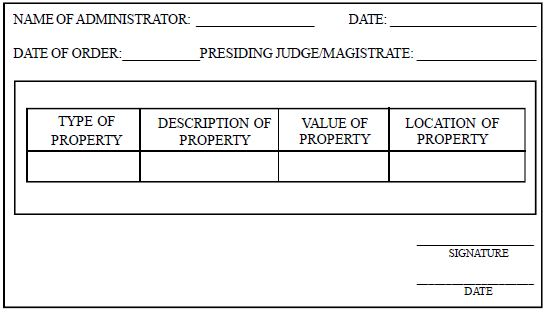
(1) An administrator shall, where an administrator takes control of seized and forfeited property pursuant to an order of the court, as soon as practicable after the order is issued, prepare and submit a report to the Committee in the Form set out in the Schedule.
(2) An administrator shall maintain a record of all property that is seized and forfeited, which shall include the value of any property under the management of the administrator and the property that has been destructed and in the case of sale, the value realised.
(3) An administrator shall, where the property is no longer at the place where it was reported to be located under sub-regulation (1), or the property has been sold, prepare and submit a report to the Committee, identifying the new location of the property or the value realised from the sell of the property.
17. Sale of seized and forfeited property
(1) Subject to the Public Finance Management Act, 2018, an administrator may take steps to sell the seized and forfeited property as the administrator considers appropriate.
(2) An administrator shall, where the administrator sells the seized and forfeited property, realise the value of the property so far as practicable.
(3) An administrator may expend not more than 10 per cent of the value of each property for the purposes of realising the value of property under sub-regulation (2).
(4) Any expenditure incurred by the administrator under sub-regulation (3) shall be recovered from the amount realised from the sale of the seized and forfeited property.
(5) Subject to the Public Finance Management Act, 2018, the proceeds realised from the sale of property seized and forfeited shall be paid into the Fund.
SCHEDULE
[Regulation 16]
The Forfeiture of Proceeds of Crime Act, 2010
(Act No. 19 of 2010)
The Forfeiture of Proceeds of Crime (Fund Management) Regulations, 2023
STATUS REPORT ON PROPERTY