
MEDICINES AND ALLIED SUBSTANCES ACT: INDEX TO SUBSIDIARY LEGISLATION
Appointment of the Pharmacy and Poisons Board
Proprietary Preparations (Prohibition of Importation) Order
Proprietary Preparations (Prohibition of Importation or Sale) Order
Pharmacy and Poisons (Equivalents for Dealings in Drugs) Rules
Poisons (Prohibition of Exportation) Rules
Pharmacy and Poisons (Issue and Control of Wholesale Licences) Rules
Pharmacy and Poisons (Fees) Order
Pharmaceutical (Fees) Regulations
Medicines and Allied Substances (Agro-Veterinary Shops) Regulations
Medicines and Allied Substances (Dispensing Certificates) Regulations
Medicines and Allied Substances (Health Shops) Regulations
Medicines and Allied Substances (Fees) Regulations
Medicines and Allied Substances (Importation and Exportation) Regulations
Medicines and Allied Substances (Certificate of Registration) Regulations
Medicines and Allied Substances (Pharmaceutical Licence) Regulations
Medicines and Allied Substances (Marketing Authorisation of Medicines) Regulations
Medicines and Allied Substances (Expert Advisory Committee) Regulations
APPOINTMENT OF THE PHARMACY AND POISONS BOARD
[Section 3]
[RETAINED AS PER SECTION 15 OF THE INTERPRETATION AND GENERAL PROVISIONS ACT]
GN 106 of 1941.
A Board, to be called the Pharmacy and Poisons Board, is hereby appointed.
EXEMPTIONS FROM PART II
[Section 9]
[RETAINED AS PER SECTION 15 OF THE INTERPRETATION AND GENERAL PROVISIONS ACT]
GN 236 of 1945.
It is hereby ordered that Part II of the Act shall not apply to drugs supplied by—
Any mission hospital or mission dispensary at which is employed a trained nurse whose dispensing ability has been approved in writing by the Provincial Medical Officer.
APPROVED INSTITUTIONS
[Section 16(1)(c)]
[RETAINED AS PER SECTION 15 OF THE INTERPRETATION AND GENERAL PROVISIONS ACT]
[Order by the Minister]
GN 365 of 1964.
1. All Government hospitals.
2. All mission hospitals, dispensaries or similar institutions in respect of orders for poisons which have been countersigned by a Provincial Medical Officer.
3. The Bancroft Mine Hospitals.
4. The Chibuluma Mine Hospitals.
5. The Mufulira Mine Hospitals.
6. The Nchanga Mine Hospitals.
7. The Nkana Mine Hospitals.
8. The Roan Mpatamatu Mine Hospitals.
9. The Zambia Broken Hill Development Company Dispensary.
POISONS LIST
[Section 11(4)]
[RETAINED AS PER SECTION 15 OF THE INTERPRETATION AND GENERAL PROVISIONS ACT]
GN 224 of 1957,
GN 337 of 1962,
GN 176 of 1963,
GN 430 of 1963,
GN 474 of 1964,
GN 846 of 1965,
SI 114 of 1967,
SI 335 of 1967,
SI 192 of 1972,
SI 58 of 1980,
SI 146 of 1981,
SI 152 of 1981,
SI 88 of 1986,
SI 63 of 1985,
SI 61 of 1985,
SI 146 of 1981,
SI 152 of 1981.
[Order by the Minister, upon the recommendation of the Pharmacy and Poisons Board]
The following is a list of substances which are to be treated as poisons for the purposes of the Act and the Rules made thereunder.
PART I
Subject to various exceptions, for which reference must be made to the Act and the Rules, poisons in this Part may only be supplied by registered pharmacists.
Abrus precatorius L.; seed of.
Acetanilide; alkyl acetanilides.
Acetazolamide;
Acetohexamide.
Acetylcarbromal.
Acetyldihydrocodeine; its salts.
Alcuronium chloride.
Alkali fluorides other than those specified in Part 2 of this List.
Alkaloids and related substances, the following, their salts, simple or complex, their quaternary compounds:
Aconite, alkaloids of;
Atropine;
Belladonna, alkaloids of;
Brucine;
Calabar bean, alkaloids of;
Coca, alkaloids of;
Cocaine;
Codeine;
Colchicum, alkaloids of;
Coniine;
Cotarnine;
Curare, alkaloids of;
curare bases;
Ecgonine; its esters;
Emetine;
Ephedra, alkaloids of;
Ergot, alkaloids of, whether hydrogenated or not; their homologues; any salt of any substance falling within this item;
Gelsemium, alkaloids of;
Homatropine;
Hyoscine;
Hyoscyamine;
Jaborandi, alkaloids of;
Lobelia, alkaloids of;
Morphine;
Papaverine;
Pomegranate, alkaloids of;
Quebracho, alkaloids of, other than the alkaloids of red quebracho;
Rauwolfia, alkaloids of, their salts; derivatives of the alkaloids of rauwolfia; their salts;
Sabadilla, alkaloids of;
Solanaceous alkaloids not otherwise included in this List; Stavesacre, alkaloids of;
Strychnine;
Thebaine;
Veratrum, alkaloids of;
Yohimba, alkaloids of.
Allopunnol
Allylisopropylacetylurea.
Allylprodine; its salts.
Alphameprodine; its salts.
Alphaprodine; its salts.
Amidopyrine; its salts; amidopyrine sulphonates; their salts.
Amiloloride Hydrochloride
Amino-alcohols esterified with benzoic acid, phenylacetic acid, phenylpropionic acid, cinnamic acid or the derivatives of these acids; their salts.
p-Aminobenzenesulphonamide; its salts; derivatives of
p-aminobenzenesulphonamide having any of the hydrogen atoms of the
p-amino group or of the sulphonamide group substituted by another radical; their salts.
p-Amino-benzoic acid, esters of; their salts. Aminophyllin;
 -Aminopropylbenzene and â-aminoisopropylbenzene and any compound structurally derived from either of those substances by substitution in the side chain or by ring enclosure therein or both (except ephedrine, N-methylephedrine, N-diethylaminoethylephedrine and prenylamine); their salts.
Amitriptyline; its salts.
Amphetamine; its salts and isomers
Amyl nitrite.
Ancyclovir triphosphate
Androgenic, oestrogenic and progestational substances, the following:
Benzoestrol;
Derivatives of stilbene, dibenzyl or naphthalene with oestrogenic activity; their esters;
Steroid compounds with androgenic or oestrogenic or progestational activity; their esters.
Anileridine; its salts.
Antibiotics, any antimicrobial or antifungal substance synthesised by bacteria, fungi or protozoa, and any substance the chemical properties of which are identical with or similar to any such antimicrobial or antifungal substance but which is not produced from living organisms, being a substance which is used in the specific treatment of infections; their salts.
Anti-histamine substances, the following; their salts; their molecular compounds:
Antazoline;
Bromodiphenhydramine;
Buclizine;
Carbinoxamine;
Chlorocyclizine;
Chlorpheniramine;
Cinnarizine;
Clemizole;
Cyclizine;
Cyproheptadine;
3-Di-n-butylaminomethyl-4:5:6-trihydroxyphthalide;
Diphenhydramine;
Diphenylpyraline;
Doxylamine;
Isothipendyl;
Mebhydrolin;
Meclozine;
Phenindamine;
Pheniramine;
Phenyltoloxamine;
Promethazine;
Pyrrobutamine;
Thenalidine;
Tolpropamine;
Triprolidine;
Substances being tetra-substituted N derivatives of ethylenediamine or propylenediamine.
Antimonial substances, the following:
Chlorides of antimony;
Oxides of antimony;
Sulphides of antimony;
Antimonates;
Antimonites;
Organic compounds of antimony.
Apomorphine; its salts.
Arsenical substances, the following, except those specified in Part 2 of this List:
Halides of arsenic;
Oxides of arsenic;
Arsenates;
Arsenites;
Organic compounds of arsenic.
Azacyclonal; its salts.
Barbituric acid; its salts; derivatives of barbituric acid; their salts; compounds of barbituric acid, its salts, its derivatives, their salts, with any other substance.
Barium, salts of, other than barium sulphate and the salts of barium specified in Part 2 of this List.
Benactyzine; its salts.
Benzethidine; its salts.
Benzhexol; its salts.
Benzoylmorphine; its salts.
Benzphetamine; its salts.
Benztropine and its homologues; their salts.
Benzylmorphine; its salts.
Betameprodine; its salts.
Betaprodine; its salts.
Bis-(1-(2-Isobutyryloxyethl)-2-N(4 amino-2 methyl-5 pyrimidiny) methyl tor-manido-l-propenydisulphide Sulbutiamine;
Bromvaletone.
Busulphan; its salts.
Butylchloral hydrate.
Cannabin tannate.
Cannabis (the dried flowering or fruiting tops of Cannabis Sativa Linn).
“Dagga”, the resin, extract or tinctures thereof.
Cantharidin; cantharidates.
Captodiame; its salts.
Caramiphen; its salts.
Carbachol.
Carbamozepine;
Carbimazole;
Carbromal.
Carisoprodol.
Carperidine; its salts.
Chloral; its addition and its condensation products; their molecular compounds.
Chlorambucil;
Chlordiazepoxide; its salts.
Chlorexolone.
Chlormethiazole; its salts.
Chloroform.
Chlorothiazide and other derivatives of benzo-1 : 2 : 4-thiadiazine-7 sulphonamide-1 : 1-dioxide, whether hydrogenated or not.
Chlorphenoxamine.
Chlorphentermine; its salts.
Chlorpropamide; its salts.
Chlorprothixene and other derivatives of 9-Methylenethiaxanthen; their salts.
Chlorthalidone and other derivatives of o-chlorobenzene sulphonamide.
Cimetidine clioquint.
Cinchocaine; its salts in injectable form;
Clotazamine;
Clonitazine; its salts.
Creosote obtained from wood.
Croton, oil of.
Cyclarbamate.
Cyclizine; its salts;
Cyclophosphamide;
Cycrimine; its salts.
Debnsoquine; its salts;
Dehydroemetine; its salts.
Demecarium bromide.
Desipramine; its salts.
Desomorphine; its salts.
Dextromethorphan; its salts.
Dextromoramide; its salts.
Dextrorphan; its salts.
Diacetylmorphine; its salts.
Diacetyl-N-allylnormorphine; its salts.
Diamidinodiazoaminobenzene; its salts.
Diampromide; its salts.
Diazepam and other compounds containing the chemical structure of Dihydro-1,4-Benzodiazepine substituted to any degree; their salts.
Diazoxide;
Diethyl carboinazine;
Digitalis, glycosides of; other active principles of digitalis.
Dihydrocodeine; its salts.
Dihydrocodeinone; its salts; its esters; their salts.
Dihydromorphine; its salts; its esters; their salts.
Dimenoxadole; its salts.
Dimepheptanol; its salts.
Dinitrocresols (D.N.O.C.); their compounds with a metal or base (except those specified in Part 2 of this List).
Dinitronaphthols; dinitrophenols; dinitrothymols.
Dioxaphetyl butyrate; its salts.
Diperodon; its salts.
Diphenyl sulphone;
Diphenoxylate; its salts.
Dipipanone; its salts.
Disopyramide; its salts;
Disulfiram.
Dithienylallylamines; dithienylalkylallylamines; their salts. Dyflos.
Ecothiopate iodide.
Ectylurea.
Elaterin.
Embutramide.
Emylcamate.
Ergot (the sclerotia of any species of Claviceps); extracts of ergot; tinctures of ergot.
Erithrityl tetranitrate.
Ethambutol; its salts;
Ethacrynic acid; its salts.
Ethchlorvynol. Ethinamate.
Ethionamide.
Ethoheptazine; its salts.
Etonitazene; its salts.
Etoxeridine; its salts.
Fenfluramine; its salts.
Fentanyl; its salts.
Fluanisone.
Fluoroacetamide;
fluoroacetanilide.
Fluphenazine; its salts;
Furethidine; its salts.
Frusemide.
Gallamine; its salts; its quaternary compounds.
Glibenclamide;
Glutethimide; its salts. Glyceryl trinitrate. Glymidine.
Guanidines, the following:
polymethylene diguanidines;
dipara-anisyl-p-phenetyl guanidine.
Haloperidol and other 4-substituted derivatives of N-(3-fluoro-benzoylpropyl) piperidine. Halothane;
Hepann;
Hexapropymate.
Hydrazines, bensyl, phenethyl and phenoxyethyl; their a-methyl derivatives; acyl derivatives of any of the foregoing substances comprised in this item; salts of any compounds comprised in this item.
Hydrochlorothiaride
Hydrocyanic acid; cyanides; double cyanides of mercury and zinc.
Hydromorphinol; its salts.
Hydromorphone; its salts; its esters; their salts.
Hydroxycarbamide.
Hydroxy-N,N-dimethyltryptamines; their esters or esters; any salt of any substance falling within this item.
Hydroxypethidine; its salts.
Hydroxyzine; its salts.
Imipramine; its salts.
Indomethacin; its salts.
Insulin.
Isomethadone (isomidone); its salts.
Ketamine; its salts;
Ketobemidone; its salts.
Ketotifen; its salts;
Laudexium; its salts.
Lead acetates; compounds of lead with acids from fixed oils.
Levomethorphan; its salts.
Levomoramide; its salts.
Levophenacylmorphan; its salts.
Levorphanol; its salts.
Lignocaine; its salts infectionable form
Lucanthone; its salts.
Lysergide; its salts.
Mannityl hexanitrate.
Mannomustine; its salts.
Mebezonium iodide.
Matloquine; its salts
Mephenesin; its esters.
Meprobamate.
Mercaptopurine; its salts; derivatives of mercaptopurine; their salts.
Mercurial substances, the following:
Oxides of mercury;
Nitrates of mercury;
Mercuric ammonium chlorides;
Potassio-mercuric iodides;
Organic compounds of mercury which contain a methyl (CH3) group directly linked to the mercury atom;
Mercuric oxycyanides;
Mercuric thiocyanate.
Mescaline; its salts.
Megtaramind; its salts;
Metaxalone.
Metazocine; its salts.
Metformin; its salts.
Methadone (amidone); its salts.
Methadyl acetate; its salts.
Methaqualone; its salts.
Methixene; its salts.
Methocarbamol.
Methotrexote;
Methoxasalen.
Methyldesorphine; its salts.
Methyldihydromorphine; its salts.
Methyldopa
Methyldopate Hydrochloride
Methylpentynol; its esters and other derivatives.
1-Methyl-4-phenylpiperidine-4-carboxylic acid, esters; their salts.
Methyprylone.
Metopon; its salts.
Metronidazole;
Monofluoroacetic acid; its salts.
Morpheridine; its salts.
Mustine and any other N-substituted derivative of di-(2-chlorethyl)
amine; their salts.
Myrophine; its salts.
Nalidixic Acid Nalorphine; it salts.
Neastigmine; its salts
Naproxen Nicocodine; its salts.
Niridazole;
m-Nitrophenol; o-nitrophenol; p-nitrophenol.
Nomifensine hydrogen maloate;
Noracymethadol; its salts.
Norcodeine; its salts.
Norlevorphanol; its salts.
Normethadone; its salts.
Normorphine; its salts.
Nortriptyline; its salts.
Nux vomica.
Opium.
Orphenadrine; its salts.
Orthocaine; its salts.
Ouabain.
Oxalic acid.
Oxamniquine;
Oxethazaine.
Oxycinchoninic acid, derivatives of; their salts; their esters.
Oxycodone; its salts; its esters; their salts.
Oxymorphone; its salts.
Oxyphenbutazone. P
araldehyde.
Paramethadione.
Pargyline; its salts
Pemoline; its salts.
Pentazocine; its salts.
Phenacemide.
Phenadoxone; its salts.
Phenaglycodol.
Phenampromide; its salts.
Phenanthridinium; its salts, derivatives of phenanthridinium having any of the hydrogen atoms of the phenanthridinium group substituted by another radical; molecular compounds of phenanthridinium or of its derivatives; their salts.
Phenatine; its salts.
Phenazocine; its salts.
Phenbutrazate.
Phencyclidine; its salts.
Phenetidylphenacetin.
Phenformin; its salts.
Phenols (any member of the series of phenols of which the first member is phenol and of which the molecular composition varies from member to member by one atom of carbon and two atoms of hydrogen) except in substances containing less than 60 per centum, weight in weight of phenols; compounds of phenol with a metal, except in substances containing less than the equivalent of 60 per centum, weight in weight of phenols.
Phenomorphan; its salts.
Phenoperidine.
Phenothiazine, derivatives of; their salts; except dimethoxanate and its salts.
Phentermine; its salts.
Phenylbutazone; its salts.
Phenylcinchininic acid; salicylcinchoninic acid; their salts; their esters.
5-Phenylhydantoin; its alkyl and aryl derivatives; their salts.
Phenylpropanolamine; its salts.
Phenytoin; its salts.
Pholcodine; its salts.
Phosphorus, yellow.
Pieric acid. Picrotoxin.
Pilocarpine, its salts (under Alkaloids)
Piminodine; its salts.
Pituitary gland, the active principles of.
Pizotifen; its salts.
Polymethylenebistrimethylammonium salts.
Pratidoxime; its salts;
Praziquantel;
Procarbazine; its salts.
Procyclidine; its salts.
Proheptazine; its salts.
Promoxolan.
Propanolol Hydroxide
Propantheline;
Propoxyphene; its salts.
Propylhexedrine; its salts.
Prothionamide.
Prothipendyl; its salts.
Protriptyline; its salts.
Psilocin; its salts; its esters and ethers; their salts.
Psilocybin; its salts.
Ptrazinamide;
Pyroxicam
Quinapyramine; its salts.
Quinethazone.
Racemethorphan; its salts.
Racemoramide; its salts.
Racemorphan; its salts.
Sabutamol; its salts.
Savin, oil of.
Strophanthus; glycosides of strophanthus.
Styramate.
Sulphinpyrazone.
Sulphonal; alkyl sulphonals.
Suprarenal gland, the active principles of; their salts and derivatives, whether obtained from natural or synthetic sources.
Suxamethonium; its salts;
Suramin;
Syrosingopine.
Tetrabenazine; its salts.
Thalidomide; its salts.
Thallium; salts of.
The bacon; its salts; its esters; their salts.
Thiacetazone;
Thyroid gland, the active principles of; their salts.
Tolazamide.
Tolbutamide.
Timolol; its salts;
Tinidazole;
Trimetnoprim; its salts
Tranylcypromine; its salts;
Tretamine; its salts.
Triaziquone.
Tribomethyl alcohol.
2:2:2-Trichloroethyl alcohol; its esters; their salts.
Trithioperazine; its salts.
Trimeperidine; its salts.
Trimethoprim; its salts
Trimipramine; its salts.
Troxidone,
Tybamate.
Verapamil; its salts.
Warfann;
Zoxazolamine; its salts.
Any preparation or substance containing a substance specified in any other item of this Part.
[As amended by S.I. 58 of 1980; 146 of 1981 and 88 of 1986.]
PART 2
Subject to various exceptions, poisons in this Part may only be supplied by registered pharmacists and licensed sellers of Part 2 poisons: the latter may not supply any poisons except those in this Part.
Ammonia.
Arsenical substances, the following:
Arsenic sulphides;
Arsenious oxide;
Calcium arsenates;
Calcium arsenites;
Copper acetoarsenite;
Copper arsenates;
Copper arsenites;
Lead arsenates;
Potassium arsenites;
Sodium arsenates;
Sodium arsenites;
Sodium thioarsenates.
Barium, salts of, the following:
Barium carbonate;
Barium silicofluoride.
Diamines, the following; their salts: phenylene diamines; tolylene diamines; other alkylated-benzene diamines.
Dinitrocresols (D.N.O.C.); their compounds with a metal or a base. Dinosam; its compounds with a metal or a base.
Dinoseb; its compounds with a metal or a base.
Endosulfan.
Endothal; its salts.
Endrin.
Formaldehyde.
Formic acid.
Hydrochloric acid.
Hydrofluoric acid; potassium fluoride; sodium fluoride; sodium silicofluoride.
Isometamidium Chloride
Mercuric chloride; mercuric iodide; organic compounds of mercury except compounds which contain a methyl (CH3) group directly linked to the mercury atom.
Metallic oxalates.
Nalidixic Acid
Nicotine; its salts.
Nitric acid.
Nitrobenzene.
Phenols as defined in Part 1 in substances containing less than 60 per centum, weight in weight, of phenols; compounds of phenol with a metal in substances containing less than the equivalent of 60 per centum, weight in weight, of phenols.
Phosphoric acid.
Phosphorus compounds, the following:
Amiton, azinphos-ethyl, azinphos-methyl, chlorfenvinphos, demeton-O, demeton-S, demeton-O-methyl, demeton-S-methyl, dichlorvos, diethyl 4-methyl-7-coumarinyl phosphorothionate, diethyl p-nitrophenyl phosphate, dimefox, disulfoton, ethion, ethyl p-nitrophenyl phenylphosphonothionate, mazidox, mecarbam, mevinphos, mipafox, oxydemetonmethyl, parathion, phenkapton, phorate, phosphamidon, schradan, sulfotep, TEPP (HETP), thionazin, triphosphoric pentadimethylamide, vamidothion.
Potassium hydroxide.
Sodium hydroxide.
Sodium nitrite.
Sulphuric acid.
Zinc phosphide.
Any preparation or substance containing a substance specified in any other item of this Part.
PROPRIETARY PREPARATIONS (PROHIBITION OF IMPORTATION) ORDER
[Section 25]
[RETAINED AS PER SECTION 15 OF THE INTERPRETATION AND GENERAL PROVISIONS ACT]
Arrangement of Paragraphs
Paragraph
1. Title
2. Prohibition of importation of proprietary preparation
SI 1 of 1970.
[Order by the Minister, upon the recommendation of the Pharmacy and Poisons Board]
This Order may be cited as the Proprietary Preparations (Prohibition of Importation) Order.
2. Prohibition of importation of proprietary preparation
The importation of the proprietary preparation specified in the Schedule is hereby prohibited.
SCHEDULE
[Paragraph 2]
SPECIFIED PROPRIETARY PREPARATION
The proprietary preparation known as “Dublosan Salbe”.
PROPRIETARY PREPARATIONS (PROHIBITION OF IMPORTATION OR SALE) ORDER
[Section 25]
[RETAINED AS PER SECTION 15 OF THE INTERPRETATION AND GENERAL PROVISIONS ACT]
Arrangement of Paragraphs
Paragraph
1. Title
2. Prohibition of importation
3. Prohibition of sale
SI 2 of 1970.
[Order by the Minister, upon the recommendation of the Pharmacy and Poisons Board.]
This Order may be cited as the Proprietary Preparations (Prohibition of Importation or Sale) Order.
The importation of the proprietary preparations specified in the Schedule is hereby prohibited.
The sale of the proprietary preparations specified in the Schedule is hereby prohibited.
SCHEDULE
[Paragraphs 2 and 3]
SPECIFIED PROPRIETARY PREPARATIONS
The substance known as Cyclamic Acid or any proprietary preparation containing Cyclamic Acid, or the salts of Cyclamic Acid.
PHARMACY AND POISONS (EQUIVALENTS FOR DEALINGS IN DRUGS) RULES
[Section 26]
[RETAINED AS PER SECTION 15 OF THE INTERPRETATION AND GENERAL PROVISIONS ACT]
Arrangement of Rules
Rule
1. Title
2. Interpretation
3. Equivalents for weights and volumes of ingredients
4. Equivalents for doses of liquids
5. Equivalents for total quantity prescribed for external or bulk oral preparation
6. Control of sale and supply
SI 161 of 1972.
[Rules by the Minister]
These Rules may be cited as the Pharmacy and Poisons (Equivalents for Dealings in Drugs) Rules.
In these Rules, unless the context otherwise requires—
“ingredient” means a drug which is one constituent of a preparation which is itself a drug;
“mixture” means any liquid preparation intended for administration by mouth, which consists of one or more drugs dissolved or suspended in an aqueous or other appropriate vehicle;
“Table” means a Table set out in the Schedule;
“total quantity” means the total quantity of a drug or of a preparation which is itself a drug other than an ingredient.
3. Equivalents for weights and volumes of ingredients
Any unit of measurement mentioned in column 2 of Table 1 or column 2 of Table 2 shall be treated for the purpose of any dealing with quantities of ingredients as the equivalent of the unit set opposite thereto in column 1 of the Table, and for any fraction of one grain not specifically mentioned in column 1 of Table 1, the equivalent for such purpose shall be treated as the corresponding fraction of the equivalent of one grain set out in column 2 of that Table.
4. Equivalents for doses of liquids
(1) Where a prescription for any drug states that the quantity of each dose is to be either one fluid drachm (fl dr) or two fluid drachms, the equivalent of that quantity for the purpose of dispensing the prescription shall be treated as five millilitres or ten millilitres respectively.
(2) Where the prescription for any drug, which is a mixture, states that the quantity of each dose is to be one-half of one fluid ounce (fl oz), the equivalent of that quantity for the purpose of dispensing that prescription shall be ten millilitres, except as provided for in sub-rule (4).
(3) Where a prescription for any drug, which is a mixture, states that the quantity of each dose is to be two fluid drachms, the equivalent of that quantity for the purpose of dispensing that prescription shall be ten millilitres.
(4) Where a prescription for liquid paraffin or other fixed oil states the quantity of each dose in terms of fluid ounces, the equivalent of each half of a fluid ounce shall, for the purpose of that prescription, be treated as fifteen millilitres.
(5) Where any prescription to which this rule refers specifies the quantity of the ingredients of any drug in the total quantity to be dispensed, this rule shall be treated as applying to the quantity of each such ingredient in each dose.
5. Equivalents for total quantity prescribed for external or bulk oral preparation
(1) Any unit of measurement mentioned in column 2 of Table 3 or column 2 of Table 4 shall be treated for the purpose of any dealing with total quantities of drugs as the equivalent of the unit set opposite thereto in column 1 of the Table.
(2) Where in a prescription for an external preparation or bulk oral preparation the total quantity to be supplied is expressed in ounces avoirdupois or apothecary, the metric quantity supplied will be on the basis that one ounce avoirdupois or apothecary is equivalent to twenty-five grams.
(3) Where in a prescription for an external preparation or bulk oral preparation the total quantity to be supplied is expressed in fluid ounces (fl oz), the metric quantity supplied will be on the basis that one fluid ounce (fl oz) is equivalent to twenty-five millilitres.
(4) For the purpose of implementing the provisions of the preceding rules, Tables 3 and 4 shall be used.
(5) Where any quantity of an external preparation or bulk oral preparation is expressed in terms of one or more of the units mentioned in column 1 of Table 3 or column 1 of Table 4 and is greater than one pound or one pint, the equivalent, for the purpose of any dealing with the prescription, shall be treated as the corresponding multiple of the equivalent for one pound or one pint, as the case may be, plus the equivalent of any residue of less than a pound or pint as ascertained from the appropriate Tables.
(1) Where any manufacturer, wholesale dealer or retail dealer sells or supplies any drug on or after the 1st January, 1973, he shall, if the order or prescription relating to such a dealing is expressed in terms of a unit of measurement specified in column 1 of Tables 1, 2, 3 and 4, or of any such fraction as is mentioned in rule 3, carry out such dealing in terms of the equivalent quantity ascertained in accordance with that rule.
(2) The provisions of rules 4 and 5 shall not apply to imported medicaments that are sold in their original containers as packaged by the manufacturer.
SCHEDULE
[Rule 2]
TABLE 1 – WEIGHTS
|
Column 1 grains |
|
Column 2 milligrams |
Column 1 grains |
|
Column 2 milligrams |
|
1/600 |
} |
0.1 |
5½ |
} |
400 |
|
1/500 |
0.125 |
|
|
||
|
1/480 |
|
|
6½ |
|
|
|
1/400 |
|
0.15 |
7 |
450 |
|
|
1/320 |
} |
0.2 |
7½ |
||
|
1/300 |
8 |
|
500 |
||
|
1/240 |
|
0.25 |
9 |
} |
600 |
|
1/200 |
|
0.3 |
10 |
||
|
1/160 |
} |
0.4 |
11 to 13 |
|
800 |
|
1/150 |
|
|
|
||
|
1/130 |
} |
0.5 |
grains |
|
grams |
|
1/100 |
|
0.6 |
14 to 16 |
|
1 |
|
1/80 |
} |
0.8 |
17 to 20 |
|
1.2 |
|
1/75 |
21 to 25 |
|
1.5 |
||
|
1/60 |
|
1 |
26 to 29 |
|
1.8 |
|
1/50 |
|
1.25 |
30 to 33 |
|
2 |
|
1/40 |
|
1.5 |
34 to 37 |
|
2.3 |
|
1/30 |
|
2 |
38 to 43 |
|
2.5 |
|
1/25 |
} |
2.5 |
44 to 51 |
|
3 |
|
1/24 |
52 to 57 |
|
3.5 |
||
|
1/20 |
|
3 |
58 to 65 |
|
4 |
|
1/15 |
|
4 |
66 to 76 |
|
4.5 |
|
1/12 |
|
5 |
77 to 84 |
|
5 |
|
1/10 |
|
6 |
85 to 102 |
|
6 |
|
1/8 |
|
7.5 |
103 to 115 |
|
7 |
|
1/6 |
|
10 |
116 to 135 |
|
8 |
|
1/5 |
|
12.5 |
136 to 150 |
|
9 |
|
1/4 |
|
15 |
151 to 165 |
|
10 |
|
1/3 |
|
20 |
166 to 180 |
|
11 |
|
2/5 |
|
25 |
181 to 190 |
|
13 |
|
1/2 |
|
30 |
191 to 220 |
|
13 |
|
3/5 |
|
40 |
221 to 250 |
|
15 |
|
3/4 |
|
50 |
251 to 275 |
|
17 |
|
1 |
|
60 |
276 to 325 |
|
20 |
|
1¼ |
|
75 |
326 to 350 |
|
22 |
|
1½ |
|
100 |
351 to 375 |
|
23 |
|
2 |
|
125 |
376 to 400 |
|
25 |
|
2½ |
|
150 |
401 to 425 |
|
26 |
|
3 |
|
200 |
426 to 450 |
|
28 |
|
3½ |
} |
250 |
451 to 510 |
|
30 |
|
4 |
|
||||
|
4½ |
} |
300 |
Entries in the above Table expressed as one figure to another are inclusive of both figures |
TABLE 2 – VOLUMES
|
Column 1 minims |
|
Column 2 millilitres |
Column 1 minims |
Column 2 millilitres |
|
1 |
|
0.06 |
28 to 32 |
1.8 |
|
1½ |
|
0.09 |
33 to 37 |
2 |
|
2 |
|
0.12 |
38 to 46 |
2.5 |
|
2½ |
|
0.15 |
47 to 55 |
3 |
|
3 |
|
0.18 |
56 to 64 |
3.5 |
|
3½ |
|
0.2 |
65 to 74 |
4 |
|
4 |
} |
0.25 |
75 to 84 |
4.5 |
|
4½ |
85 to 93 |
5 |
||
|
5 |
} |
0.3 |
94 to 110 |
6 |
|
5½ |
111 to 130 |
7 |
||
|
6 |
} |
0.4 |
131 to 149 |
8 |
|
7 |
150 to 167 |
9 |
||
|
7½ |
168 to 185 |
10 |
||
|
8 |
} |
0.5 |
186 to 200 |
11 |
|
9 |
201 to 220 |
12 |
||
|
10 |
} |
0.6 |
221 to 250 |
14 |
|
11 |
251 to 275 |
15 |
||
|
12 |
} |
0.7 |
276 to 300 |
17 |
|
13 |
301 to 330 |
18 |
||
|
14 |
} |
0.9 |
331 to 370 |
20 |
|
15 |
371 to 400 |
22 |
||
|
16 |
401 to 450 |
25 |
||
|
17 |
} |
1 |
451 to 500 |
28 |
|
18 |
|
|||
|
19 to 22 |
|
1.2 |
Entries in the above Table expressed as one figure to another are inclusive of both figures. |
|
|
23 to 27 |
|
1.5 |
TABLE 3 – WEIGHTS
|
Column 1 |
Column 2 |
|
|
|
|
1 oz or more but less than 11/2oz |
25 |
|
11/2 oz or more but less than 3 oz |
50 |
|
3 oz or more but less than 51/2oz |
100 |
|
51/2 oz or more but less than 9 oz |
200 |
|
9 oz or more but less than 141/2 oz |
300 |
|
141/2 oz or more but not more than 16 oz or 1 lb avoirdupois |
500 |
TABLE 4 – VOLUMES
|
Column 1 |
Column 2 |
|
fluid ounces |
millilitres |
|
1 fl oz or more but less than 11/2 fl oz |
25 |
|
11/2 fl oz or more but less than 3 fl oz |
50 |
|
3 fl oz or more but less than 51/2 fl oz |
100 |
|
51/2 fl oz or more but less than 9 fl oz |
200 |
|
9 fl oz or more but less than 141/2 fl oz 141/2 fl oz or more but not more than |
300 |
|
20 fl oz or 1 pint, or 1/8 gallon |
500 |
POISONS (PROHIBITION OF EXPORTATION) RULES
[Section 26]
[RETAINED AS PER SECTION 15 OF THE INTERPRETATION AND GENERAL PROVISIONS ACT]
Arrangement of Rules
Rule
1. Title
2. Prohibition of exportation
SI 194 of 1972.
[Rules by the Minister]
These Rules may be cited as the Poisons (Prohibition of Exportation) Rules, and shall be read as one with the Poisons Rules.
The exportation of the poison specified in the Schedule is hereby prohibited.
SCHEDULE
[Rule 2]
Abrus Precatorius L., Seed of
POISONS RULES
[Section 26]
[RETAINED AS PER SECTION 15 OF THE INTERPRETATION AND GENERAL PROVISIONS ACT]
Arrangement of Rules
Rule
PART I
PRELIMINARY
1. Title
2. Interpretation
PART II
IMPORTATION
3. Importation of poisons
PART III
EXEMPTION
4. Exemption from the provisions of section 12(1)(c) and 12(2)(a) and (b) of the Act
5. Certain articles and substances exempted from Part III of the Act and these Rules
6. Exemption from certain provisions of section 16 of the Act
PART IV
POISONS TO BE SUPPLIED ONLY UPON PRESCRIPTION
7. Certain poisons to be sold only upon prescription
8. Wholesale dealing with Part 1 poisons
PART V
SALE OF PART 2 POISONS BY LICENSED SELLERS
9. Containers of poisons sold by Part 2 sellers
10. Conditions with respect to sale of certain poisons by Part 2 sellers
11. Entry of certain Part 2 poisons in Poisons Book
PART VI
LABELS AND CONTAINERS
12. Manner of labelling containers
13. Labelling of name of poisons
14. Label to contain particulars as to proportion of poison
15. Labelling of certain substances with indication of character
16. Special precautions as to labels in case of certain articles
17. Form of containers
PART VII
SAFE CUSTODY OF POISONS
18. Safe custody of poisons not exempted under rule 4
PART VIII
TRANSPORT OF POISONS
19. Special provisions with respect to the transport of certain poisons
PART IX
COLOURING OF POISONS
20. Colouring of certain poisons
PART X
MISCELLANEOUS
21. Manufacture of pharmaceutical preparations
22. Prescribed fees
23. Prescribed forms
24. Preservation of records
25. Penalty
Act 51 of 1963,
Act 13 of 1994,
GN 40 of 1941,
GN 178 of 1941,
GN 107 of 1944,
GN 216 of 1946,
GN 25 of 1949,
GN 324 of 1953,
GN 429 of 1963,
GN 475 of 1964,
GN 497 of 1964,
GN 500 of 1964,
GN 161 of 1954,
GN 223 of 1957,
GN 338 of 1962,
GN 177 of 1963,
GN 845 of 1965,
SI 163 of 1965,
SI 115 of 1967,
SI 336 of 1967,
SI 39 of 1970,
SI 193 of 1972,
SI 147 of 1981,
SI 150 of 1981,
SI 151 of 1981,
SI 62 of 1985,
SI 64 of 1985,
SI 143 of 1985.
[Rules by the Minister]
PART I
PRELIMINARY
These Rules may be cited as the Poisons Rules.
(1) In these Rules, unless the context otherwise requires—
“antimonial poisons” means chlorides of antimony, oxides of antimony, sulphides of antimony, antimonates, antimonites, and organic compounds of antimony;
“arsenical poisons” means halides of arsenic, oxides of arsenic, sulphides of arsenic, arsenates, arsenites, copper acetoarsenites, sodium thioarsenates, and organic compounds of arsenic;
“British Pharmaceutical Codex” and “British Pharmacopoeia” include supplements;
“food” includes drink;
“medicine for the internal treatment of human ailments” includes any medicine to be administered by hypodermic injection but does not include any mouthwash, eye-drops, eye-lotion, ear-drops, douche or similar article;
“Part 1 poison” or “Part 2 poison” means a poison included in Part 1 or Part 2 of the Poisons List, as the case may be;
“Poisons List” means the Poisons List for which provision is made in section 11 of the Act.
(2) Any reference to the percentage of a poison contained in any substance shall, unless otherwise expressly provided, be construed in the following manner, that is to say, a reference to a substance containing one per centum of any poison means—
(a) in the case of a solid, that one gramme of the poison is contained in every hundred grammes of the substance;
(b) in the case of a liquid, that one millilitre of the poison, or, if the poison itself is a solid, one gramme of the poison, is contained in every hundred millilitres of the substance,
and so in proportion for any greater or less percentage.
PART II
IMPORTATION
(1) No person, other than a registered pharmacist or a duly qualified medical practitioner or dentist or a veterinary surgeon, shall import poisons without a permit in writing from the Board: such permit may be in general terms:
Provided that a licensed seller of Part 2 poisons may import Part 2 poisons without such permit.
(2) The Board may, without assigning any reason therefor, refuse any application for such a permit.
(3) Notwithstanding the provisions of sub-rule (1), no person shall import or export the poisons listed hereunder unless he is in possession of a permit issued to him by the Director of Medical Services, authorising him either to import or export the said poisons, that is to say—
Amphetamine; its salts;
Dexamphetamine; its salts;
Lysergide; its salts;
Mecloqualone;
Mescaline; its salts;
Methaqualone hydrochloride and preparations containing methaqualone hydrochloride;
Methamphetamine; its salts;
Methylphenidate; its salts;
Phencyclidine; its salts;
Phenmetrazine; its salts;
Psilocin; its salts; its esters and ethers;
Psilocybin; its salts.
Amidopyrine and preparations containing amidopyrine;
Clioquinol in preparations for internal use;
Hormone pregnancy test preparations containing estrogens and progestogens;
Medroxyprogesterone acetate in injectable form for use as a contraceptive; and
Methaqualone hydrochloride and preparations containing methaqualone hydrochloride;
Lysergide; its salts;
Mescaline; its salts;
Mafloquine, its salts
Oxyphenbutazone
Psilocin; its salts; its esters and ethers;
Psilocybin; its salts.
[As amended by 336 of 1967; 143 of 1985 and S.I. 87 of 1986]
(4) Where any poison to which this rule applies is alleged to be in transit through Zambia, the carrier thereof shall, at the points of entry and exit, and at any other time when so required, produce documentary evidence to any officer of the Customs and Excise Department, of the Immigration Department, any Police officer or any person authorised in writing in that behalf by the Board, to show that the export of such poison from the country of its origin or supply and its import into the country of final destination has been authorised by the respective drug regulatory authorities, or other relevant authorities, of the countries concerned.
[As amended by S.I. 143 of 1985]
PART III
EXEMPTION
4. Exemption from the provisions of section 12(1)(c) and 12(2)(a) and (b) of the Act
The provisions of section 12(1)(c), (2)(a) and (b) of the Act (which make provision as to persons to whom poisons may be sold and to the keeping of records of sales) shall not apply—
(a) to the substances included in the First Schedule;
(b) to the following articles, that is to say—
(i) machine-spread plasters;
(ii) surgical dressings;
(iii) articles containing barium carbonate or zinc phosphide and prepared for the destruction of rats and mice;
(iv) any preparation, being a preparation capable of external use only, made from extract or tincture of Cannabis.
[As amended by GN 223 of 1957.]
5. Certain articles and substances exempted from Part III of the Act and these Rules
Nothing in Part III of the Act or these Rules shall apply to—
(a) any article in Group I of the Second Schedule;
(b) any poison specified in the first column of Group II of the Second Schedule if contained in or in the form of any of the articles or substances specified in the second column.
6. Exemption from certain provisions of section 16 of the Act
(1) The provisions of sub-sections (3), (4) and (6) of section 16 of the Act shall not apply to the sale or supply of a poison by the manufacturer thereof or by a person carrying on a business in the course of which poisons are regularly sold by way of wholesale dealing if—
(a) the poison is sold or supplied to a person carrying on a business in the course of which poisons are regularly sold or are regularly used in the manufacture of other articles; and
(b) the seller is reasonably satisfied that the purchaser requires the poison for the purpose of that business.
(2) So much of sub-section (6) of section 16 of the Act as requires an entry in the Poisons Book to be signed by the purchaser of a poison shall not apply in respect of sales made to a person for the purposes of his trade or business if the provisions of sub-sections (3) and (4) of that section are complied with and the seller inserts in the entry in the Poisons Book the words “signed order” and a reference number by which the order can be identified.
[Am by 115 of 1967]
PART IV
POISONS TO BE SUPPLIED ONLY UPON PRESCRIPTION
7. Certain poisons to be sold only upon prescription
(1) It shall not be lawful to sell by retail any poison included in the Fourth Schedule except on and in accordance with a prescription given by a duly qualified medical practitioner or dentist or a veterinary Surgeon.
(2) This rule shall not apply—
(a) to any sale exempted by section 16 of the Act; or
(b) to strychnine or its salts sold—
(i) with the permission of the Board for the purpose of poisoning vermin; or
(ii) as an ingredient in a medicine which contains not more than 0.2 per centum of strychnine or the equivalent thereof; or
(c) to poisons of the sulphonamide group sold on registered premises by an authorised seller of poisons when such poisons are—
(i) sold for the treatment of animals; or
(ii) present in an amount not exceeding 11 per centum in a preparation visibly marked as intended for external use; or
(d) to any sale of an anti-histamine preparation for the prevention or treatment of travel sickness to a person for administration to himself or to a dependant if the following conditions, in addition to any other requirements of the Act or of these Rules, are complied with—
(i) there shall be written so as to be clearly legible on the container in which the preparation is sold, or on a label affixed thereto or, if the preparation is sold in more than one container, on the inner container or a label affixed thereto, or on a direction slip supplied at the time the preparation is sold—
A. the specific purpose for which the preparation is sold;
B. the dose and method of administration;
C. a warning of any untoward reaction which may occur and of precautions which should be observed in the use of the preparation;
(ii) no other purpose for which the preparation may be used shall be indicated on the aforesaid container, label, direction slip or other literature supplied with the preparation.
(3) For the purposes of this rule, a prescription shall—
(a) be in writing and be signed by the person giving it with his usual signature and be dated by him;
(b) specify the address of the person giving it;
(c) specify the name and address of the person for whose treatment it is given or, if the prescription is given by a veterinary surgeon, of the person to whom the medicine is to be delivered;
(d) have written thereon, if given by a dentist, the words “for dental treatment only” or, if given by a veterinary surgeon, the words “for animal treatment only”.
(e) specify the total amount of the medicine to be supplied and the dose to be taken.
(4) The person dispensing the prescription shall comply with the following requirements:
(a) the prescription must not be dispensed more than once unless the prescriber has stated thereon that it may be dispensed a stated number of times or at stated intervals;
(b) if the prescription contains a direction that it may be dispensed a stated number of times or at stated intervals, it must not be dispensed otherwise than in accordance with the direction;
(c) at the time of dispensing there must be noted on the prescription above the signature of the prescriber the name and address of the seller and the date on which the prescription is dispensed;
(d) except in the case of a prescription which may be dispensed again, the prescription must, for a period of two years, be retained and kept on the premises on which it was dispensed in such manner as to be readily available for inspection.
[As amended by 216 of 1946; 324 of 1953 and G.N. 223 of 1957.]
8. Wholesale dealing with Part 1 poisons
It shall not be lawful to sell by way of wholesale dealings any poison included in Part 1 of the Poisons List to a person carrying on a business of shopkeeping unless the seller—
(a) has reasonable grounds for believing that the purchaser is an authorised seller of poisons; or
(b) has received a statement signed by the purchaser or by a person authorised by him on his behalf to the effect that the purchaser does not intend to sell the poison on any premises used for or in connection with his retail business.
[Am by 336 of 1967.]
PART V
SALE OF PART 2 POISONS BY LICENSED SELLERS
9. Containers of poisons sold by Part 2 sellers
A licensed seller of Part 2 poisons shall not sell any poison other than ammonia, hydrochloric acid, nitric acid, potassium quadroxalate and sulphuric acid unless—
(a) it is in the original container as supplied to such licensed seller; or
(b) it is sold in containers in which it has been repacked by a registered pharmacist.
[As amended by G.N. 223 of 1957 and 115 of 1967.]
10. Conditions with respect to sale of certain poisons by Part 2 sellers
No licensed seller of Part 2 poisons shall be entitled by virtue of being authorised to sell poisons listed in Part 2 of the Poisons List, to sell—
(a) any poison included in the first column of the Fifth Schedule unless the article or substance sold is one of the articles or substances specified against the description of the poison in the second column of that Schedule, and the container of the substance is, in addition to any other direction of the Act or of these Rules with respect to labelling, labelled clearly with a notice of the special purpose for which the article or substance is intended, and a warning that it is only to be used for that purpose;
(b) any arsenical poison, other than lead arsenates, calcium arsenates and copper acetoarsenites, any mercuric chloride, mercuric iodide, any organic compound of mercury, unless the purchaser thereof is himself a licensed seller of Part 2 poisons or is engaged in the trade or business of mining, agriculture, horticulture or pest control, or in any industry and requires the poison for the purpose of that trade, business or industry.
[GN 223 of 1957 as amended by 115 of 1967.]
11. Entry of certain Part 2 poisons in Poisons Book
(1) A licensed seller of Part 2 poisons shall not deliver any poison sold by him to which the provisions of this rule apply until—
(a) he has made or caused to be made an entry in a book kept for the purpose to be called the Poisons Book stating—
(i) the date of the sale;
(ii) the name and quantity of the poison sold;
(iii) the name and address and the business, trade or occupation of the purchaser; and
(iv) the purposes for which it is stated by the purchaser to be required; and
(b) the purchaser has affixed his signature to the aforesaid entry.
(2) The provisions of this rule shall apply to the following poisons and to preparations of them:
Arsenical substances listed in Part 2 of the Poisons List, except preparations containing less than the equivalent of 0.01 per centum of arsenic trioxide.
Barium carbonate, barium silicofluoride.
Dinosam; its compounds with a metal or base.
Dinoseb; its compounds with a metal or base.
Mercuric chloride, except substances containing less than 1.0 per centum of mercuric chloride.
Mercuric iodide, except substances containing less than 2.0 per centum of mercuric iodide.
Organic compounds of mercury, except substances containing less than the equivalent of 0.2 per centum weight in weight of mercury (Hg).
Nicotine; its salts.
Phosphorus compounds listed in Part 2 of the Poisons List. Zinc phosphide.
[G.N. 223 of 1957 as amended by 115 of 1967.]
PART VI
LABELS AND CONTAINERS
12. Manner of labelling containers
(1) The particulars with which the container of a poison is required to be labelled by section 14 of the Act and rules 11 to 15 must appear clearly and distinctly in a conspicuous position on the container in which the poison is supplied and on every box or other covering of whatever nature enclosing the container.
(2) Where the poison is contained in an ampoule, cachet or similar article, it shall not be necessary to label the article itself if the article is contained in a box or other covering duly labelled.
(3) If the container is duly labelled, it shall not be necessary to label any outer cover or wrapper used only for the purpose of delivery or transport except as required by rule 18.
(4) The word “Poison”, or the alternative indication of character prescribed by rule 14, as the case may be, shall—
(a) in the case of a poison not exempted from certain provisions by the First Schedule, either be printed in red letters on a contrasting background or in letters of some colour set against a red background;
(b) in all cases be easily legible and either on a separate label or surrounded by a line within which there must be no other words except words with which the container of the poison is required to be labelled under the Act or these Rules.
13. Labelling of name of poisons
The name with which a poison must be labelled in compliance with section 14 of the Act shall be the term under which it is included in the Poisons List:
Provided that—
(i) where the said term describes a group of poisons and not the poison specifically, the name of the poison shall be—
(a) if the poison is the subject of a monograph in either the British Pharmacopoeia or the British Pharmaceutical Codex, one or other of the names or synonyms or abbreviated names set out at the head of the monograph; and
(b) in any other case, the accepted scientific name or name descriptive of the true nature and origin of the poison;
(ii) in the case of a preparation in the British Pharmacopoeia or the Formulary of the British Pharmaceutical Codex, or any dilution or admixture of such a preparation, or any surgical dressing for which a standard is described in the British Pharmaceutical Codex, it shall be sufficient to state the name, synonym or abbreviated name used to describe the preparation or surgical dressing in the British Pharmacopoeia or the British Pharmaceutical Codex with the addition of the letters B.P., or B.P.C., as the case may be.
14. Label to contain particulars as to proportion of poison
(1) The label of the container of any preparation containing a poison as one of its ingredients shall include a statement of the “proportion” expressed in the form of a percentage which the poison bears to the total ingredients of the preparation:
Provided that—
(i) in the case of a preparation containing a poison specified in the first column of the Third Schedule, it shall be sufficient to state on the label the particulars specified in the second column of that Schedule against the description of the poison;
(ii) in the case of a preparation or surgical dressing which is named in accordance with proviso (ii) to rule 12, it shall not be necessary to state on the label the proportion of the poison contained in the preparation, and in the case of any dilution or admixture of such a preparation, it shall be sufficient to state the proportion which the preparation bears to the total ingredients of the dilution or admixture;
(iii) where the poison is in tablets, pills, cachets, capsules, lozenges or similar articles, or in ampoules, it shall be sufficient to state on the label of the box or other covering in which the articles are enclosed the number of the articles and the amount of the poison, or in the case of such a preparation as is mentioned in proviso (ii), the amount of the preparation, contained in each article.
(2) Where any proportion is stated as a percentage, the statement shall indicate how the percentage is calculated.
15. Labelling of certain substances with indication of character
In pursuance of the provisions of paragraph (c) of section 14 of the Act, the container of any article specified in the Sixth Schedule shall, instead of being labelled with the word “Poison”, be labelled with the words specified in the said Schedule as applicable to that article.
[Am by GN 223 of 1957.]
16. Special precautions as to labels in case of certain articles
(1) It shall not be lawful to supply any poison—
(a) in the case of a liquid other than a medicine, contained in a bottle of a capacity of not more than 120 fluid ounces, unless the bottle is labelled with the words “Not to be taken”;
(b) in the case of an embrocation, liniment, lotion, liquid antiseptic, or other liquid medicine for external application, unless the container is labelled with the name of the article and the words “For external use only”.
(2) It shall not be lawful to sell or supply any hydrocyanic acid, or cyanide, unless the container is labelled with the words “Warning. This container holds a poisonous substance and should only be opened and used by persons having expert knowledge of the precautions to be taken in its use”.
It shall not be lawful to keep, supply or consign for transport any poison unless—
(a) it is contained in a container impervious to the poison and sufficiently stout to prevent leakage arising from the ordinary risks of handling and transport; and
(b) in the case of a liquid contained in a glass bottle of a capacity of not more than 120 fluid ounces, not being a medicine made up ready to be taken for the internal treatment of human ailments, or a sterile ophthalmic solution in a single dose sterile bottle enclosed in a sealed container, the outer surface of the bottle is fluted vertically with ribs or grooves recognisable by touch.
[As amended by 115 of 1967.]
PART VII
SAFE CUSTODY OF POISONS
18. Safe custody of poisons not exempted under rule 4
(1) It shall not be lawful for any person knowingly to have in his possession or under his control on any premises any poison, other than a substance included in the First Schedule, unless the following conditions are complied with at all times when the poison is not in actual use—
(a) The poison shall be kept under lock and key—
(i) in a separate room or compartment specially reserved for keeping poisons and partitioned off from the rest of the premises; or
(ii) in a cupboard, box or other receptacle specially reserved for keeping poisons, clearly marked with the words “Poisons Only”, and kept in a place apart from anything containing food or drink.
(b) The poison shall be kept in a place ordinarily accessible only to persons lawfully having access thereto.
(c) The key of any room, compartment, cupboard, box or other receptacle in which poisons are kept shall be retained under the control of the person in charge of such poison.
(2) Any person in possession of any receptacle which has been used for containing any such poison, and which is no longer required for that purpose, shall destroy that receptacle in such a manner as effectively to prevent its further use or otherwise render the receptacle innocuous.
(3) The provisions of sub-rules (1) and (2) shall not apply to wholesalers, educational institutions, laboratories, industrial plants or to poisons kept and maintained at mines and works.
(4) In any hospital or other similar institution all such poisons not in actual use shall be kept under the control of the person in charge of the institution, or some fit and proper person specially detailed by him for the purpose and shall be issued for use as required.
(5) Poisons for use in the treatment of human ailments shall be kept entirely separate from any other poisons.
(6) In any hospital, infirmary, dispensary, clinic, nursing home or other similar institution at which human ailments are treated and at which medicines are dispensed in a dispensing or pharmaceutical department in charge of a person appointed for that purpose, no medicine containing a poison shall, except in a case of emergency, be supplied from that department for use in the wards, operating theatres or other sections of the institution except upon a written order signed by a duly qualified medical or dental practitioner or by a sister or nurse in charge of a ward, theatre or other section of the institution.
(7) Where in any hospital, infirmary, dispensary, clinic, nursing home or other similar institution at which human ailments are treated, poisons are stored elsewhere than in a pharmacy under the direct control and supervision of a registered pharmacist such storage places shall be regularly inspected by the pharmacist in charge at intervals of not more than three months, or if no pharmacist is employed in such institution the Director of Medical Services shall make suitable arrangements for the periodic inspection of such storage places.
[As amended by 25 of 1949 and 324 of 1953]
PART VIII
TRANSPORT OF POISONS
19. Special provisions with respect to the transport of certain poisons
(1) It shall not be lawful to consign for transport any of the poisons included in the Seventh Schedule, not being medicines, unless the outside of the package is labelled conspicuously with the name or description of the poison and a notice indicating that it is to be kept separate from food and from empty food containers.
(2) It shall not be lawful for any person knowingly to transport any such poison in any vehicle in which food is being transported unless the food is carried in a part of the vehicle effectively separated from that containing the poison, or is otherwise adequately protected from the risk of contamination.
[As amended by G.N. 223 of 1957]
PART IX
COLOURING OF POISONS
20. Colouring of certain poisons
It shall not be lawful to sell, or to import into Zambia, any poison included in the Eighth Schedule which is intended for use as a weed killer or in the prevention or treatment of infestation by animals, plants or other living organisms unless there has been added to such poison a dye or other substance which renders it of a distinctive colour, whether the poison is dry, wet or in solution:
Provided that this rule shall not apply in the case of—
(i) poisons which are themselves of a distinctive colour; or
(ii) sheep dips which are already of a distinctive colour.
[Am by 115 of 1967.]
21. Manufacture of pharmaceutical preparations
In all establishments in which pharmaceutical preparations containing any poison are manufactured for the purpose of the internal treatment of human ailments, the preparation must be manufactured by, or under the supervision of—
(a) a registered pharmacist; or
(b) a person having one of the following qualifications in chemistry—
(i) the Fellowship of the Institute of Chemistry;
(ii) the Associateship of the Institute of Chemistry;
(iii) any similar qualification recognised by the Board:
Provided that this rule shall not apply to the manufacture by or under the supervision of a duly qualified medical practitioner of preparations containing pituitary, suprarenal or thyroid glands, the active principles of any of those glands, or the salts of the active principles of thyroid gland.
The following fees shall be paid in connection with matters arising under the Act—
| (a) For a dealer’s licence [section 16(2)]: | Annually K2 |
| (b) For a licence to sell Part 2 poisons [section 19(1)] | K2 |
| (c) For renewal of licence to sell Part 2 poisons [section 19(3)] | Annually K2 |
The forms to be used in pursuance of the Act shall be those prescribed in the Ninth Schedule.
[As amended by G.N. 223 of 1957.]
All books kept for the purposes of Part III of the Act shall be preserved on the premises on which the sales recorded therein were made for a period of two years from the date on which the last entry was made therein.
Any person who contravenes any provision of these Rules is guilty of an offence and shall be liable to a fine of one thousand five hundred penalty units or to imprisonment for six months and the court before which a person is convicted may order any articles in respect of which the offence was committed to be forfeited and disposed of as it may think fit.
[As amended by Act 13 of 1994.]
FIRST SCHEDULE
[Rule 4]
SUBSTANCES EXEMPTED BY RULE 4 FROM THE PROVISIONS OF SECTION 12(1)(C) OF THE ACT, WHICH RELATES TO PERSONS TO WHOM POISONS MAY BE SOLD, AND SECTION 12(2)(A) AND (B), WHICH RELATES TO THE MAKING AND SIGNING OF ENTRIES IN THE POISONS BOOK
Any substance containing any of the poisons specified in the first column below if the poison content is less than the percentage specified in the second column.
|
Poison |
Percentage of poison content below which substance is exempted |
|
Alkali fluorides |
Exempt all percentages |
|
Alkaloids and related substances, the following, their salts, simple or complex; their quaternary compounds: |
|
|
Aconite, alkaloids of |
0.02 per centum |
|
Apomorphine |
0.2 per centum |
|
Atropine |
0.15 per centum |
|
Belladonna, alkaloids of |
0.15 per centum, calculated as hyoscyamine |
|
Brucine |
0.2 per centum |
|
Coca, alkaloids of |
0.1 per centum |
|
Cocaine |
0.1 per centum |
|
Codeine |
1.5 per centum |
|
Colchicine |
0.5 per centum |
|
Coniine |
0.1 per centum |
|
Cotarnine |
0.2 per centum |
|
Ecgonine and its esters |
0.1 per centum |
|
Emetine |
1.00 per centum |
|
Ephedra, alkaloids of |
Exempt all percentages |
|
Ethylmorphine |
0.2 per centum |
|
Gelsemium, alkaloids of |
0.1 per centum |
|
Homatropine |
0.15 per centum |
|
Hyoscine |
0.15 per centum |
|
Hyoscyamine |
0.15 per centum |
|
Jaborandi, alkaloids of |
0.5 per centum |
|
Lobelia, alkaloids of |
0.5 per centum |
|
Morphine |
0.2 per centum, calculated as anhydrous morphine |
|
Papaverine |
1.00 per centum |
|
Pomegranate, alkaloids of |
0.5 per centum |
|
Sabadilla, alkaloids of |
1.00 per centum |
|
Solanaceous alkaloids, not otherwise included in this Schedule |
0.15 per centum, calculated as hyoscyamine |
|
Stavesare, alkaloids of |
0.2 per centum |
|
Strychnine |
0.2 per centum |
|
Thebaine |
1.00 per centum |
|
Veratrum, alkaloids of |
1.00 per centum |
|
Amino-alcohols, esterified with benzoic acid, phenylacetic acid, phenylpropionic acid, cinnamic acid or the these acids. |
10.00 per centum of esterified amino-alcohols |
|
Amyl nitrite |
Exempt all percentages |
|
Antimonial poisons |
Equivalent of 1.00 per centum of antimony trioxide |
|
Arsenical poisons |
Equivalent of 0.01 per centum of arsenic trioxide and dentifrices containing less than 0.5 per centum of acetarsol |
|
Cantharidin |
0.01 per centum |
|
Cantharidates |
Equivalent of 0.01 per centum of cantharidin |
|
Chloroform |
Exempt all percentages |
|
Cresote obtained from wood |
Exempt all percentages |
|
Croton, oil of |
Exempt all percentages |
|
Dextromethorphan; its salts |
Substances containing less than 1.5 per centum of dextromethorphan |
|
Digitalis, glycosides and other active principles of |
One unit of activity (as defined in the British Pharmacopoeia) in two grammes of the substance |
|
Elaterin |
Exempt all percentages |
|
Erythrityl tetranitrate |
Exempt all percentages |
|
Fenfluramine; its salts |
Exempt all percentages |
|
Glyceryl trinitrate |
Exempt all percentages |
|
Hydrocyanic acid |
0.15 per centum weight in weight of hydrocyanic acid (HCN) |
|
Cyanides |
Equivalent of 0.15 per centum weight in weight of hydrocyanic acid (HCN) |
|
Insulin |
Exempt all percentages |
|
Lucanthone; its salts |
Exempt all percentages |
|
Mannityl hexanitrate |
Exempt all percentages |
|
Mercuric chloride |
1.00 per centum |
|
Mercuric ammonium chlorides |
Exempt all percentages |
|
Mercuric iodide |
2.00 per centum |
|
Mercuric thiocyanate |
Exempt all percentages |
|
Mercury, oxides of |
Exempt all percentages |
|
Nitrates of mercury |
Equivalent of 3.00 per centum weight in weight of mercury (Hg) |
|
Organic compounds of mercury |
Equivalent of 0.2 per centum weight in weight of mercury (Hg) |
|
Potassio-mercuric iodides of |
Equivalent of 1.00 per centum mercuric iodide |
|
Nux vomica |
0.2 per centum of strychnine |
|
Opium |
0.2 per centum of morphine calculated as anhydrous morphine |
|
Oxalic acid |
Exempt all percentages |
|
Orthocaine, its salts |
Exempt all percentages |
|
Para-aminobenzoic acid, esters of; their salts |
Exempt all percentages |
|
Phosphorus, yellow |
Exempt all percentages |
|
Picric acid |
Exempt all percentages |
|
Pituitary gland, the active principles of |
Exempt all percentages |
|
Suprarenal gland, the active principles of; their salts. |
Exempt all percentages |
|
Thyroid gland, the active principles of; their salts |
Exempt all percentages |
[GN 233 of 1957 as amended by G.N. 117 of 1963; 115 of 1967 and 39 of 1970.]
SECOND SCHEDULE
[Rule 5]
ARTICLES EXEMPTED BY RULE 5 FROM THE PROVISIONS OF PART III OF THE ACT AND OF THESE RULES
Group I-General Exemptions
Adhesives, anti-fouling compositions, builders’ materials, ceramics, distempers, electrical valves, enamels, explosives, fillers, fireworks, fluorescent lighting tubes, glazes, glue, inks, lacquer solvents, loading materials, matches, motor fuels and lubricants, paints other than pharmaceutical paints, photographic paper, pigments, plastics, propellants, rubber, varnishes.
Group II-Special Exemptions
|
Poison |
Substance or Article in which exempted |
|
Acetanilide; alkyl acetanilides |
Substances not being preparations for the treatment of human ailments. |
|
Alkali fluorides |
Dentifrices containing not more than 0.3 per centum of the alkali salts of hydrofluoric acid. |
|
Alkaloids: |
|
|
Brucine |
Surgical spirit containing not more than 0.015 per centum of brucine. |
|
Emetine |
Ipecacuanha; extracts and tinctures of ipecacuanha; substances containing less than 0.05 per centum of emetine. |
|
Ephedra, alkaloids of . |
Substances containing less than 1 per centum of the alkaloids of ephedra. |
|
Jaborandi, alkaloids of |
Substances containing less than 0.025 per centum of the alkaloids of jaborandi. |
|
Lobelia, alkaloids of |
Preparations for the relief of asthma in the form of cigarettes, smoking mixtures or fumigants; substances containing less than 0.1 per centum of the alkaloids of lobelia. |
|
Nicotine |
Tobacco, preparations with a soap base containing not more than 7.5 per centum of nicotine, weight in weight; aerosols containing not more than 0.2 per centum of nicotine, weight in weight. |
|
Pomegranate, alkaloids of |
Pomegranate bark. |
|
Solanaceous alkaloids |
Stramonium contained in preparations for the relief of asthma in the form of cigarettes, smoking mixtures or fumigants. |
|
Stavesacre, alkaloids of |
Soaps; ointments; lotions for external use. |
|
Amino-alcohols, esterified with benzoic acid, phenylacetic acids, phenylpropionic acid cinnamic acid or the derivatives of these acids. |
Preparations for the supplementing of animal foodstuffs. |
|
p-Aminobenzenesulphonamide; its salts; derivatives of p-aminobenzenesulphoinamide having any of the hydrogen atoms of the p-amino group or of the sulphonamide groups substituted by another radical; their salts. |
Feeding stuffs containing not more than 0.5 per centum of total sulphonamides; sulphaquinoxaline when contained, to a concentration not exceeding 0.5 per centum, in preparations for the destruction of rats and mice. |
|
ß-Aminopropylbenzene andàb-aminoisoprophylbenzene and any compound structurally derived from either of those by substitution in the side chain or by ring closure therein or both; their salts. |
Appliances for inhalation in which the poison is absorbed in inert solid material. |
|
Ammonia |
Substances not being solutions of ammonia or preparations containing solutions of ammonia; substances containing less than 5 per centum, weight in weight, of ammonia (NH3); refrigerators; smelling bottles. |
|
Androgenic, oestrogenic and progestational stuffs. |
Preparations intended for external application only; feeding substances, the following: |
|
Benzoestrol. |
|
|
Derivatives of stilbene, dibenzyl or naphthalene with oestrogenic activity; their esters. |
|
|
Steroid compounds with androgenic or oestrogenic or progestational activity; their esters. |
|
|
Antibiotics: any antimicrobial or antifungal substance synthesised by bacteria, fungi or protozoa, and any substance the chemical properties of which are identical with or similar to any such antimicrobial or anti- fungal substance, but which is not produced from living organisms, being a substance which is used in the specific treatment of infections; their salts. |
Animal foodstuffs and animal feed supplements. |
|
Antihistamine substances, the following; their molecular compounds: |
Preparations intended for external application salts only and preparations containing not more than 1 per centum of antihistamine substances for application in the nose or eye. |
|
Antazoline; |
|
|
Bromodiphenhydramine; |
|
|
Buelizine; |
|
|
Carbinoxamine; |
|
|
Chlorcyclizine; |
|
|
Chlorpheniramine; |
|
|
Cinnarizine; |
|
|
Clemizole; |
|
|
Cyclizine; |
|
|
Cyproheptadine; |
|
|
3-Di-n-butylaminomethyl-4: 5: 6-tri- hydroxyphthalide: |
|
|
Diphenhydramine; |
|
|
Diphenylpyraline; |
|
|
Doxylamine; |
|
|
Isothipendyl; |
|
|
Mebhydrolin; |
|
|
Meclozine; |
|
|
Phenindamine; |
|
|
Pheniramine; |
|
|
Phenyltoloxamine; |
|
|
Promethazine; |
|
|
Pyrrobutamine; |
|
|
Thenalidine; |
|
|
Tolpropamine; |
|
|
Triprolidine; |
|
|
Substances being tetra substituted N derivatives of ethylenediamine or propylenediamine. |
|
|
Antimony, chlorides of |
Polishes. |
|
Arsenical poisons |
Pyrites ores or sulphuric acid containing arsenical poisons as natural impurities. |
|
Barium, salts of |
Witherite other than finely-ground witherite. |
|
Carbasone |
Poultry foeding stuffs containing not more than 0.0375 per centum of carbasone. |
|
Chloroform. |
Substances containing not more than 5 per centum of chloroform; preparations not intended for the internal treatment of human ailments; solid preparations. |
|
Creosote obtained from wood |
Substances containing less than 50 per centum of creosote obtained from wood. |
|
Dinitrocresols (D.N.O.C.): their compounds with a metal or a base. |
Substances being neither preparations for the treatment of human ailments nor agricultural or horticultural insecticides or fungicides. |
|
Dinitrophenols |
Substances not being preparations for the treatment of human ailments. |
|
Dinosam; its compounds with a metal or a base. |
Substances not being preparations for use in agriculture or horticulture. |
|
Dinoseb; its compounds with a metal or a base. |
Substances not being preparations for use in agriculture or horticulture. |
|
Diperodon; its salts. |
Preparations intended for external application only, containing not more than 1 per centum of diperodon, calculated as anhydrous base. |
|
Disulfram |
Substances not being preparations for the treatment of human ailments. |
|
Formaldehyde |
Substances containing less than 5 per centum, weight in weight, of formaldehyde (H.CHO): photographic glazing or hardening solutions. |
|
Formic acid |
Substances, containing less than 5 per centum of formic acid (H.COOH). |
|
Hydrochloric acid |
Substances containing less than 9 per centum, weight in weight, of hydrochloric acid (HCl). |
|
Hydrocyanic acid |
Syrup of wild cherry B.P.C. Isometamidium Chloride |
|
Lead acetate. |
Substances containing less than 4 per centum of load acetate. |
|
Lead, compounds of. |
Machine-spread plasters. |
|
Mercuric chloride |
Batteries. |
|
Mercuric chloride; mercuric iodide; organic compounds of mercury. |
Dressings on seeds or bulbs. |
|
Mercury, nitrates of. |
Ointments containing less than the equivalent of 3 per centum, weight in weight, of mercury (Hg). |
|
Nitric acid |
Substances containing loss than 9 per centum, weight in weight, of nitric acid (HNO3). |
|
Nitrobenzene. |
Substances containing less than 0.1 per centum of nitrobenzene; soaps containing less than 1 per centum of nitrobenzene; polishes. |
|
Oxalic acid; metallic oxalates |
Laundry blue, polishes, cleaning powders containing the equivalent of not more than 10 per centum of oxalic acid dihydrate. |
|
Oxycinchoninic acid, derivatives of; their salts; their esters. |
Preparations for external application only, containing not more than the equivalent of 3 per centum of oxycinchoninic acid. |
|
Paranitrobenzyl cyanide |
Photographic solutions containing less than the equivalent of 0.1 per centum, weight in weight, of hydrocyanic acid (HCN). |
|
Paranitrophenol |
Preparations for use in agriculture or horticulture containing not more than 0.5 per centum of paranitrophenol as a preservative. |
|
Phenols |
Carvacrol; |
|
|
Creosote obtained from coal tar; |
|
|
Essential oils in which phenols occur naturally; Medicines containing less than 1 per centum of phenols; |
|
|
Nasal sprays, mouthwashes, pastilles, lozenges, capsules, pessaries, ointments or suppositories containing less than 2.5 per centum of phenols; |
|
|
Smelling bottles; |
|
|
Soaps for washing; |
|
|
Solid substances, other than pastilles, lozenges, capsules, pessaries, ointments and suppositories, containing less esters than 60 per centum of phenols; |
|
|
Tar (coal or wood), crude or refined; |
|
|
Tertiary butyl-cresol; |
|
|
Thymol. |
|
Phenylene diamines, tolylene diamines, other alkylated-benzene diamines; their salt. |
Substances other than preparations for the dyeing of the hair. |
|
Phenyl mercuric salts. |
Toilet, cosmetic and therapeutic preparations containing not more than 0.01 per centum of phenyl mercuric salts as a preservative. |
|
Phosphoric acid |
Fluids containing phosphoric acid not being descaling preparations containing more than 50 per centum, weight in weight, of phosphoric acid. |
|
Picric acid |
Substances containing less than 5 per centum of picric acid. |
|
Phosphorus compounds, the following; |
Substances other than agricultural or horticultural insecticides or fungicides. |
|
Amiton: |
|
|
Azinphos-ethyl: |
|
|
Azinphos-methyl; |
|
|
Chlorfenvinphos; |
|
|
Demeton-O; |
|
|
Demeton-S; |
|
|
Dichlorvos; |
|
|
Diethyl 4-methyl-7-coumarinyl phosphono-thionate; |
|
|
Diethyl p-nitrophenyl phosphate; |
|
|
Dimefox; |
|
|
Disulfoton; |
|
|
Ethion; |
|
|
Ethyl p-nitrophenyl phonylphosphonothionate; |
|
|
Mazidox; |
|
|
Mecarbam; |
|
|
Mevinphos: |
|
|
Mipafox: |
|
|
Oxydemeton-methyl; |
|
|
Parathion; |
|
|
Phenkapton; |
|
|
Phorate; |
|
|
Phosphamidon; |
|
|
Schradan; |
|
|
Sulfotep; |
|
|
TEPP (HETP): |
|
|
Thionazin; |
|
|
Triphosphoric pentadimethylamide; |
|
|
Vamidothion. |
|
|
Potassium hydroxide . |
Substances containing less than 12 per centum of potassium hydroxide; accumulators; batteries. |
|
Sodium ethyl merecuithiosalicylate. |
Therapeutic substances containing less than 0.1 per centum of sodium ethyl mercurithiosalicylate as a preservative. |
|
Sodium fluoride |
Substances containing less than 3 per centum of sodium fluoride as a preservative or fungicide. |
|
Sodium hydroxide |
Substances containing less than 12 per centum of sodium hydroxide. |
|
Sodium nitrite |
Substances other than preparations containing more than 0.1 per centum of sodium nitrite for the destruction of rats and mice. |
|
Sodium silicofluoride |
. . Substances containing less than 3 per centum of sodium silicofluoride as a preservative. |
|
Sulphuric acid |
Substances containing less than 9 per centum, weight in weight, of sulphuric acid (H2SO4): accumulators; batteries; fire extinguishers. |
|
Warfarin |
Rodenticides |
[G.N. 223 of 1957 as amended by G.N. 177 of 1963; 429 of 1963; 11 and 336 of 1967; SI 87 of 1986.]
THIRD SCHEDULE
[Rule 13]
STATEMENT ON LABEL OF PARTICULARS AS TO PROPORTION OF POISON IN CERTAIN CASES
|
Poison |
Particulars |
|
Alkaloids: |
|
|
Aconite, alkaloids of |
The proportion of any one alkaloid of aconite that the preparation would be calculated to contain on the assumption that all the alkaloids of aconite in the preparation were that alkaloid. |
|
Belladonna, alkaloids of Calabar bean, alkaloids of. or Coca, alkaloids of. |
The same as above, with the substitution or the reference to aconite of a reference to belladonna, calabar bean or such other of the said poisons as the case may require. |
|
Ephedra, alkaloids of. |
|
|
Ergo alkaloids of. |
|
|
Gelsemium, alkaloids of. |
|
|
Jaborandi, alkaloids of. |
|
|
Lobelia, alkaloids of. |
|
|
Pomegranate, alkaloids of. |
|
|
Quebracho, alkaloids of, other than the alkaloids of red quebracho |
|
|
Sabadilla, alkaloids of. |
|
|
Solanaceous alkaloids not otherwise included in the Poisons List. |
|
|
Stavesacre, alkaloids of. |
|
|
Veratrum, alkaloids of. |
|
|
Yohimba, alkaloids of. |
|
|
Antimonial poisons. |
The proportion of antimony trioxide (Sb2 O3) or antimony pentoxide (Sb2 O5) that the preparation would be calculated to contain on the assumption that the antimony (Sb) in the poison had been wholly converted into antimony trioxide or antimony pentoxide as the case may be. |
|
Arsenical poisons |
The proportion of arsenic trioxide (As2 O3) (As2 O5) or arsenic pentoxide that the preparation would be calculated to contain on the assumption that the arsenic (As) in the poison had been wholly converted into arsenic trioxide or arsenic pentoxide as the case may be. |
|
Barium, salts of |
The proportion of one particular barium salt which the preparation would be calculated to contain on the assumption that the barium (Ba) in the poison had been wholly converted into that salt. |
|
Digitalis, glycosides of; other active principles of digitalis. |
The number of units of activity as defined in the British Pharmacopoeia contained in a specified quantity of the preparation. |
|
Hydrocyanic acid; cyanides; doubles cyanides |
The proportion of hydrocyanic acid (HCN) that the of mercury and zinc preparation would be calculated to contain on the assumption that the cyanides in the poison had been wholly converted into hydrocyanic acid. |
|
Lead, compounds of, with acids from fixed oils. |
The proportion of lead oxide (PbO) that the preparation would be calculated to contain on the assumption that the lead in the poison had been wholly converted into lead oxide. |
|
Mercury, organic compounds of |
The proportion of organically combined mercury (Hg) contained in the preparation. |
|
Phenols |
The proportion of phenols (added together) contained in the preparation. |
|
Compounds of phenol with a metal. |
The proportion of phenols (added together) that the preparation would be calculated to contain on the assumption that the compounds of phenols with a metal had been wholly converted into the corresponding phenols. |
|
Pituitary gland, the active principles of |
Either- |
|
(a) the number of units of activity as defined in the British Pharmacopoeia contained in a specified quantity of the preparation; or |
|
|
(b) the proportion of pituitary gland, or of anterior or of posterior lobe of the gland, as the case may be, contained in the preparation;or |
|
|
(c) the amount of pituitary gland, or of anterior or of posterior lobe of the gland, as the case may be, from which a specified quantity of the preparation was obtained, together with an indication whether the amount relates to fresh or to dried gland substance. |
|
|
Potassium hydroxide |
The proportion of potassium monoxide (K2O) which the preparation would be calculated to contain on the assumption that the potassium hydroxide in the preparation had been wholly converted into potassium monoxide. |
|
Sodium hydroxide |
The proportion of sodium monoxide (Na2 O) which the preparation would be calculated to contain on the assumption that the sodium hydroxide in the preparation had been wholly converted into sodium monoxide. |
|
Strophanthus, glycosides of. |
The amount of standard tincture of strophanthus as defined in the British Pharmacopoeia which possesses the same activity as a specified quantity of the preparation when assayed by the method described in the said Pharmacopoeia. |
|
Suprarenal gland, the active principles of; their salts. |
Either- |
|
(a) the proportion of suprarenal gland or of the cortex of the medulla of the gland, as the case may be, contained in the preparation; or |
|
|
(b) the amount of suprarenal gland, or of the cortex of the medulla of the gland, as the case may be, from which a specified quantity of the preparation was obtained, together with an indication whether the amount relates to fresh or to dried gland substance. |
|
|
Thyroid gland, the active principles of; their salts. |
Either- |
|
(a) the proportion of thyroid gland contained in the preparation; or |
|
|
(b) the amount of thyroid gland from which a specified quantity of the preparation was obtained together with an indication whether the amount relates to fresh or to dried gland. |
[As amended by 178 of 1941.]
FOURTH SCHEDULE
[Rule 7(1)]
SUBSTANCES REQUIRED TO BE SOLD BY RETAIL ONLY UPON A PRESCRIPTION GIVEN BY A DULY QUALIFIED MEDICAL PRACTITIONER OR DENTIST OR A VETERINARY SURGEON
Abrus precatorius L., seed of.
Acetanilide; alkyl acetanilides.
Acetohexamide.
Acetyl-carbromal.
Alcuronium chloride.
Allylispropylacetylurea.
Amidopyrine; its salts; amidopyrine sulphonates; their salts.
p-Aminobenzenesulphonamide; its salts; derivatives of; p-aminobenzene-sulphonamide having any of the hydrogen atoms of the p-amino group or of the sulphonamide group substituted by another radical; their salts; except when contained in ointments or surgical dressings or in preparations for the prevention and treatment of diseases in poultry.
-Aminopropylbenzene and â-aminoisopropylbenzene and any compound structurally derived from either of those substances by substitution in the side chain or by ring closure therein (or by such substitution and such closure), except ephedrine, N-methylephedrine, N-diethylaminoethylephedrine, phenylpropanolamine and prenylamine; any salt of any substance falling within this item.
Aminophyllin;
Amitriptyline; its salts.
Amphetamine;
Androgenic, oestrogenic and progestational substances, the following:
(i) benzoestrol;
(ii) derivatives of stilbene, dibenzyl or naphthalene with oestrogenic activity; their esters;
(iii) steroid compounds with androgenic, oestrogenic or progestational activity; their esters.
Antibiotics; any antimicrobial or antifungal substances synthesised by bacteria, fungi, or protozoa and any substance the chemical properties of which are identical with or similar to any such antimicrobial or antifungal substance but which is not produced from living organisms, being a substance which is used in the specific treatment of infections; their salts.
Azacyclonal; its salts.
Barbituric acid; its salts; derivatives of barbituric acid, their salts; compounds of barbituric acid, its salts, its derivatives, their salts, with any other substance.
Benactyzine; its salts, molecular compounds, esters and derivatives.
Benzhexol; its salts.
Benztropine and its homologues; its salts.
Bis(1(-2lsobutyry loxyethyl)-2-N-(-4 amino-2 methyl-5 pyrimidinyl tormanindol-l-proplnyl
disulplnide
sulbutiamine
Bromvaletone.
Busulphan; its salts.
Captodiame; its salts.
Caramiphen; its salts; except tablets containing not more than the equivalent of 7.5 milligrammes of caramiphen base, or liquid preparations containing not more than the equivalent of 0.1 per centum of caramiphen base.
carbamazepine
carbimazole;
Carbaromal.
Carisoprodol.
Chloral; its addition and its condensation products; their molecular compounds.
Chlorambacil,
Chlordiazepoxide; its salts.
Chloromethiazole; its salts.
Chlorothiazide and other derivatives of benzo-1:2:4-thiadiazine-7-sulphonamide 1:1-dioxide, whether hydrogenated or not.
Chlorphenoxamine.
Chlorphentermine; its salts.
Chlorpropamide; its salts.
Chlorprothixene and other derivatives of 9-methylenethiaxanthen; their salts.
Chlorthalidone and other derivatives of o-chlorobenzene sulphonamide.
Cinchocaine its salts in injectable from
Clorexolone.
cimetidine
Clofazamine;
Cyclarbamate.
Cydizine; its salts
Cyclophosphamide;
Cycrinine (1-cyclopentyl-1-phenyl-3-piperidinopropan-1-ol); its salts.
Debrisoquine; its salts;
Demecarium bromide.
Desipramine; its salts.
Diamidinodiazoaminobenzene; its salts.
Diazepam and other compounds containing the chemical structure of dihydro-1,4-benzodiazepine substituted to any degree; their salts. Diazoxide;
Diethl carbamazine
Diphenoxylate; its salts.
Diphenyl sulphone;
Dinitrocresols (DNOC); their compounds with a metal or a base, except preparations for use in agriculture or horticulture.
Dinitronaphtols, dinitrophenols; dinitrothymols.
Disopyramide; its salts;
Disulfiram.
Dithienylallylamines, dithienylalkykallylamines; their salts (except diethylthiambutene, dimethylthiambutene and ethylmethylthiambutene).
Ectylurea.
Embutramide.
Emylcamate.
Ergot, alkaloids of, whether hydrogenated or not; their homologues; any salt of any substance falling within this item.
Ethacrynic acid; its salts.
Ethambutol; its salts;
Ethchlorvynol.
Ethinamate.
Ethionamide.
Ethoheptazine; its salts.
Fluphenazine; its salts;
Frusamide;
Gallamine; its salts; its quaternary compounds.
Glibenclamide;
Glutethimide; its salts.
Glymidine.
Haloperidol and other 4-substituted derivatives of N-(3-p-fluorbenzoyl-propyl) piperidine.
Halothane;
Hexapropymate.
Hydrazines, benzyl, phenethyl or phenoxyethyl; their a-methyl derivatives; acyl derivatives of any of the foregoing; salts of any compounds comprised in this heading.
Hydroxycarbamide.
Hydroxy-N,N-dimethyltryptamines; their esters or ethers; any salt of any substance falling within this item.
Hydroxyzine; its salts.
Imipramine; its derivatives; their salts.
Indomethacin; its salts.
Ketamine; its salts;
Lignocaine; its salts in injectionable form;
Lysergide; its salts.
Mannomustine; its salts.
Mebezonium iodide.
Methoquine; its salts
Mephenesin; its esters.
Meprobamate.
Mercaptopurine; its salts; derivatives of mercaptopurine; their salts.
Metaxalone.
Metformin; its salts.
Methaqualone; its salts.
Methixene; its salts.
Methocarbamol.
Methoin; its salts.
Methothrexatic;
Methoxsalen.
Methylpentynol; its esters and other derivatives.
Methyprylone.
Metraminol; its salts;
Mustine; and any other N-substituted derivatives of di-(2-chloroethyl)amine;
Nalidixic Acid
Naproxen
Neostiqmine; its salts;
Niridazole;
Nomitensine hydrogen muleate.
Nortryptyline; its salts.
Orphenadrine; its salts.
Oxamniquine
Oxethazaine.
Oxyphenbutazone.
Paramethadione.
Pargylie; its salts.
Pemoline; its salts.
Pentazocine; its salts.
Phenacemide.
Phenaglycodol.
Phenanthridinium; its salts; derivatives of phenanthridinium having any of the hydrogen atoms of the phenanthridinium group substituted by another radical; molecular compounds of phenanthridinium or of its derivatives; their salts.
Phenbutrazate.
Phenetidylphenacetin.
Phenformin; its salts.
Phenothiazine, derivatives of; their salts, except dimethoxanate, its salts and molecular compounds.
Phentermine; its salts.
Phenylbutazone; its salts.
Phenylcinchoninic acid;
salicylcinchoninic acid; their salts, their esters.
5-Phenylhydantoin: its alkyl and aryl derivatives; their salts.
Phenytoin; its salts.
Pilocarpine; its salts; (under Alkaloids)
Pituitary gland; the active principles of; except when contained in preparations intended for external application only or in inhalants, except oxytocin.
Pizotifen; its salts;
Polymethylenebistrimethylammonium salts.
Pralidoxime; its salts
Praziquantel;
Procarbazine; its salts.
Procyclidine; its salts.
Promoxolan.
Propantheline; its salts;
Propylhexedrine; its salts, except when contained in inhalers.
Propanol Hydrochloride pyroxicam
Prothionamide.
Prothipendyl; its salts.
Protriptyline; its salts.
Psilocin; its salts; its esters and ethers; their salts.
Psilocybin; its salts.
Pyrazinamide;
Pyroxicam;
Quinapyramine; its salts.
Quinethazone.
Rauwolfia, alkaloids of; derivatives of rauwolfia alkaloids, whether obtained from natural or synthetic sources; their salts.
Salbutamol; its salts;
Styramate.
Sulphinpyrazone.
Sulphonal; alkyl sulphonals.
Suprarenal gland, the active principles of, their salts, and derivatives, whether obtained from natural or synthetic sources.
Suramin;
Suxamethonium; its salts;
Syrosingopine.
Tetrabenazine; its salts.
Thalidomide; its salts.
Thiacetazone;
Thyroid gland, the active principles of; their salts.
Timolol; its salts;
Tinidazole
Tolazamide.
Tolbutamide.
Tranylcypromine; its salts.
Tretamine; its salts.
Triaziquone.
Tribromethyl alcohol.
2:2:2-Trichloroethyl alcohol, esters of; their salts.
Trifhoperazine; its salts;
Trimethoprim; its salts
Trimipramine; its salts.
Troxidone.
Tybamate.
Verapamil; its salts.
Vincristine; its salts
Warfarin;
Zoxazolamine; its salts.
[No. 475 of 1964 as amended by G.N. No. 845 of 1965, Nos. 115 and 336 of 1967 No. 39 of 1970, No. 193 of 1972, No 57 of 1980, Nos. 148, 149, 150 of 1981 and No. 87 of 1986]
FIFTH SCHEDULE
[Rule 9(a)]
FORM IN WHICH THE SUBSTANCES SPECIFIED ARE RESTRICTED WHEN SOLD BY A LICENSED SELLER OF PART 2 POISONS
|
Poison |
Form to which sale is restricted |
|
Arsenical substances- |
|
|
Arsenious oxide |
Dips and washes for cattle and sheep; agricultural and horticultural insecticides or fungicides; wood preservatives; or weed-killers. |
|
Arsenic sulphides |
Dips and washes for cattle and sheep; agricultural and horticultural insecticides or fungicides; wood preservatives; or weed-killers. |
|
Calcium arsenates |
Dips and washes for cattle and sheep; agricultural and horticultural insecticides or fungicides; wood preservatives; or weed-killers. |
|
Calcium arsenites |
Dips and washes for cattle and sheep; agricultural and horticultural insecticides or fungicides; wood preservatives; or weed-killers. |
|
Copper acetoarsenite |
Dips and washes for cattle and sheep; agricultural and horticultural weed-killers, insecticides or fungicides; wood preservatives; or |
|
Copper arsenates |
Dips and washes for cattle and sheep; agricultural and horticultural insecticides or fungicides; wood preservatives; or weed-killers. |
|
Copper arsenites |
Dips and washes for cattle and sheep; agricultural and horticultural insecticides or fungicides; wood preservatives; or weed-killers. |
|
Lead arsenates |
Dips and washes for cattle and sheep; agricultural and horticultural insecticides or fungicides; wood preservatives; or weed-killers. |
|
Potassium arsenites |
Dips and washes for cattle and sheep; agricultural and horticultural insecticides or fungicides; wood preservatives; or weed-killers. |
|
Sodium arsenates |
Dips and washes for cattle and sheep; agricultural and horticultural insecticides or fungicides; wood preservatives; or weed-killers. |
|
Sodium arsenites |
Dips and washes for cattle and sheep; agricultural and horticultural insecticides or fungicides; wood preservatives; or weed-killers. |
|
Sodium thioarsenates |
Dips and washes for cattle and sheep; agricultural and horticultural insecticides or fungicides; wood preservatives; or weed-killers. |
|
Barium carbonate |
Preparations for the destruction of rats and mice. |
|
Dinitrocresols (D.N.O.C.); their compounds and as or insecticides or with a metal base. |
Agricultural and horticultural uses fungicides. |
|
Dinosam; its compounds with a metal or base. |
Preparations for use in agriculture or horticulture. |
|
Dinoseb; its compounds with a metal or base |
Preparations for use in agriculture or horticulture. |
|
Mercurial substances-Mercurie chloride. |
Agricultural and horticultural fungicides, seed and bulb dressings, insecticides. |
|
Mercuric iodide |
Agricultural and horticultural fungicides, seed and bulb dressings. |
|
Organic compounds of mercury. |
Agricultural and horticultural fungicides, seed and bulb dressings; solutions containing not more than 5 per centum, weight, in volume of phenyl mercuric acetate for use in swimming baths. |
|
Metallic oxalates other than potassium quadroxalate. |
Photographic solutions or materials. |
|
Nicotine and its salts |
Agricultural and horticultural insecticides or fungicides, and preparations for the treatment of animals. |
|
Nitrobenzene |
Agricultural and horticultural insecticides; substances for the treatment of bee disease; ointments for the treatment of animals. |
|
Phosphorus compounds, the following: |
Preparations for use in agriculture or horticulture. |
|
Amiton, azinphosethyl, azinphosmethyl, chlorfenvinphos demeton-O, demeton-S, demeton-O-methyl, demeton-S-methyl, dichlorvos, diethyl 4-methyl-7-coumari-nylphosphorothionate, diethyl p-nitro-phenyl phosphate, dimefox, disulfoton, ethion, ethyl p-nitrophenyl phenylphos-phonothionate, mazidox, mecarbam, mevinphos, mipafox, oxydemeton-methyl, parathion, phenkapton, phorate, phosphamidon, schradan, sulfotep, EPP (HETP), thionazin, triphosphoric pentadimethylamide, vamidothion. |
|
|
Potassium fluoride and sodium silicofluoride |
Insecticides. |
|
Sodium fluoride |
Insecticides and preparations for the treatment of animals. |
|
Zinc phosphide |
Preparations for the destruction of rats and mice. |
[GN 223 of 1957 as amended by 115 and 336 of 1967.]
SIXTH SCHEDULE
[Rule 14]
INDICATION OF CHARACTER PRESCRIBED BY RULE 14 FOR THE PURPOSES OF SECTION 14 (c) OF THE ACT
1. To be labelled with the words “Caution. It is dangerous to take this preparation except under medical supervision“:
Medicines made up ready for internal treatment of human ailments if the poison is one of the following:
Insulin.
Lucanthone; its salts.
2. To be labelled with the words “Caution. It is dangerous to exceed the stated dose“: Medicines (other than medicines mentioned in paragraph 1) made up ready for the internal treatment of human ailments and being substances exempted from certain provisions by rule 4 (b) and the First Schedule.
3. To be labelled with the words “Poison. For animal treatment only” or ” Poison. For veterinary use only“:
Medicines made up ready for the treatment of animals.
4. To be labelled with the words “Caution. This preparation may cause serious inflammation of the skin in certain persons and should be used only in accordance with expert advice“:
Preparations for the dyeing of hair containing phenylene diamines, tolylene diamines or other alkylated-benzene diamines or their salts.
5. To be labelled with the words “Caution. This substance is caustic“:
Potassium hydroxide, sodium hydroxide, and articles containing either of these substances.
6. To be labelled with the words “Caution. This substance is poisonous. This inhalation of its vapour, mist, spray or dust may have harmful consequences. It may also be dangerous to let it come into contact with the skin or clothing“:
Dinitrocresols (D.N.O.C.); their compounds with a metal or a base; except preparations for the treatment of human ailments and except winter washes containing not more than the equivalent of 5 per centum of dinitrocresols.
Dinosam; its compounds with a metal or a base.
Dinoseb; its compounds with a metal or a base.
Endosulfan.
Endothal; its salts.
Endrin.
Fluoroacetamide; fluoroacetanilide.
Organic compounds of mercury in aerosols.
Phosphorus compounds, the following:
Amiton;
Azinphos-ethyl;
Azinphos-methyl;
Chlorfenvinphos;
Demeton-O;
Demeton-S;
Dichlorvos;
Diethyl 4-methyl-7-coumarinyl phosphorothionate;
Diethyl p-nitrophenyl phosphate;
Dimefox;
Disulfoton;
Ethion;
Ethyl p-nitrophenyl phenylphosphonothionate;
Mazidox;
Mecarbam;
Mavinphos;
Mipafox;
Oxydemeton-methyl;
Parathion;
Phenkapton;
Phorate;
Phosphamidon;
Schradan;
Sulfotep;
TEPP (HETP):
Thionazin;
Triphosphoric pentadimethylamide;
Vamidothion.
7. To be labelled with the words “Caution. This preparation should be administered only under medical supervision. The vapour is dangerous“:
Medicines made up ready for internal or external treatment of human ailments and containing di-isopropyl fluorophosphonate.
8. To be labelled with the words “Caution. Care is necessary in opening the bottle, owing to pressure of gas” in addition to the word “Poison“:
Liquid ammonia, containing over 30 per centum of ammonia (NH3).
9. To be labelled with the words “Caution. This substance is poisonous. Inhalation of the powder is dangerous. It is also dangerous to let the substance come into contact with the skin or clothing“:
Monofluoroacetic acid; its salts.
10. To be labelled with the words “Caution. This may cause drowsiness. If affected, do not drive or operate machinery“:
Medicines made up ready for the internal treatment of human ailments if the poison is one of the following:
Antihistamine substances, the following; their salts; their molecular compounds:
Antazoline;
Bromodiphenhydramine;
Buclizine;
Carbinoxamine;
Chlorcyclizine;
Chlorpheniramine;
Cinnarizine;
Clemizole;
Cyclizine;
Cyproheptadine;
3-Di-n-butylaminomethyl-4 5, 6-trihydroxyphthalide;
Diphenhydramine;
Diphenylpyraline;
Doxylamine;
Isothipendyl;
Mebhydrolin;
Meclozine;
Phenindamine;
Pheniramine;
Phenyltoloxamine;
Promethazine;
Pyrrobutamine;
Thenalidine;
Tolpropamine;
Triprolidine;
Substances being tetra-substituted N derivatives of ethylenediamine or propylenediamine.
[GN 223 of 1957 as amended by GN No. 845 of 1965 and Nos. 115 and 336 of 1967]
SEVENTH SCHEDULE
[Rule 18]
POISONS TO WHICH RULE 18(1) APPLIES
Arsenical poisons.
Barium, salts of.
Dinitrocresols (D.N.O.C.); their compounds with a metal or a base.
Dinosam; its compounds with a metal or a base.
Dinoseb; its compounds with a metal or a base.
Hydrocyanic acid; cyanides.
Nicotine.
Phosphorus compounds, the following:
Diethyl thiophosphate of ethyl-mercapto-ethanol, dimefox, ethylparanitropheny1-benzene thiophosphonate, hexaethyl tetraphosphate (HETP), 4-methyl-hydroxy-coumarin-diethyl thiophosphate, mipafox, paranitrophenyl-diethyl phosphate, parathion, schradan, sulphotepp, tetraethyl pyrophosphate (TEPP), triphosphoric pentadimethylamide. Thallium, salts of.
[G.N. No. 223 of 1957.]
EIGHTH SCHEDULE
[Rule 19]
POISONS REQUIRED TO BE COLOURED IN CERTAIN CASES
Arsenical poisons, fluoroacetamide; fluoroacetanilide, monofluoroacetic acid; its salts, phosphorus compounds, the following:
Azinphos-ethyl;
Azinphos-methyl;
Chlorfenvinphos;
Dichlorvos;
Ethion;
Mecarbam;
Mevinphos;
Oxydemeton-methyl;
Phenkapton;
Vamidothion.
[115 of 1967 as amended by 336 of 1967]
NINTH SCHEDULE
[Rule 22]
PRESCRIBED FORMS
1. Application for registration of premises. (Section 6(2).)
2. Register of premises. (Section 6(5).)
3. Certificate for purchase of poison. (Section 12.)
4. Poisons Book. (Section 12(2).)
5. Dealer’s licence. (Section 16(2).)
6. Application for licence to sell Part 2 poisons. (Section 18.)
7. Licence to sell Part 2 poisons. (Section 19.)
8. Register of licences issued to sellers of Part 2 poisons. (Section 20.)
GOVERNMENT OF THE REPUBLIC OF ZAMBIA
PHARMACY AND POISONS ACT
FORM 1
[Section 6(2)]
APPLICATION FOR REGISTRATION OF PREMISES
The Registrar,
Pharmacy and Poisons Board, P. O. Box 205, Lusaka
In accordance with the provisions of section 6 of the Pharmacy and Poisons Act, I, being duly registered as a Pharmacist, do hereby apply for registration of premises situated at (give full address of premises) …………………………………………………………………………………………………………………………………………………………………………………………………………………………………………………………………………………………………………………………………………………………………………………………………………………………
Date ………………………..
……………………………………
Signature of Applicant
GOVERNMENT OF THE REPUBLIC OF ZAMBIA
PHARMACY AND POISONS ACT
FORM 2
[Section 6(5)]
REGISTER OF PREMISES
|
Registration |
Name(s) of Owner(s) of the business |
Address of Premises where business of Pharmacist is carried on |
Name of Pharmacist under whose control the business of Pharmacist is carried on |
|
No. |
Date |
||
|
|
|
|
|
GOVERNMENT OF THE REPUBLIC OF ZAMBIA
PHARMACY AND POISONS ACT
FORM 3
[Section 12]
CERTIFICATE FOR PURCHASE OF POISON
For the purpose of sub-section (1)(c)(i) of section 12 the Pharmacy and Poisons Act, I, the undersigned, hereby certify from my knowledge of (a) ………………………………………………………………………………. of (b) …………………………………………………………………………………………………………………….. that he is a person to whom (c) …………………………………………………………………………………………………may properly be supplied. I further certify that (d) ……………………………………………………………………. is the signature of the said (a) ……………………………………………………………………………………………….
Date ………………………………………………………
………………………………………………………………………
Signature and designation of person giving certificate
(a) Insert full name of intending purchaser.
(b) Insert full postal address.
(c) Insert name of poison
(d) Intending purchaser to sign his name here.
GOVERNMENT OF THE REPUBLIC OF ZAMBIA
PHARMACY AND POISONS ACT
FORM 4
[Section 12(2)]
POISONS BOOK
| Date of Sale | Name and quantity of poison supplied | Purchaser’s | Purpose for which stated to be required | Date of certificate (if any) | ||
| Name | Address | Business, trade or occupation | ||||
GOVERNMENT OF THE REPUBLIC OF ZAMBIA
PHARMACY AND POISONS ACT
FORM 5
[Section 16(2)]
DEALER’S LICENCE
Messrs of ………………………………………………………………………………………………. carrying on business in at are hereby authorised to sell poisons by way of wholesale dealing, or*
NOTE:-This licence exempts the holder from certain provisions of the Pharmacy and Poisons Act-see section 16.
Fee: K2 annually
(*State the nature of the transaction which the licensee is permitted to conduct in accordance with paragraph (b) of sub-section (1) of section 16.)
………………………………………………………………
Registrar, Pharmacy and Poisons Board
GOVERNMENT OF THE REPUBLIC OF ZAMBIA
PHARMACY AND POISONS ACT
FORM 6
[Section 18]
APPLICATION FOR LICENCE TO SELL PART 2 POISONS
To the Provincial Medical Officer,
……………………………………………………….
I, …………………………………………….. being engaged in the business of ……………………………………………… hereby apply for a licence to sell poisons in Part 2 of the Poisons List on the following premises
Date ……………………………………………………….
…………………………………..
Signature of Applicant
GOVERNMENT OF THE REPUBLIC OF ZAMBIA
PHARMACY AND POISONS ACT
FORM 7
[Section 19]
LICENCE TO SELL PART 2 POISONS
Of ……………………………………………………………….. carrying on the business of at is hereby licensed to sell and keep open for the sale of poisons in Part 2 of the Poisons List, at the following premises:
This licence is in force until the 31st December, 20 …………
Date ………………………………………………………
………………………………………….
Provincial Medical Officer
Fee: K2
Renewals
GOVERNMENT OF THE REPUBLIC OF ZAMBIA
PHARMACY AND POISONS ACT
FORM 8
[Section 20]
REGISTER OF LICENCES ISSUED TO SELLERS OF PART 2 POISONS PROVINCE
|
Year of Issue or Renewal |
Name and Address of Person Licensed |
Date of Issue or Renewal |
Serial Number of Receipt for Fee |
|
|
|
|
[GN 223 of 1957 Am by Act 51 of 1963; 500 of 1964 and 163 of 1965.]
POISONS (PROHIBITION) RULES
[Section 26]
[RETAINED AS PER SECTION 15 OF THE INTERPRETATION AND GENERAL PROVISIONS ACT]
Arrangement of Rules
Rule
1. Title
2. Sale of certain poisons prohibited
3. Penalty
SI 166 of 1983.
These Rules may be cited as the Poisons (Prohibition) Rules.
2. Sale of certain poisons prohibited
No person shall sell, prescribe or use any substance referred to in the Schedule hereto for the purpose specified therein.
Any person who contravenes any provision of these Rules is guilty of an offence and shall be liable upon conviction to a fine of two hundred and fifty penalty units or to imprisonment for a term not exceeding six months, or to both penalty units and the court before which such person is convicted may order any article in respect of which the offence was committed to be forfeited.
[As amended by Act 13 of 1994.]
PHARMACY AND POISONS (ISSUE AND CONTROL OF WHOLESALE LICENCES) RULES
[RETAINED AS PER SECTION 15 OF THE INTERPRETATION AND GENERAL PROVISIONS ACT]
Arrangement of Rules
Rule
1. Title
2. Refusal of application for wholesale licence
3. Revocation of wholesale licence
SI 14 of 1977.
[Rules by the Minister]
These Rules may be cited as the Pharmacy and Poisons (Issue and Control of Wholesale Licences) Rules.
2. Refusal of application for wholesale licence
The Board may, without assigning any reason therefore, refuse any application for a licence to carry out wholesale dealing in poisons.
3. Revocation of wholesale licence
The Board may, after consultation with the Minister, revoke any wholesale licence of any person without assigning any reason therefore.
PHARMACY AND POISONS (FEES) ORDER
[Section 26]
[RETAINED AS PER SECTION 15 OF THE INTERPRETATION AND GENERAL PROVISIONS ACT]
Arrangement of Paragraphs
Paragraph
1. Title
2. Interpretation
3. Fee
Act 13 of 1994,
SI 46 of 1993,
SI 111 of 1999.
This Order may be cited as the Pharmacy and Poisons (Fees) Order.
In this Order, unless the context otherwise requires “medicine” means any medicine and includes any secret, patent, proprietary, generic or homoeopathic medicine or preparation.
The fees set out in the Schedule hereto shall be payable to the Pharmacy and Poisons Board for the purposes therein specified.
SCHEDULE
[Paragraph 2]
[Sch subs by para 2 of SI 111 of 1999.]
FEES
|
Fee Units |
|
|
1. Registration of a medicine to be imported as a finished product into Zambia |
4217 |
|
2. Registration of a medicine imported into, relabelled and repackaged in Zambia |
1111 |
|
3. Registration of a medicine wholly manufactured in Zambia |
833 |
|
4. Annual retention of registration of a medicine to be imported as a finished product into Zambia |
2811 |
|
5. Annual retention of registration of a medicine to be imported into, relabelled and repackaged in Zambia |
833 |
|
6. Annual retention of registration of a medicine wholly manufactured in Zambia |
556 |
|
7. Application for licence to manufacture medicines |
2222 |
|
8. Inspection for grant of licence for premises for the manufacture of medicines |
5556 |
|
9. Application for licence for wholesale dealing of medicines |
2222 |
|
10. Inspection for grant of licence for premises to be used for wholesale dealing |
1111 |
|
11. Application for a licence to import medicines |
2778 |
|
12. Application for a certificate of registration of premises to be operated as a retail pharmacy |
2222 |
|
13. Inspection for grant of licence for premises to be operated as a retail pharmacy |
1111 |
|
14. Application for licence to sell Part II Poisons |
2778 |
|
15. Annual retention of licence to manufacture medicines |
5000 |
|
16. Annual retention of licence to import medicines |
2222 |
|
17. Annual retention of licence for premises to be used for wholesale dealing |
2500 |
|
18. Annual retention of certificate of registration for premises to be operated as a retail pharmacy |
2500 |
|
19. Annual retention of a licence to sell Part II Poisons |
1667 |
PHARMACEUTICAL (FEES) REGULATIONS
[Sections 29, 48 and 64]
Arrangement of Regulations
Regulation
1. Title
2. Prescribed fees
SI 7 of 2008.
The Regulations may be cited as the Pharmaceutical (Fees) Regulations.
The fees set out in the Schedule to these Regulations shall be the prescribed fees for the matters mentioned therein.
SCHEDULE
[Regulation 2]
PRESCRIBED FEES
PART I
RETAIL OR HOSPITAL PHARMACY
|
|
Fee units |
|
1. Application for registration certificate to operate a retail pharmacy |
5,000 |
|
2. Application for registration certificate to operate a hospital pharmacy |
2,834 |
|
3. Inspection fee relating to application to operate a retail or hospital pharmacy |
4,223 |
|
4. Application for change of premises |
2,500 |
|
5. Re-inspection of retail or hospital pharmacy |
2,500 |
|
6. Application for a renewal of a registration certificate |
6,667 |
|
7. Application for renewal of hospital pharmacy registration certificate |
4,445 |
PART II
IMPORT OR WHOLESALE DEALER’S LICENCE
|
|
Fee Units |
|
1. Application for import licence |
5,556 |
|
2. Application for wholesale dealer’s licence |
5,000 |
|
3. Inspection fees relating to an application for a wholesale dealer’s licence |
4,223 |
|
4. Application for renewal of import licence |
5,000 |
|
5. Application for renewal of wholesale dealer’s licence |
7,778 |
|
6. Application for change of premises for wholesale dealing |
4,445 |
|
7. Re-inspection fee for wholesale dealer |
2,778 |
PART III
MANUFACTURER’S LICENCE
|
|
Fee Units |
|
1. Application for licence to manufacture |
10,000 |
|
2. Inspection fee – local manufacturer |
20,000 |
|
3. Application for renewal of manufacture’s licence |
10,000 |
|
4. Application for change of premises |
5,000 |
|
5. Issue of licence to manufacture – 5 years |
50,000 |
|
6. Application for manufacturer’s licence— |
|
|
(a) to repackage medicines |
10,000 |
|
(b) inspection |
11,112 |
|
(c) annual renewal |
7,778 |
|
(d) re-inspection |
5,000 |
|
(e) change of premises |
4,445 |
PART IV
OTHER SERVICES
|
|
Fee Units |
|
1. Screening fees for import authorisation |
2% of invoice value in kwacha |
|
2. Screening fees for export authorisation |
278 |
|
3. Application for clinical trial certificate |
2,778 |
|
4. Application for product licence of an investigational product |
16,889 |
|
5. Application for issue of GMP certificate |
2,223 |
|
6. Application for import of narcotics and psychotropic substances |
223 |
|
7. Minor amendments to dossier or labelling |
1,389 |
|
8. Major amendments to dossier |
2,778 |
|
9. Issue of certificate of a pharmaceutical product (CPP) |
278 |
|
10. Amendment to product licence imported |
1,389 |
|
11. Amendments to licences and certificates locally manufactured and locally packaged |
1,389 |
|
12. Amendments to import or export authorisation |
1% of invoice value in kwacha |
|
13. Application for approval of advertisement, promotion, launch, etc |
5,556 |
|
14. Application for fast track registration |
18,334 |
|
15. Inspection for good clinical practice |
29,445 |
|
16. Inspection and supervision of disposal of expired |
500 per day products |
|
17. Application by an individual for importation or exportation of a medicine for personal use |
278 |
|
18. Application for change of category of distribution |
5,556 |
|
19. Inspection of premises for issue of a GMP certificate |
2,000 |
|
20. Application by an authorised institution for the importation of small quantities of drugs for specific patient(s) |
2,500 |
|
21. Application for registration for import of a medicine for supply through government public tenders (Where the medicine is required to be maintained on the market, a fresh application fee shall be paid.) |
4,223 |
|
22. Replacement of lost document, licence or certificate |
1,389 |
|
23. Application for restoration of a product licence |
16,667 |
PART V
PRODUCT REGISTRATION
|
|
Registration Fee Units |
Retention Fee Units |
|
1. Human medicines |
|
|
|
Application for registration— |
|
|
|
(a) Imported as finished Product; |
21,112 |
14,056 |
|
(b) Packaged in Zambia |
18,334 |
14,056 |
|
(c) Locally manufactured |
4,223 |
2,778 |
|
(d) New chemical entities |
23,334 |
11,278 |
|
(e) Biological including vaccines |
23,334 |
11,278 |
|
2. Veterinary medicines |
|
|
|
(a) Imported as a finished product |
12,778 |
10,556 |
|
(b) Packaged in Zambia |
8,445 |
10,556 |
|
(c) Locally manufactured |
2,834 |
2,223 |
|
3.Herbal Medicinal product |
|
|
|
(a) Imported as a finished product |
21,112 |
14,056 |
|
(b) Herbal medicinal product packaged in Zambia |
12,778 |
10,566 |
|
(c) Herbal medicinal locally manufactured |
4,223 |
2,778 |
|
4. Allied substances |
|
|
|
(a) Application for restoration of a product licence |
16,667 |
14,056 |
|
(b) Registration of an allied substance |
4,223 |
2,778 |
|
Note: |
1 fee unit = K180.00 |
MEDICINES AND ALLIED SUBSTANCES (AGRO-VETERINARY SHOPS) REGULATIONS
[Section 29]
Arrangement of Regulations
Regulation
PART I
PRELIMINARY
1. Title
2. Interpretation
PART II
AGRO-VETERINARY SHOP PERMIT
3. Application for permit
4. Request for information
5. Rejection of application for permit
6. Issuance of permit
7. Application for renewal of permit
8. Transfer of permit
9. Amendment of permit
10. Application for duplicate permit
11. Suspension of permit
12. Revocation of permit
13. Location of agro-veterinary shop
14. Identity of agro-veterinary shop
15. Sale of veterinary medicines
16. Sale, supply and dispensing of veterinary medicines
17. Storage of veterinary medicines
PART III
GENERAL PROVISIONS
18. Register of agro-veterinary shop permits
SI 10 of 2016.
PART I
PRELIMINARY
These Regulations may be cited as the Medicines and Allied Substances (Agro-Veterinary Shops) Regulations.
In these Regulations, unless the context otherwise requires—
“authorised supplier” means a holder of a pharmaceutical licence issued under section 34 of the Act;
“insanitary conditions” means the conditions or circumstances that could cause contamination of a medicine or allied substance with dirt or filth or could render the medicine or allied substance injurious or dangerous to health;
“permit” means an agro-veterinary shop permit issued under section 29 of the Act; and
“responsible person” means a person who has the control and management of an agro-veterinary shop.
PART II
AGRO-VETERINARY SHOP PERMIT
(1) A person shall apply to the Authority for a permit in Form I set out in the First Schedule.
(2) The Authority shall, within 14 days of the receipt of an application, notify the applicant of the decision of the Authority in respect of the application.
(3) A separate application shall be made and a separate permit issued in respect of each premises.
(4) The Authority may inspect the premises in respect of which an application for a permit is made to determine if the applicant meets the requirements of the Act and the guidelines issued by the Authority.
The Authority may request an applicant to submit information in relation to an application for a permit in Form II set out in the First Schedule.
5. Rejection of application for permit
(1) The Authority shall reject an application for a permit if—
(a) the applicant fails to meet the requirements of the Act and the guidelines issued by the Authority;
(b) the permit issued to the applicant was revoked by the Authority within a period of two years preceding the application; or
(c) the applicant is convicted of an offence under the Act or any other relevant written law.
(2) The Authority shall, where it rejects an application under sub-regulation (1), inform the applicant within seven days of the decision in Form III set out in the First Schedule.
(1) The Authority shall, where the applicant meets the requirements of the Act and the guidelines issued by the Authority, issue a permit in Form IV set out in the First Schedule.
(2) A permit shall be valid for two years from the date of issue.
(3) A permit may be issued in respect of the following classes of agro-veterinary shops—
(a) Class I, to stock for sell the veterinary medicines and allied substances specified in Part A of the Second Schedule;
(b) Class II, to stock for sale the veterinary medicines and allied substances as specified in Part B of the Second Schedule; and
(c) Class III, to stock for sale the veterinary medicines and allied substances specified in Part C of the Second Schedule.
(4) The classes of agro-veterinary shops shall be managed as follows—
(a) Class I, by a registered veterinary surgeon or pharmacist;
(b) Class II, by a registered veterinary para-professional under the supervision of a registered veterinary surgeon or pharmacist; and
(c) Class III, by a suitably qualified person as determined by the Authority.
7. Application for renewal of permit
(1) An application for the renewal of a permit shall be made to the Authority in Form V set out in the First Schedule.
(2) The Authority shall, within 14 days of receipt of an application for the renewal of a permit, grant the application if the applicant meets the requirements of the Act and the guidelines issued by the Authority and has complied with the terms and conditions of the permit.
(3) A permit that is not renewed by the Authority lapses on its date of expiry.
(1) A permit shall be used solely by the holder and is not transferable to any other person without the prior approval of the Authority.
(2) An application for approval to transfer a permit shall be made to the Authority in Form VI set out in the First Schedule.
(3) The Authority shall, within 30 days of receipt of an application for the transfer of a permit, approve the transfer if the applicant meets the requirements of the Act and the guidelines issued by the Authority and issue the transferee with a new permit.
(4) The Authority shall reject an application for the transfer of a permit if the applicant fails to comply with the conditions for the grant of the permit, the provisions of the Act and the guidelines issued by the Authority.
(5) The Authority shall, where it rejects an application to transfer a permit under sub-regulation (4), inform the applicant in Form III set out in the First Schedule.
(1) The Authority may amend a permit where—
(a) some other person succeeds to the interest of the business of the holder;
(b) the name of the business changes; or
(c) there is a change in the employment of the responsible person.
(2) An application for the amendment of a permit shall be made in Form VII set out in the First Schedule.
(3) The Authority shall communicate its decision to the permit holder within 14 days of receipt of the application for amendment of the permit.
(4) The Authority shall, where it approves the amendment of a permit, issue the applicant with a new permit.
10. Application for duplicate permit
A person may, where a permit is lost, damaged or defaced, apply to the Authority for a duplicate permit in Form VIII set out in the First Schedule.
(1) The Authority shall suspend a permit if—
(a) the holder operates the agro-veterinary shop in respect of which it is issued under insanitary conditions;
(b) the holder or manager of the agro-veterinary shop in respect of which it is issued obtains or sells veterinary medicines from unauthorised suppliers or stocks and sells unauthorised products;
(c) the agro-veterinary shop in respect of which it was issued contravenes the prescribed standards or the provisions of the Act;
(d) the agro-veterinary shop is not managed or controlled by a responsible person determined by the Authority;
(e) the responsible person fails to maintain the required records on veterinary medicines and allied substances;
(f) the agro-veterinary shop stocks and sells medicines that are not on the prescribed list; or
(g) the holder contravenes the terms and conditions of the permit, the provisions of the Act or any other relevant written law.
(2) The Authority shall, before suspending a permit, give notice to the holder of the intention to suspend the permit and request the holder to show cause, within a specified period, why the permit should not be suspended.
(3) A notice of intention to suspend a permit shall be in Form IX set out in the First Schedule.
(4) The Authority shall suspend a permit if the holder of the permit fails to take remedial measures within the period specified in the notice issued under sub-regulation (2).
(5) A notice of the suspension of a permit shall be in Form X set out in the First Schedule.
(6) The Authority shall, during the period of the suspension of the permit, quarantine any product affected by the suspension of the permit at the cost of the permit holder.
(1) The Authority shall revoke a permit if the holder—
(a) contravenes the provisions of the Act or any other relevant written law or breaches the terms or conditions of the permit;
(b) fails to take corrective measures following the suspension of the permit within the specified period;
(c) changes the agro-veterinary shop premises without authorisation; or
(d) obtained the permit by fraud or deliberate or negligent submission of false information or statements.
(2) The Authority shall, before revoking a permit, give notice to the holder of the permit of the intention to revoke the permit and request the holder to show cause, within a specified period, why the permit should not be revoked.
(3) A notice of the intention to revoke a permit shall be in Form IX set out in the First Schedule.
(4) The Authority shall revoke a permit if the holder fails to take remedial measures during the period specified by the Authority.
(5) A notice of the revocation of a permit shall be in Form X set out in the First Schedule.
(6) Upon the revocation of a permit, the medicines and allied substances on the premises shall be quarantined and disposed of as directed by the Authority at the holder’s cost.
13. Location of agro-veterinary shop
The Authority shall, in considering an application for a permit, give priority to submissions filed by the applicants in the following areas—
(a) rural areas and districts where access to medicines is limited; and
(b) peripheral areas of municipalities or cities, where access to medicines is limited.
14. Identity of agro-veterinary shop
An agro-veterinary shop shall fix a standard logo for purposes of identifying the agro-veterinary shop as specified in the guidelines issued by the Authority.
15. Sale of veterinary medicines
A holder of a permit shall sell the veterinary medicines prescribed in the Second Schedule.
16. Sale, supply and dispensing of veterinary medicines
Veterinary medicines shall be sold, supplied and dispensed in accordance with the guidelines issued by the Authority.
17. Storage of veterinary medicines
(1) The storage of veterinary medicines in an agro-veterinary shop shall be in the manufacturer’s original container and under conditions stipulated by the manufacturer.
(2) Where veterinary medicines are transferred to another container, care shall be taken to protect the integrity of the product and prevent contamination of the medicines.
(3) The Authority shall, where it is established that the holder of a permit stocks veterinary medicines or products under insanitary conditions, direct the holder to dispose of the veterinary medicines or products at the holder’s cost.
PART III
GENERAL PROVISIONS
18. Register of agro-veterinary shop permits
(1) The Authority shall keep and maintain a register of agro-veterinary permits in Form XI set out in the First Schedule.
(2) The register referred to in sub-regulation (1) shall be kept at the offices of the Authority and shall be open to inspection by the public at such times and upon payment of an inspection fee prescribed in the Third Schedule.
FIRST SCHEDULE
[Regulations 3, 4, 5, 6, 7, 8, 9, 10, 11 and 12]
PRESCRIBED FORMS
Form I
[Regulation 3(1)]
(To be completed in triplicate)
|
|

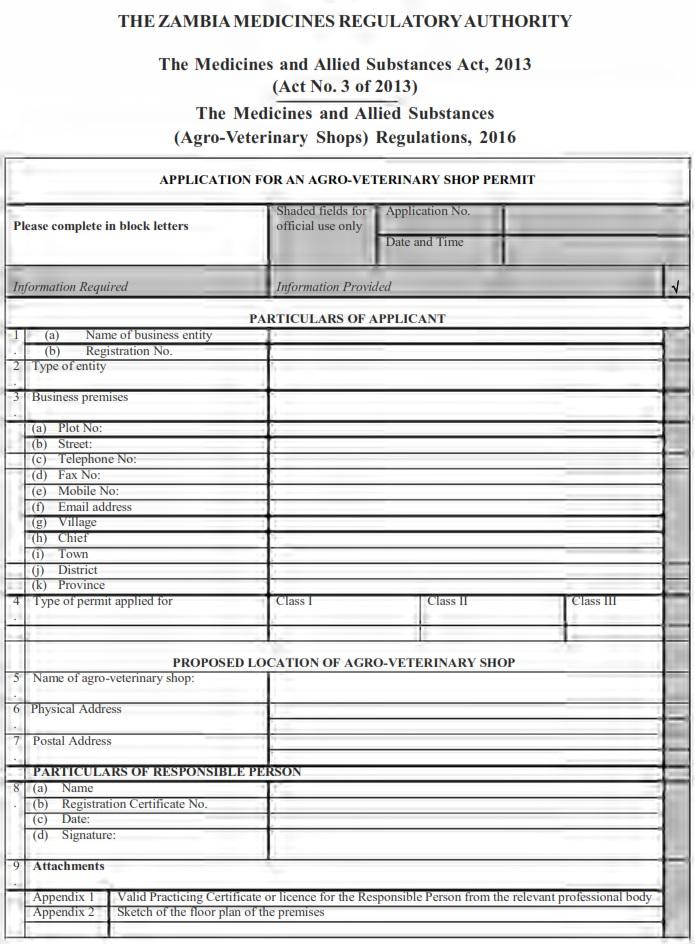
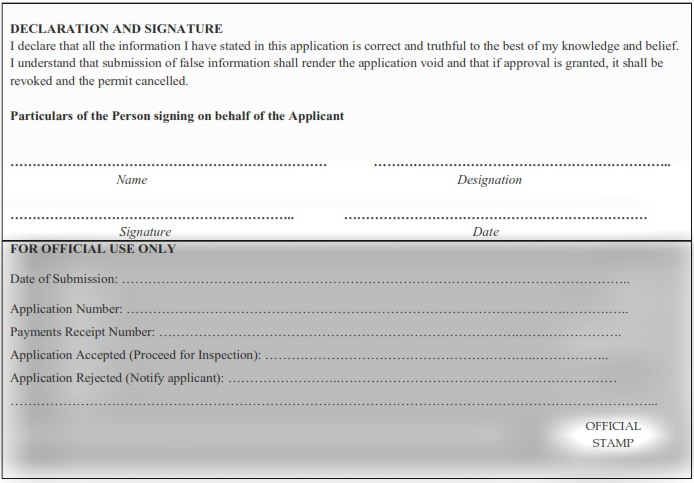
Form II
[Regulation 4]
|
|
|
THE ZAMBIA MEDICINES REGULATORY AUTHORITY |
|
The Medicines and Allied Substances Act, 2013 |
|
The Medicines and Allied Substances (Agro-Veterinary Shops) Regulations, 2016 |
|
REQUEST FOR INFORMATION |
|
To: ……………………………………………………………………………………………………………….. |
|
Address: ……………………………………………………………………………………………………….. |
|
Application No.: ………………………………………………………………………………………………. |
|
You are requested to furnish the following information or documents in respect of your application for …………………………………………………………………………………………………. |
|
(a) ……………………………………………………………………………………………………………. |
|
(b) ……………………………………………………………………………………………………………. |
|
(c) ……………………………………………………………………………………………………………. |
|
(d) ……………………………………………………………………………………………………………. |
|
within ………………… days of this notice. |
|
|
|
If you fail to furnish the requested information within the stipulated period, your application will be treated as invalid and shall be rejected. |
|
Dated this ………… day of ……………………. 20…… |
|
|
|
………………………………………….. |
|
|
|
|
Form III
[Regulations 5(2) and 8(5)]
|
|
|
|
THE ZAMBIA MEDICINES REGULATORY AUTHORITY |
|
|
The Medicines and Allied Substances Act, 2013 |
|
|
The Medicines and Allied Substances |
|
|
NOTICE OF REJECTION OF APPLICATION |
|
|
(1) Here insert the full names and address of the applicant |
To (1) ……………………………………………………………………………………. |
|
……………………………………………………………………………………. |
|
|
(2) Here insert the reference No. of the application |
IN THE MATTER OF (2) …………………………………. you are notified that your application for (3) ……………………………………………. has been rejected by the Authority on the following grounds: |
|
(3) Here insert type of application |
(a) …………………………………………………………………………… |
|
(b) ……………………………………………………………………………… |
|
|
(c) ……………………………………………………………………………….. |
|
|
(d) ………………………………………………………………………………. |
|
|
|
|
|
|
Dated this ………. day of ……………………, 20…… |
|
|
|
|
|
…………………………………………. |
|
|
|
Form IV
[Regulation 6]
|
|
|
THE ZAMBIA MEDICINES REGULATORY AUTHORITY |
|
The Medicines and Allied Substances Act, 2013 |
|
The Medicines and Allied Substances |
|
AGRO-VETERINARY SHOP PERMIT |
|
Registration No.: ………………………………………….. AVS |
|
Permit No.: AVS/……………………………………………….. |
|
This is to certify that (Name of agro-veterinary shop) …………………………………………….. |
|
……………………………………………………………………………………………………………………. |
|
of (Physical address) ………………………………………………………………………………………. |
|
…………………………………………………………………………………………………………………… |
|
…………………………………………………………. is registered to operate an agro-veterinary shop. |
|
|
|
Name of responsible person: ………………………………………………………………………………. |
|
The conditions of the agro-veterinary shop permit are overleaf. |
|
|
|
This permit is valid until ……………………. 20….. |
|
|
|
………………………………………….. |
|
|
|
Conditions for agro-veterinary shop permit |
|
1. Any change in the responsible person, name, location or condition of permit of the agro-veterinary shop shall be approved by the Authority. |
|
2. The agro-veterinary shop shall only stock and sell medicinal products that are on the prescribed list. |
|
3. The premises and the manner in which the business is to be conducted must comply with the requirements of the Medicines and Allied Substances Act, No. 3 of 2013, and any other relevant written law. |
|
4. The agro-veterinary shop permit is not transferable without the written approval of the Authority. |
|
5. The agro-veterinary shop permit shall, upon grant, be displayed conspicuously at the front shop in a place visible to the public. |
Form V
[Regulation 7(1)]
(To be completed in triplicate)
|
|
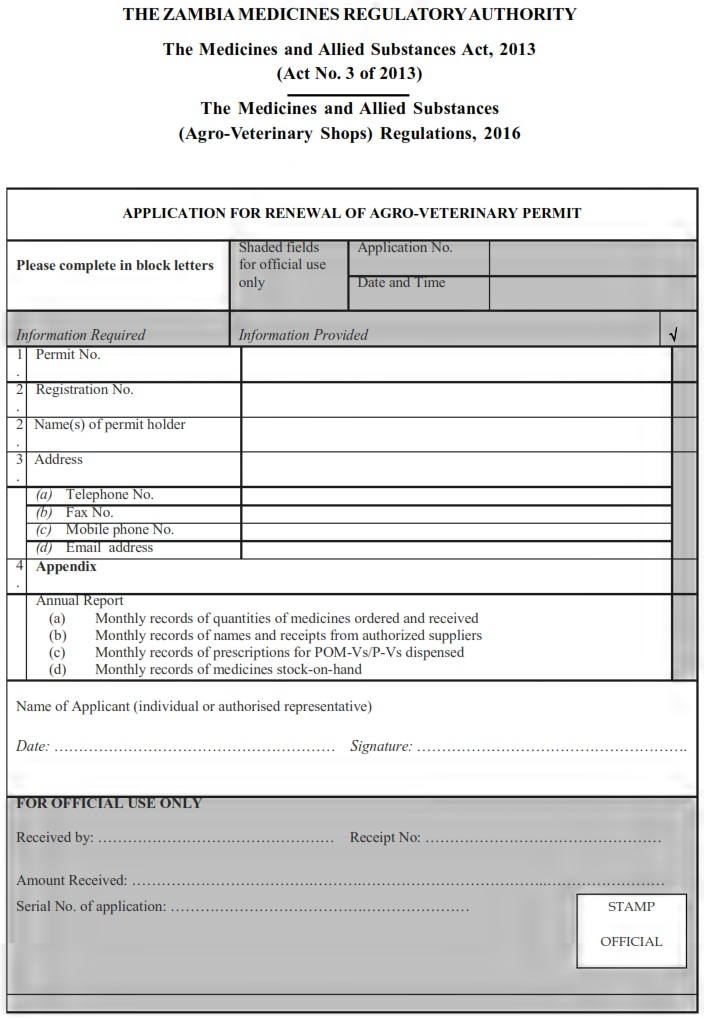
Form VI
[Regulation 8(2)]
(To be completed in triplicate)
|
|
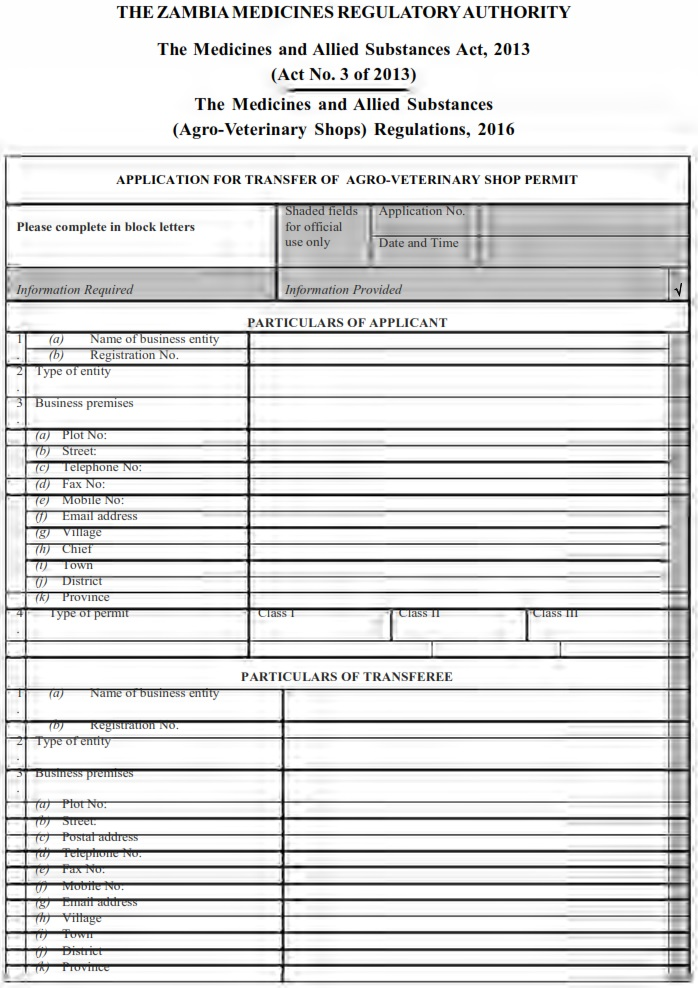
Form VII
[Regulation 9]
(To be completed in triplicate)
|
|
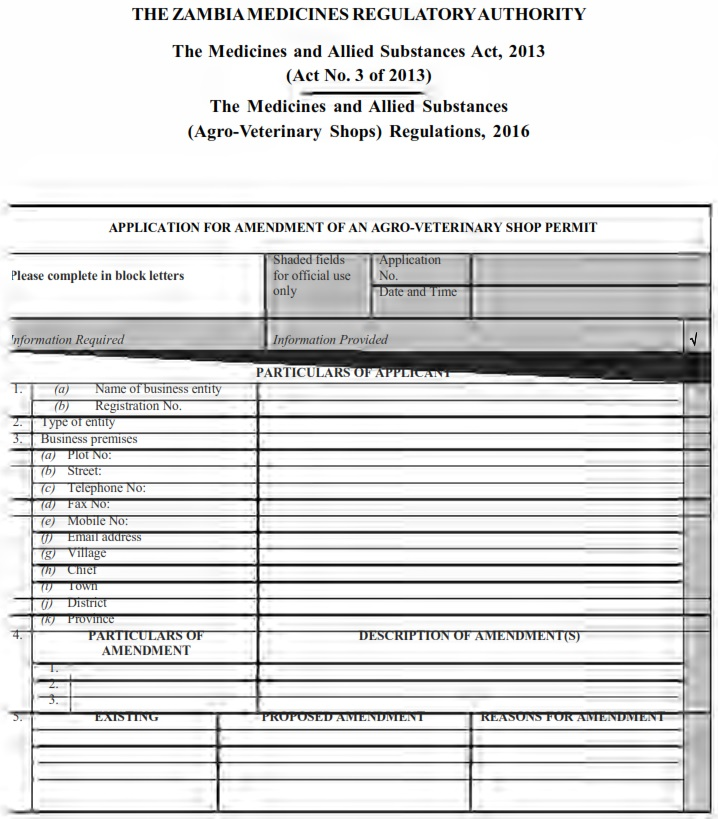
Form VIII
[Regulation 10]
(To be completed in triplicate)
|
|
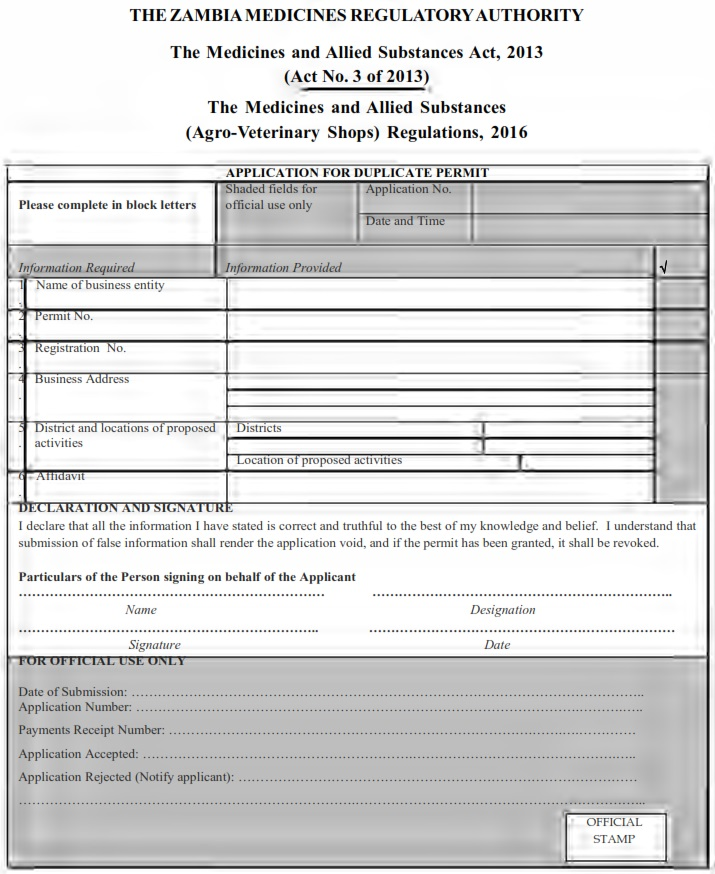
Form IX
[Regulations 11(3) and 12(3)]
(To be completed in triplicate)
|
|
|
|
THE ZAMBIA MEDICINES REGULATORY AUTHORITY |
|
|
The Medicines and Allied Substances Act, 2013 |
|
|
The Medicines and Allied Substances |
|
|
NOTICE OF INTENTION TO SUSPEND/REVOKE AGRO-VETERINARY SHOP PERMIT |
|
|
(1) Here insert the full names and address of holder of permit |
To (1) ……………………………………………………………………………….. |
|
………………………………………………………………………………………… |
|
|
……………………………………………………………………………………….. |
|
|
(2) Here insert the Permit No. |
IN THE MATTER OF (2) ………………….. …. you are notified that the Authority intends to |
|
(a) ………………………………………………………………………………….. |
|
|
|
(b) ………………………………………………………………………………….. |
|
|
(c) ………………………………………………………………………………….. |
|
|
(d) …………………………………………..………….………………………….. |
|
(3) Here insert the number of days stipulated |
Accordingly, you are requested to show cause why your permit should not be |
|
|
Dated this …………. day of ……………………. 20….. |
|
|
|
|
(4) Signature of Director-General |
(4) ………………………………………… |
|
|
|
Form X
[Regulations 11(5) and 12(5)]
(To be completed in triplicate)
|
|
|
|
THE ZAMBIA MEDICINES REGULATORY AUTHORITY |
|
|
The Medicines and Allied Substances Act, 2013 |
|
|
The Medicines and Allied Substances |
|
|
NOTICE OF SUSPENSION OR REVOCATION OF AGRO-VETERINARY SHOP PERMIT |
|
|
(1) Here insert the full names and address of holder of permit |
To (1) …………………………………………………………………….. |
|
…………………………………………………………..…………………. |
|
|
(2) Here insert the permit no. |
IN THE MATTER OF (2) …………………………………………. you are notified that your permit has been |
|
(3) Here insert the period |
(a) …………………………………………………………………….. |
|
(4) Signature of Director-General |
(b) ………………………………………..………………………….. |
|
(c) ………………………………………………….……………….. |
|
|
(d) …………………………………………………………………… |
|
|
|
|
|
|
Dated this …………. day of ……………………. 20….. |
|
|
|
|
|
(4) ………………………………………… |
|
|
|
Form XI
[Regulation 18]
|
|
|
THE ZAMBIA MEDICINES REGULATORY AUTHORITY |
|
The Medicines and Allied Substances Act, 2013 |
|
The Medicines and Allied Substances |
|
REGISTER OF AGRO-VETERINARY SHOP PERMITS |
|
No. |
Name and address of business |
Permit No. |
Class of permit |
Registration number |
Date of issue |
Expiry date |
|
1. |
|
|
|
|
|
|
|
2. |
|
|
|
|
|
|
|
3. |
|
|
|
|
|
|
|
4. |
|
|
|
|
|
|
|
5. |
|
|
|
|
|
|
|
6. |
|
|
|
|
|
|
|
7. |
|
|
|
|
|
SECOND SCHEDULE
[Regulations 16(3) and 15(1)]
VETERINARY PRODUCTS FOR AGRO-VETERINARY SHOPS
|
A. Agro-Veterinary Shop Class I |
|
1. All prescription-only veterinary medicine (POM-V) with marketing authorisation |
|
2. All pharmacy (P-V) veterinary medicines with market authorisation |
|
3. All general sales (GS-V) veterinary medicines and allied substances |
|
4. All medicines that have been imported with special authorisation |
|
5. Medicines and allied substances added by guidelines issued by the Authority on the recommendation of the Ministry responsible for veterinary services in response to changing disease epidemiological status or disease outbreaks |
|
B. Agro-Veterinary Shops Class II |
|
Part A |
|
No. |
Item |
Dosage Form |
|
Analgesics- non-steroidal anti-inflammatories |
|
|
|
1 |
Acetaminophen |
Tablets or powder |
|
2 |
Carprofen |
Tablets |
|
3 |
Diclofenac |
Tablets or gel |
|
4 |
Dimethyl sulfoxide (DMSO) |
Tablets, or cream or ointment |
|
5 |
Dipyrone |
Injection |
|
6 |
Flunixin meglumine |
Injection |
|
7 |
Ketoprofen |
Tablets or powder |
|
8 |
Meloxicam |
Tablets or powder |
|
Antiprotozoa |
|
|
|
1 |
Amprolium |
Injectable solutions |
|
2 |
Amprolium |
Soluble powders |
|
3 |
Parvaquone |
Injectable solutions |
|
4 |
Burparvaquone |
Injectable solutions |
|
5 |
Diminazene aceturate |
Injectable solutions |
|
6 |
Diminazene aceturate |
Injectable solutions granules |
|
7 |
Imidocarb dipropionate |
Injectable solutions |
|
8 |
Isometamidium chloride |
Injectable solutions |
|
9 |
Parvarquone |
Injectable solutions powder |
|
10 |
Quinapyramine sulphate/chloride |
Injectable solutions |
|
Antifungals |
|
|
|
1 |
Fluconazole |
Tablets or powder |
|
2 |
Griseofulvin |
Tablets or capsules |
|
3 |
Ketoconazole |
Tablets, capsules, lotions, shampoo |
|
Antihistamines |
|
|
|
1 |
Chlorpheniramine |
Tablets |
|
2 |
Cimetidine |
Tablets |
|
3 |
Diphenhydramine |
Tablets |
|
4 |
Cetrizine |
Tablets |
|
Antimicrobials |
|
|
|
1 |
Amikacin |
Tablets |
|
2 |
Amoxicillin |
Tablets, capsules or injection |
|
3 |
Ampicillin |
Tablets, capsules or injection |
|
4 |
Doxycycline |
Tablets, capsules or injection |
|
5 |
Neomycin |
Pessaries, ointment or creams |
|
6 |
Oxytetracycline injectable solutions |
All concentrations and dosage forms |
|
7 |
Oxytetracycline soluble powder |
All concentrations and dosage forms |
|
8 |
Oxytetracycline soluble powder with vitamins |
All concentrations and dosage forms |
|
9 |
Penicillin |
Injection |
|
10 |
Penicillin-streptomycin |
Injection |
|
11 |
Sulfadimidine |
Injectable solutions 33% w/v, 33.3% |
|
12 |
Sulfadimidine |
Powder |
|
13 |
Tetracycline |
Ointment or spray |
|
14 |
Tetracycline |
Powder |
|
15 |
Tiamulin |
Powder |
|
Autonomic drugs |
|
|
|
1 |
Atropine |
Injection |
|
2 |
Bethanechol |
Injection |
|
3 |
Glycopyrrolate |
Injection |
|
Electrolytes/Nutritional |
|
|
|
1 |
Calcium |
Injection and powder |
|
2 |
Iron |
Injection or oral liquid |
|
3 |
Methionine, D-L |
Powder |
|
4 |
Multivitamin |
Injectable solution |
|
5 |
Multivitamin |
Soluble powder |
|
6 |
Potassium |
Injection |
|
7 |
Selenium/Vitamin E |
Injection |
|
8 |
Taurine |
Injection |
|
9 |
Vitamin A & D |
Injection |
|
10 |
Vitamin B complex |
Injection |
|
11 |
Vitamin C |
Tablets or powder |
|
12 |
Vitamin D |
Injection |
|
13 |
Vitamin K |
Injection |
|
14 |
Sodium chloride 0.9% (N-Saline) |
Solution |
|
15 |
Dextrose 5%, 10%, 50% |
Solution |
|
16 |
Ringers lactate |
Solution |
|
Gastrointestinal agents |
|
|
|
1 |
Metoclopramide |
Tablets |
|
2 |
Sucralfate |
Tablets |
|
Hormones |
|
|
|
1 |
Dexamethasone |
Injection |
|
2 |
Dinoprost |
Injection |
|
3 |
Estradiol cypionate |
Injection |
|
4 |
Gonadorelin |
Injection |
|
5 |
Oxytocin |
Injection |
|
6 |
Progesterone |
Injection |
|
7 |
Stilboestral dipropionate |
Injection |
|
8 |
Triamcinolone |
Injection |
|
Respiratory |
|
|
|
1 |
Aminophyline |
Tablet or injection |
|
2 |
Dextromethorphan |
Injection |
|
3 |
Doxapram |
Injection |
|
Sedatives |
|
|
|
1 |
Acepromazine |
Tablet |
|
Miscellaneous |
|
|
|
1 |
Methimazole |
Tablet |
|
2 |
Propylene glycol |
Liquid |
|
3 |
Protamine sulfate |
Powder |
|
Allied substances (Acaricides) |
|
|
|
1 |
Chlorfenvinphos |
Concentrate |
|
2 |
Dichlorvos |
Concentrate |
|
Anthelmintics |
|
|
|
1 |
Albendazole |
Bolus up to 2.5 g |
|
2 |
Albendazole |
Suspensions 2.5% w/v,10% w/v |
|
3 |
Clorsulon |
Injection |
|
4 |
Closantel |
Injection or drench |
|
5 |
Febantel |
Drench, bolus or injection |
|
6 |
Fenbendazole |
Drench, bolus or injection |
|
7 |
Haloxon |
Drench |
|
8 |
Hexachloroethane |
Drench |
|
9 |
Hexachloroparaxylene |
Drench |
|
10 |
Hexachlorophene |
Drench |
|
11 |
Ivermectin |
Bolus or powder |
|
12 |
Ivermectin |
Injectable solutions |
|
13 |
Levamisole |
Bolus or powder |
|
14 |
Levamisole hydrochloride |
Drench, powder or injection |
|
15 |
Levamisole phosphate injection |
Injection |
|
16 |
Mebendazole |
Drench, tablets, bolus |
|
17 |
Niclosamide |
Drench or bolus |
|
18 |
Nitoxynil |
Drench or bolus |
|
19 |
Oxfendazole |
Drench or bolus |
|
20 |
Oxibendazole |
Drench or bolus |
|
21 |
Oxyclozanide |
Drench or bolus |
|
22 |
Oxyclozanide |
Drench or bolus |
|
23 |
Parbendazole |
Drench or bolus |
|
24 |
Piperazine citrate |
Soluble powders |
|
25 |
Piperazine citrate |
Tablets |
|
26 |
Praziquantel |
Tablets |
|
27 |
Pyrantel |
Tablets or oral liquid |
|
28 |
Rafoxanide |
Drench or bolus |
|
29 |
Tetramisole |
Drench or bolus |
|
30 |
Thiabendazole |
Drench or bolus |
|
31 |
Thiophanate |
Drench or bolus |
|
32 |
Trichlorfon |
Drench or bolus |
|
33 |
Triclabendazole |
Drench or bolus |
|
34 |
Ivermectin/clorsulon |
Injection |
|
35 |
Levamisole/oxyclozanide |
Drench or bolus |
|
36 |
Piperazine citrate/pyrantel parmoate |
Tablets or oral liquid |
|
37 |
Levamisole/piperazine dihydrochloride |
Powder |
|
Biologicals: |
|
Poultry vaccines |
|
|
|
1 |
Anticoccidial vaccines |
All dosage forms |
|
2 |
Chicken anaemia virus vaccines |
All dosage forms |
|
3 |
Fowl cholera vaccines |
All dosage forms |
|
4 |
Fowl pox vaccines |
All dosage forms |
|
5 |
Fowl typhoid vaccines |
All dosage forms |
|
6 |
Infectious bronchitis vaccines |
All dosage forms |
|
7 |
Infectious bronchitis/newcastle disease/egg drop syndrome baccines |
All dosage forms |
|
8 |
Infectious bronchitis/newcastle inactivated vaccines |
All dosage forms |
|
9 |
Infectious bursal disease vaccines |
All dosage forms |
|
10 |
Infectious coryza vaccines |
All dosage forms |
|
11 |
Infectious laryngotracheitis vaccines |
All dosage forms |
|
12 |
Newcastle cloned vaccines |
All dosage forms |
|
13 |
Newcastle disease live vaccine |
All dosage forms |
|
14 |
Newcastle disease inactivated vaccines |
All dosage forms |
|
15 |
Newcastle disease thermostable vaccines |
All dosage forms |
|
16 |
Salmonella vaccines for avians |
All dosage forms |
|
17 |
Egg drop syndrome vaccines |
All dosage forms |
|
Ruminant vaccines |
|
|
|
1 |
Anaplasmosis vaccines |
All dosage forms |
|
2 |
Anthrax vaccines |
All dosage forms |
|
3 |
Avian & bovine tuberculin kit |
Injectible |
|
4 |
Black leg-clostridium chauvoei vaccines |
All dosage forms |
|
5 |
Blackleg/anthrax vaccines |
All dosage forms |
|
6 |
Blue tongue vaccines |
All dosage forms |
|
7 |
Botulism vaccines |
All dosage forms |
|
8 |
Botulism/anthrax vaccines |
All dosage forms |
|
9 |
Anthrax/black quarter/botulism vaccines |
All dosage forms |
|
10 |
Bovine ephemeral fever vaccines |
All dosage forms |
|
11 |
Brucella vaccines |
All dosage forms |
|
12 |
Calf paratyphoid live and killed vaccines |
All dosage forms |
|
13 |
Enzootic abortion vaccines |
All dosage forms |
|
14 |
Clostridial/pasteurella vaccines |
All dosage forms |
|
15 |
Infectious bovine rhinotracheitis/parainfluenza/bovine respiratory syncitial virus/bovine viral diarrhoea (combination) vaccines, both live and killed |
All dosage forms |
|
16 |
Leptospirosis vaccines |
All dosage forms |
|
17 |
Lumpy skin disease vaccines |
All dosage forms |
|
18 |
Milk ring test antigen |
All dosage forms |
|
19 |
Multiclostridials vaccines |
All dosage forms |
|
20 |
Pasturella vaccines |
All dosage forms |
|
21 |
Pulpy kidney vaccines |
All dosage forms |
|
22 |
Rift valley fever vaccines, live and inactivated |
All dosage forms |
|
23 |
Rota/corona/E.coli vaccine for cattle |
All dosage forms |
|
24 |
Rift valley fever inactivated vaccine for cattle |
All dosage forms |
|
25 |
Rift valley fever live vaccine for sheep |
All dosage forms |
|
26 |
Bovine rota/coronavirus vaccine/clostridium perfringens type C/escherichia coli bacterin/toxoid Injectable vaccine/toxoid |
All dosage forms |
|
27 |
Sheep multiclostridial vaccines |
All dosage forms |
|
28 |
Tetanus vaccines |
All dosage forms |
|
29 |
Tetanus toxoid |
All dosage forms |
|
30 |
Bovine ephemeral fever vaccines |
All dosage forms |
|
31 |
Vibriosis vaccines |
All dosage forms |
|
Pig vaccines |
||
|
1 |
Parvovirus killed vaccine/erysipelothrix/leptospira bacterin vaccine/toxoid |
All dosage forms |
|
2 |
Boar-taint vaccines |
All dosage forms |
|
3 |
E. coli/clostridium perfringens type C beta toxoid |
All dosage forms |
|
Vaccines for companion animals |
|
|
|
1 |
Equine influenza virus vaccines |
All dosage forms |
|
2 |
Feline viral rhinotracheitis/feline calicivirus/feline panleukopenia vaccines |
All dosage forms |
|
3 |
Canine parvovirus vaccines |
All dosage forms |
|
4 |
Horse sickness polyvalent vaccine |
All dosage forms |
|
5 |
Canine distemper/adenovirus type 2/ parainfluenza/parvovirus modified live virus vaccine/ leptospira bacterin vaccine/toxoid |
All dosage forms |
|
6 |
Rabies vaccines |
All dosage forms |
|
Intra-Uterine infusion drugs |
|
|
|
1 |
Intrauterine pessaries |
Pessaries |
|
Intramammary infusion drugs |
|
|
|
1 |
Mastitis intramammary infusion |
Ointments |
|
Ophthalmologic drug |
|
|
|
1 |
Cloxacillin eye ointment 16.7% w/w |
Ointments |
|
2 |
Dexamethasone ointment or drops |
Ointments or drops |
|
3 |
Doxycycline |
Eye powder |
|
4 |
Neomycin |
Ointment or drops |
|
5 |
Oxytetracycline |
Powder or ointment |
|
Antiseptics |
|
|
|
1 |
Povidone iodine |
Concentrate |
|
|
||
|
Part B |
||
|
1. All general sales (GSV) veterinary medicines and allied substances |
||
|
2. Medicines and allied substances added by guidelines issued by the Authority on the recommendation of the Ministry responsible for veterinary services in response to changing disease epidemiological status or disease outbreaks |
||
|
Agro-Veterinary Shop Class III |
||
|
Part A |
|
No. |
Item |
Dosage Form |
|
Analgesics-non-steroidal anti-inflammatories |
|
|
|
1 |
Diclofenac |
Tablets or gel |
|
2 |
Dipyrone |
Injection |
|
Antiprotozoa |
|
|
|
1 |
Amprolium |
Soluble powders |
|
|
Diminazene aceturate |
Injectable solutions |
|
Antihistamines |
|
|
|
1 |
Chlorpheniramine |
Tablets |
|
Antimicrobials |
|
|
|
1 |
Oxytetracycline injectable solutions |
All concentrations and dosage forms |
|
2 |
Oxytetracycline soluble powder |
All concentrations and dosage forms |
|
3 |
Oxytetracycline soluble powder with vitamins |
All concentrations and dosage forms |
|
4 |
Tetracycline |
Ointment or spray |
|
5 |
Tetracycline |
Powder |
|
Electrolytes/Nutritional |
|
|
|
1 |
Multivitamin |
Soluble powder |
|
2 |
Potassium |
Injection |
|
3 |
Vitamin C |
Tablets or powder |
|
Allied substances (Acaricides) |
|
|
|
1 |
Chlorfenvinphos |
Concentrate |
|
Anthelmintics |
|
|
|
1 |
Albendazole |
Bolus up to 2.5 g |
|
2 |
Albendazole |
Suspensions 2.5% w/v,10% w/v |
|
3 |
Closantel |
Injection or drench |
|
4 |
Ivermectin |
Bolus or powder |
|
5 |
Levamisole |
Bolus or powder |
|
6 |
Oxfendazole |
Drench or bolus |
|
7 |
Oxyclozanide |
Drench or bolus |
|
8 |
Parbendazole |
Drench or bolus |
|
9 |
Piperazine citrate |
Soluble powders |
|
10 |
Piperazine citrate |
Tablets |
|
11 |
Praziquantel |
Tablets |
|
12 |
Pyrantel |
Tablets or oral liquid |
|
Biologicals: |
||
|
Poultry vaccines |
|
|
|
1 |
Newcastle disease |
Thermostable vaccines |
|
Ophthalmologic drug |
|
|
|
1 |
Cloxacillin eye ointment 16.7% w/w |
Ointments |
|
2 |
Doxycycline |
Eye powder |
|
3 |
Neomycin |
Ointment or drops |
|
4 |
Oxytetracycline |
Power or ointment |
|
|
||
|
Part B |
||
|
1. All general sales (GSV) veterinary medicines and allied substances |
||
|
2. Medicines and allied substances added by guidelines issued by the Authority, and are categorised for distribution in Class 3 agro-veterinary shops, on the recommendation of the Ministry responsible for veterinary services in response to changing disease epidemiological status or disease outbreaks |
||
|
Note: All medicines with marketing authorisation for use in humans, if prescribed for use in animals, shall only be accessed from registered pharmacies on prescription from a registered veterinary surgeon. |
MEDICINES AND ALLIED SUBSTANCES (DISPENSING CERTIFICATES) REGULATIONS
[Section 28]
Arrangement of Regulations
Regulation
PART I
PRELIMINARY
1. Title
2. Interpretation
PART II
DISPENSING CERTIFICATE
3. Application for certificate
4. Request for information
5. Rejection of application for certificate
6. Issuance of certificate
7. Application for renewal of certificate
8. Transfer of certificate
9. Amendment of certificate
10. Application for duplicate certificate
11. Suspension of certificate
12. Revocation of certificate
13. Dispensing of medicines
14. Storage of medicines
PART III
GENERAL PROVISIONS
15. Register of dispensing certificates
SI 11 of 2016.
PART I
PRELIMINARY
These Regulations may be cited as the Medicines and Allied Substances (Dispensing Certificates) Regulations.
In these Regulations, unless the context otherwise requires—
“authorised supplier” means a holder of a pharmaceutical licence issued under section 34 of the Act; and
“certificate” means the dispensing certificate issued under section 28 of the Act.
PART II
DISPENSING CERTIFICATE
3. Application for certificate
(1) A person shall apply to the Authority for a certificate in Form I set out in the Schedule.
(2) The Authority shall, within 14 days of the receipt of an application, notify the applicant of the decision of the Authority in respect of the application.
(3) A separate application shall be made and a separate certificate issued in respect of each health facility.
(4) The Authority may inspect the health facility in respect of which an application for a certificate is made to determine if the applicant meets the requirements of the Act and the guidelines issued by the Authority.
(5) The Authority shall consider the following matters in determining an application for a certificate—
(a) the number of health facilities in the area;
(b) the classification of the health facility; and
(c) the competence of the health practitioners responsible for dispensing the medicines.
The Authority may request an applicant to submit information in relation to an application for a certificate in Form II set out in the Schedule.
5. Rejection of application for certificate
(1) The Authority shall reject an application for a certificate if—
(a) the applicant fails to meet the requirements of the Act and the guidelines issued by the Authority;
(b) the certificate issued to the applicant was revoked by the Authority within the preceding two years before the date of the application;
(c) the applicant’s practising certificate is withdrawn by the relevant professional body; or
(d) the applicant is convicted of an offence under the Act or any other relevant written law.
(2) The Authority shall, where it rejects an application under sub-regulation (1), inform the applicant within seven days of the decision in Form III set out in the Schedule.
(1) The Authority shall, where the applicant meets the requirements of the Act and the guidelines issued by the Authority, issue a certificate in Form IV set out in the Schedule.
(2) A certificate shall be valid for two years from the date of issue.
7. Application for renewal of certificate
(1) An application for the renewal of a certificate shall be made to the Authority in Form V set out in the Schedule.
(2) The Authority shall, within 14 days of the application for a certificate, renew the certificate if the applicant meets the requirements of the Act and the guidelines issued by the Authority and has complied with the terms and conditions of the certificate.
(3) A certificate that is not renewed by the Authority lapses on its date of expiry.
A certificate shall be used solely by the holder and is not transferable to any other person.
(1) The Authority may amend a certificate where the name of the business changes.
(2) An application for the amendment of a certificate shall be made in Form VI set out in the Schedule.
(3) The Authority shall, where it approves an application for the amendment of a certificate, issue the applicant with a new certificate.
10. Application for duplicate certificate
A person may, where a certificate is lost, damaged or defaced, apply to the Authority for a duplicate certificate in Form VII set out in the Schedule.
(1) The Authority shall suspend a certificate if—
(a) the holder dispenses medicine under insanitary conditions;
(b) the holder or manager of the health facility in respect of which it is issued obtains or sells medicines from unauthorised suppliers or stocks and sells unauthorised products;
(c) the health facility does not comply with good dispensing practices determined by the Authority;
(d) the holder fails to maintain the required records on medicines and allied substances; or
(e) the holder contravenes the terms and conditions of the certificate or the provisions of the Act or any other relevant written law.
(2) The Authority shall, before suspending a certificate, give notice to the holder of the intention to suspend the certificate and request the holder to show cause, within a specified period, why the certificate should not be suspended.
(3) A notice of intention to suspend a certificate shall be in Form VIII set out in the Schedule.
(4) The Authority shall suspend a certificate if the holder of the certificate fails to take remedial measures within the period specified in the notice issued under sub-regulation (3).
(5) A notice of the suspension of a certificate shall be in Form IX set out in the Schedule.
(6) During the period of the suspension of the certificate—
(a) the product affected by the suspension of the certificate shall be quarantined and disposed of at the cost of the certificate holder; and
(b) the health facility to which it relates shall not dispense medicines, except for emergency cases.
(7) The Authority shall lift the suspension of a certificate where the holder complies with the terms and conditions of the suspension.
(1) The Authority shall revoke a certificate if the holder—
(a) contravenes the provisions of the Act or breaches the terms or conditions of the certificate;
(b) fails to take corrective measures following the suspension of the certificate within the specified period;
(c) obtained the certificate by fraud or deliberate or negligent submission of false information or statements; or
(d) fails to comply with any other relevant written law.
(2) The Authority shall, before revoking a certificate, give notice to the holder of the certificate of the intention to revoke the certificate and request the holder to show cause, within a specified period, why the certificate should not be revoked.
(3) A notice of the intention to revoke a certificate shall be in Form VIII set out in the First Schedule.
(4) The Authority shall revoke a certificate if the holder fails to take remedial measures during the period specified by the Authority.
(5) A notice of the revocation of a certificate shall be in Form IX set out in the Schedule.
(6) Upon the revocation of a certificate, the products in the health facility shall be quarantined or disposed of as directed by the Authority at the holder’s cost.
(1) Medicines in a health facility shall be dispensed in accordance with the guidelines issued by the Authority.
(2) A holder of a dispensing certificate who undertakes dispensing activities shall stock medicines of the required quality, safety and efficacy.
(3) A patient may request a medical practitioner for a written prescription to enable the patient obtain medicines from any other health facility of their choice.
(1) The storage of medicines in a health facility shall be in the manufacturer’s original container and under conditions stipulated by the manufacturer.
(2) The Authority shall, where it determines that the holder of a certificate stocks medicines or products under insanitary conditions, direct the holder to dispose of the medicines or products at the holder’s cost.
(3) Where medicines are transferred to another container, care shall be taken to protect the integrity of the product and prevent contamination of the medicines.
PART III
GENERAL PROVISIONS
15. Register of dispensing certificates
(1) The Authority shall keep and maintain a register of dispensing certificates in Form X set out in the Schedule.
(2) The register referred to in sub-regulation (1) shall be kept at the offices of the Authority and shall be open to inspection by the public at such times and upon payment of a prescribed inspection fee.
SCHEDULE
[Regulations 3, 4, 5, 6, 7, 8, 9, 10, 11, 12 and 15]
PRESCRIBED FORMS
Form I
[Regulation 3(1)]
(To be completed in triplicate)
|
|

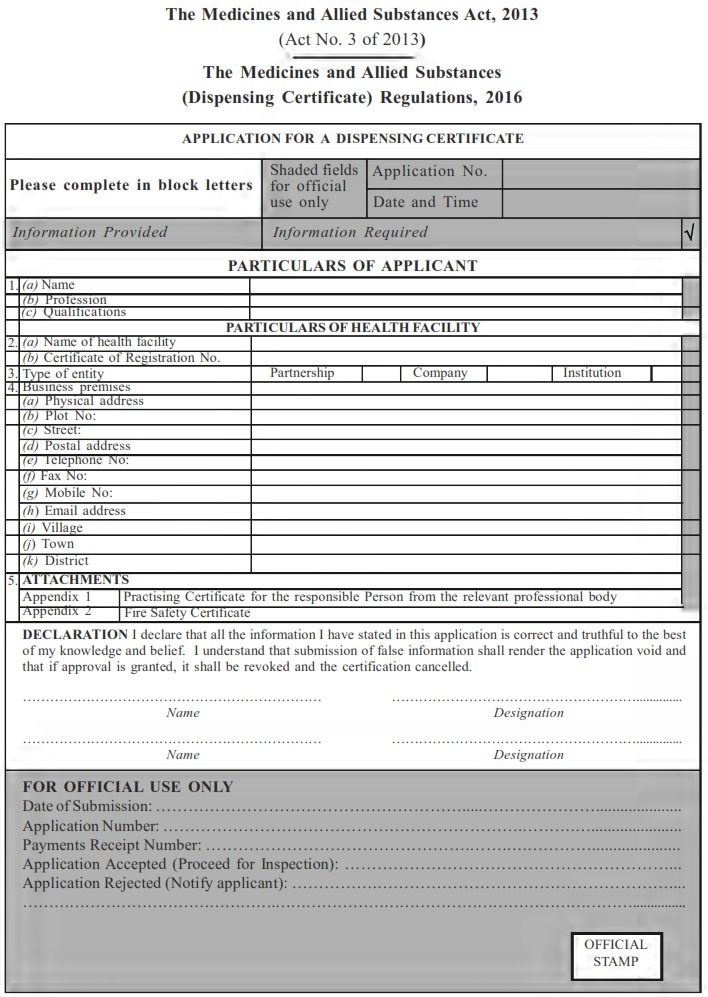
Form II
[Regulation 4]
|
|
|
The Medicines and Allied Substances Act, 2013 |
|
The Medicines and Allied Substances (Dispensing Certificates) Regulations, 2016 |
|
REQUEST FOR INFORMATION |
|
To: ………………………………………………………………………………………………………. |
|
Address: ……………………………………………………………………………………………….. |
|
Application No.: ………………………………………………………………………………………. |
|
You are requested to furnish the following information in respect of your application for ………………………………………… within ………………………………. days of this Notice: |
|
(a) …………………………………………………………………………………………………… |
|
(b) …………………………………………………………………………………………………… |
|
(c) …………………………………………………………………………………………………… |
|
(d) …………………………………………………………………………………………………… |
|
If you fail to furnish the requested information within the stipulated period, your application |
|
Dated this …………. day of ……………………….. 20…. |
|
|
|
…………………………….. |
|
|
Form III
[Regulation 5(2)]
|
|
|
The Medicines and Allied Substances Act, 2013 |
|
|
The Medicines and Allied Substances (Dispensing Certificates) Regulations, 2016 |
|
|
NOTICE OF REJECTION OF APPLICATION |
|
|
(1) Here insert the full names and address of the applicant |
To (1) ………………………………………………………………………………….………….. |
|
………………………………………………………………………………………….………….. |
|
|
(2) Here insert the reference No. of the application |
IN THE MATTER OF (2) …………………………………………. you are notified that your application for (3) …………………………………………………….. has been rejected by the Authority on the following grounds: |
|
(3) Here insert type of application |
(a) ……………………………………………………………………………………………… |
|
(b) ……………………………………………………………………………………………… |
|
|
(c) ……………………………………………………………………………………………… |
|
|
(d) ……………………………………………………………………………………………… |
|
|
|
|
|
Dated this …………. day of …………………………, 20….. |
|
|
|
|
|
…………………………….. |
|
|
|
Form IV
[Regulation 6]
|
|
|
The Medicines and Allied Substances Act, 2013 |
|
The Medicines and Allied Substances (Dispensing Certificates) Regulations, 2016 |
|
DISPENSING CERTIFICATE |
|
Registration No.: ………………………………. DC |
|
Certificate No.: DC/…………………………….. |
|
This is to certify that …………………………………………………………………………………………… |
|
……………………………………………………………………………………………………………………… |
|
of (Physical address) …………………………………………………………………………………………. |
|
……………………………………………………………………………………………………………………… |
|
…………………………………………………………………………………. may dispense medicines at |
|
……………………………………………………………………………………………………………………… |
|
Name of Health Facility: ……………………………………………………………………………………… |
|
This Certificate is valid until …………………………….. 20…. |
|
The conditions of the Dispensing Certificate are overleaf. |
|
|
|
………………………………. |
|
|
|
Conditions for Dispensing Certificate |
|
1. The holder shall inform the Authority of any change in the details of the Dispensing Certificate. |
|
2. The premises and the manner in which the business is to be conducted must comply with the requirements of the Medicines and Allied Substances Act, No. 3 of 2013, and any other relevant written law. |
|
3. The Dispensing Certificate is not transferable to any other person. |
|
4. The Dispensing Certificate shall, upon grant, be displayed conspicuously at the health facility in a place visible to the public. |
Form V
[Regulation 7(1)]
(To be completed in triplicate)
|
|
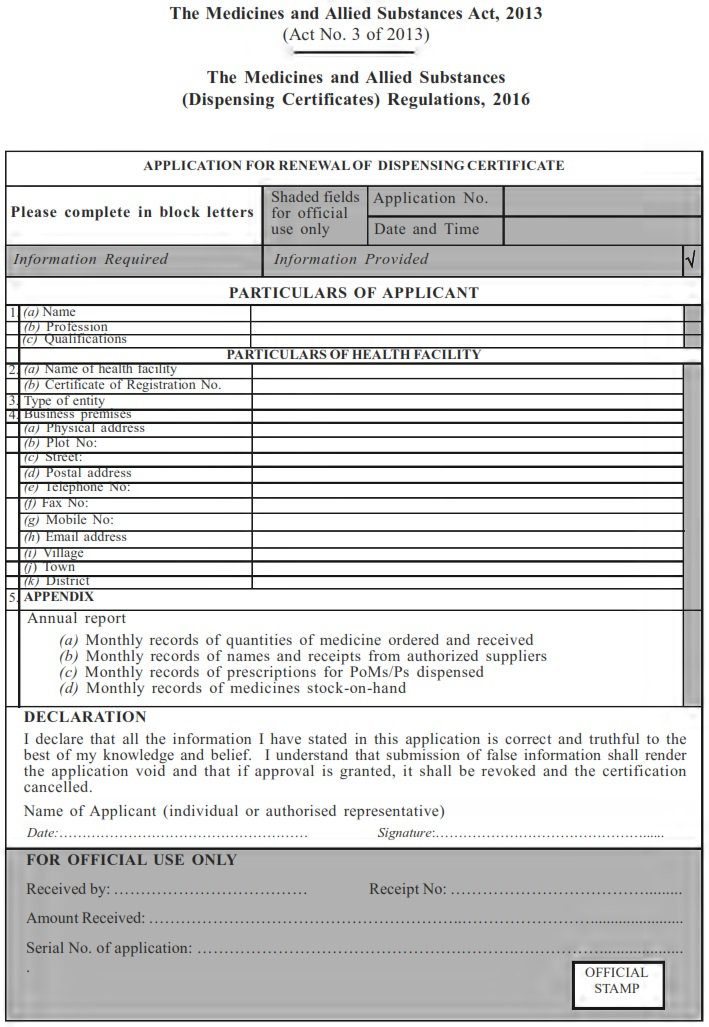
Form VI
[Regulation 9(2)]
(To be completed in triplicate)
|
|
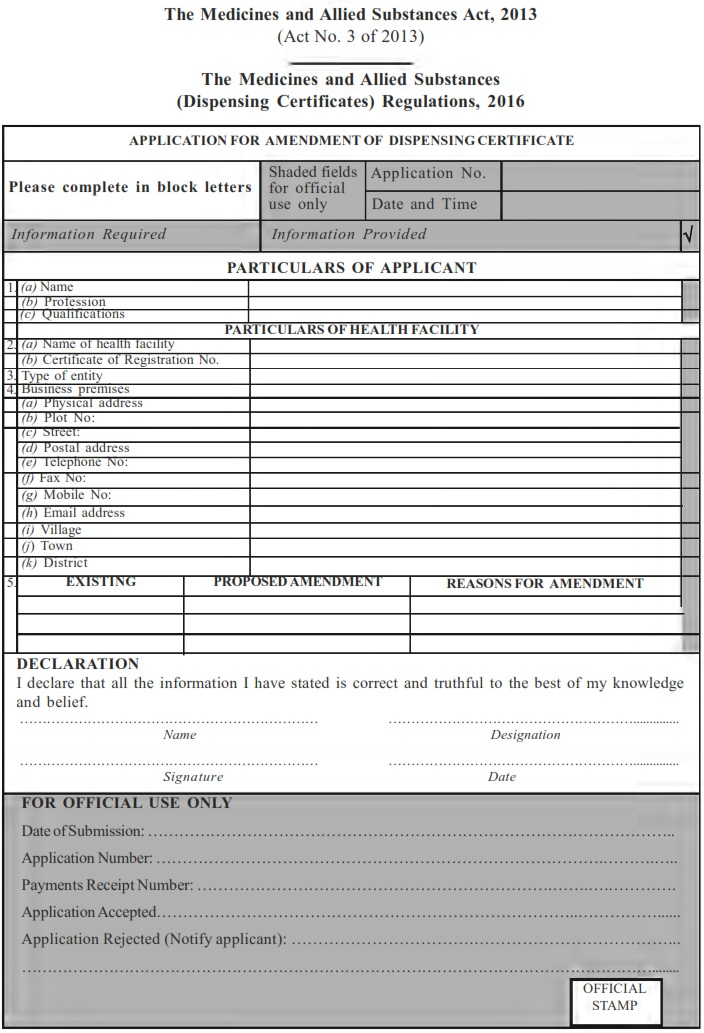
Form VII
[Regulation 10]
(To be completed in triplicate)
|
|
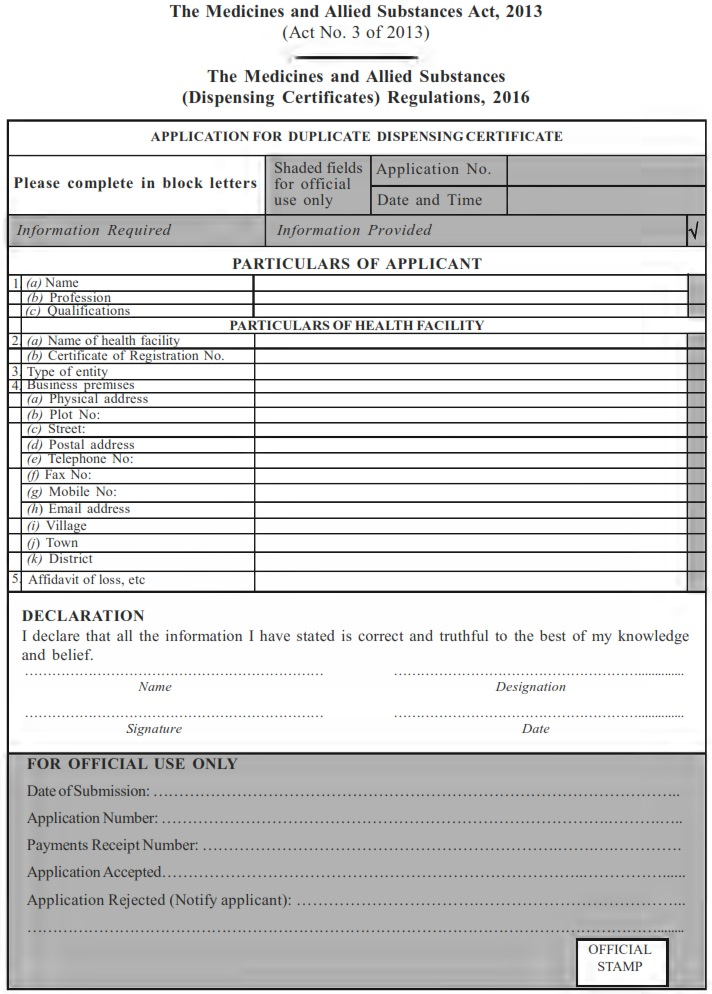
Form VIII
[Regulations 11(3) and 12(3)]
|
|
|
|
The Medicines and Allied Substances Act, 2013 |
|
|
The Medicines and Allied Substances (Dispensing Certificates) Regulations, 2016 |
|
|
NOTICE OF INTENTION TO SUSPEND/REVOKE DISPENSING CERTIFICATE |
|
|
(1) Here insert the full names and address of holder of certificate |
To (1) ……………………………………………………………………………………… |
|
……………………………………………………………………………………………… |
|
|
……………………………………………………………………………………………… |
|
|
(2) Here insert the Certificate No. |
IN THE MATTER OF (2) ……………………………………………… you are notified that the Authority intends to |
|
|
(a) …………………………………………………………………………………… |
|
|
(b) …………………………………………………………………………………… |
|
|
(c) …………………………………………………………………………………… |
|
|
(d) …………………………………………………………….…………………….. |
|
(3) Here insert the number of days stipulated |
Accordingly, you are requested to show cause why your certificate should not be suspended/revoked and to take action to remedy the breaches set out in paragraphs …………………………….. (above) within (3) ……………….. days of receiving this notice. Failure to remedy the specified breaches shall result in the |
|
|
|
|
|
Dated this …………… day of …………………………….. 20…… |
|
|
|
|
|
…………………………….. |
|
|
|
Form IX
[Regulations 11(5) and 12(5)]
|
|
|
|
The Medicines and Allied Substances Act, 2013 |
|
|
The Medicines and Allied Substances (Dispensing Certificates) Regulations, 2016 |
|
|
NOTICE OF SUSPENSION/REVOCATION OF DISPENSING CERTIFICATE |
|
|
(1) Here insert the full names and address of holder of certificate |
To (1) ………………………………………………………………………………………………….. |
|
………………………………………………………………………………………………………….. |
|
|
|
|
|
(2) Here insert the Registration No. |
(2) ……………………………………………………………………………………………………… |
|
(3) Here insert the Certificate No. |
IN THE MATTER OF (3) …………………………………………….. you are notified that your certificate has been |
|
(4) Here insert the period |
…………………………………………………………………………………………………………… |
|
…………………………………………………………………………………………………………… |
|
|
…………………………………………………………………………………………………………… |
|
|
…………………………………………………………………………………………………………… |
|
|
|
|
|
|
Dated this ……….. day of …………………. 20…… |
|
|
|
|
|
………………………………. |
|
|
|
Form X
[Regulation 15(1)]
|
|
|
The Medicines and Allied Substances Act, 2013 |
|
The Medicines and Allied Substances (Dispensing Certificates) Regulations, 2016 |
|
REGISTER OF DISPENSING CERTIFICATES |
|
No. |
Name of Certificate Holder |
Name and Address of Business |
Registration Number |
Date of Issue |
Expiry Date |
|
1. |
|
|
|
|
|
|
2. |
|
|
|
|
|
|
3. |
|
|
|
|
|
|
4. |
|
|
|
|
|
|
5. |
|
|
|
|
|
|
6. |
|
|
|
|
|
|
7. |
|
|
|
|
MEDICINES AND ALLIED SUBSTANCES (HEALTH SHOPS) REGULATIONS
[Section 30]
Arrangement of Regulations
Regulation
PART I
PRELIMINARY
1. Title
2. Interpretation
PART II
HEALTH SHOP PERMIT
3. Application for permit
4. Request for information
5. Rejection of application for permit
6. Issuance of permit
7. Application for renewal of permit
8. Transfer of permit
9. Amendment of permit
10. Application for duplicate permit
11. Suspension of permit
12. Revocation of permit
13. Location of health shop
14. Sale of medicines
15. Identity of health shop
16. Dispensing of medicines in health shop
17. Storage of medicines
PART III
GENERAL PROVISIONS
18. Register of health shop permits
SI 12 of 2016.
PART I
PRELIMINARY
These Regulations may be cited as the Medicines and Allied Substances (Health Shops) Regulations.
In these Regulations, unless the context otherwise requires—
“authorised supplier” means a holder of a pharmaceutical licence issued under section 34 of the Act;
“health shop dispenser” means a person responsible for managing the health shop and has undergone training approved by the Authority;
“patient pack” means a quantity of medicines sufficient to treat a single patient for a specified condition;
“permit” means a health shop permit issued under section 30 of the Act;
“re-packing of medicines” means the act of removing a preparation from its original primary container and placing it into a patient pack, but does not include the act of cutting of a blister pack;
“responsible person” means a pharmacist or pharmacy technologist; and
“supervising pharmacist” means a pharmacist providing supervisory services to a health shop.
PART II
HEALTH SHOP PERMIT
(1) A person shall apply to the Authority for a permit in Form I set out in the First Schedule.
(2) The Authority shall, within 14 days of the receipt of an application, notify the applicant of the decision of the Authority in respect of the application.
(3) A separate application shall be made and a separate permit issued in respect of each premises.
(4) The Authority may inspect the premises in respect of which an application for a permit is made to determine if the applicant meets the requirements of the Act and the guidelines issued by the Authority.
The Authority may request an applicant to submit information in relation to an application in Form II set out in the First Schedule.
5. Rejection of application for permit
(1) The Authority shall reject an application for a permit if—
(a) the applicant fails to comply with any condition precedent to the issue of the permit;
(b) the permit issued to the applicant was revoked by the Authority within a period of two years preceding the date of the application; or
(c) the applicant is convicted of an offence under the Act or any other relevant written law.
(2) The Authority shall, where it rejects an application under sub-regulation (1), inform the applicant within seven days of the decision in Form III set out in the First Schedule.
(1) The Authority shall, where the applicant meets the requirements of the guidelines issued by the Authority and the Act, issue a permit in Form IV set out in the First Schedule.
(2) A permit shall be valid for two years from the date of issue.
(3) A health shop shall be managed by a health shop dispenser under the supervision of a responsible person.
7. Application for renewal of permit
(1) An application for the renewal of a permit shall be made to the Authority in Form V set out in the First Schedule.
(2) The Authority shall, within 14 days of the receipt of an application for the renewal of a permit, grant the application for the renewal of the permit if the applicant meets the requirements of the Act and the guidelines issued by the Authority and has complied with the terms and conditions of the permit.
(3) The Authority shall, where it renews a permit, issue a new permit to the applicant.
(4) A permit that is not renewed by the Authority lapses on its date of expiry.
(1) A permit shall be used solely by the holder and is not transferable to any other person without the prior approval of the Authority.
(2) An application for approval to transfer a permit shall be made to the Authority in Form VI set out in the First Schedule.
(3) The Authority shall, within 30 days of receipt of an application for the transfer of a permit, approve the transfer if the applicant meets the requirements of the Act, and issue the transferee with a permit.
(4) The Authority shall reject an application for the transfer of a permit if the applicant fails to comply with the conditions for the grant of the permit, the provisions of the Act and the guidelines issued by the Authority.
(5) The Authority shall, where it rejects an application to transfer a permit under sub-regulation (4)—
(a) inform the applicant in Form III set out in the First Schedule; and
(b) suspend or revoke the permit.
(1) The Authority may amend a permit where—
(a) some other person succeeds to the interest in the business belonging to the holder of the permit; or
(b) the name of the business changes.
(2) An application for the amendment of a permit shall be made in Form VII set out in the First Schedule.
(3) The Authority shall communicate its decision to the permit holder within 14 days of receipt of the application for the permit.
(4) The Authority shall, where it approves the amendment of a permit, issue the applicant with a new permit.
10. Application for duplicate permit
A person shall, where that person’s permit is lost, damaged or defaced, apply to the Authority for a duplicate permit in Form VIII set out in the First Schedule.
(1) The Authority shall suspend a permit if—
(a) the holder operates the health shop under insanitary conditions;
(b) the holder obtains or sells medicine from unauthorised suppliers or stocks and sells unauthorised products;
(c) the health shop in respect of which it was issued contravenes the prescribed standards;
(d) the health shop is not managed or controlled by a responsible person determined by the Authority;
(e) the responsible person fails to maintain the required records on medicines;
(f) the health shop stocks and sells medicines that are not on the prescribed list; or
(g) the holder contravenes the terms and conditions of the permit, the provisions of the Act or any other relevant written law.
(2) The Authority shall, before suspending a permit, give notice to the holder of the intention to suspend the permit and request the holder to show cause, within a specified period, why the permit should not be suspended.
(3) A notice of intention to suspend a permit shall be in Form IX set out in the First Schedule.
(4) The Authority shall suspend a permit if the holder of the permit fails to take remedial measures within the period specified in the notice issued under sub-regulation (2).
(5) A notice of the suspension of a permit shall be in Form X set out in the First Schedule.
(6) The product affected by the suspension of the permit shall be quarantined at the cost of the permit holder during the period of the suspension of the permit.
(1) The Authority shall revoke a permit if the holder—
(a) contravenes the provisions of the Act or any other relevant written law or breaches the terms or conditions of the permit;
(b) fails to take corrective measures following the suspension of the permit within the specified period;
(c) changes the health shop premises without authorisation; or
(d) obtained the permit by fraud or deliberate or negligent submission of false information or statements.
(2) The Authority shall, before revoking a permit, give notice to the holder of the permit of the intention to revoke the permit and request the holder to show cause, within a specified period, why the permit should not be revoked.
(3) A notice of the intention to revoke a permit shall be in Form IX set out in the First Schedule.
(4) The Authority shall revoke a permit if the holder fails to take remedial measures during the period specified by the Authority.
(5) A notice of the revocation of a permit shall be in Form X set out in the First Schedule.
(6) The Authority shall, where it determines that the holder stocks medicines in the health shop under insanitary conditions, direct the holder to dispose of the medicine.
(7) A holder of a permit shall, where the permit is revoked, quarantine the products on the premises and dispose of the products as directed by the Authority at the holder’s cost.
(1) The Authority shall, in considering an application for a permit, prioritise the submissions filed by applicants in the following areas—
(a) rural areas and districts where access by the members of the public to medicines is limited; and
(b) peripheral areas of big towns or cities, where access to medicines is limited.
(2) The Authority shall, when considering the grant of a permit, take into account the availability of dispensing facilities in the area with respect to which the permit relates.
(1) A holder of a permit shall only sell the medicines prescribed in the Second Schedule.
(2) A health shop shall not stock for sale prescription only medicines and pharmacy sale medicines which are not specified in the prescribed list for health shops.
A health shop shall affix a standard logo for purposes of identifying the health shop as specified in the guidelines issued by the Authority.
16. Dispensing of medicines in health shop
Dispensing of medicines in a health shop shall be in accordance with the guidelines for dispensing of medicines in a health shop issued by the Authority.
The storage of medicines in a health shop shall be in the patient pack size and under conditions stipulated by the manufacturer.
PART III
GENERAL PROVISIONS
18. Register of health shop permits
(1) The Authority shall keep and maintain a register of health shop permits in Form XI set out in the First Schedule.
(2) The register referred to in sub-regulation (1) shall be kept at the offices of the Authority and shall be open to inspection by the public at such times and upon payment of an inspection fee as prescribed in the Medicines and Allied Substances (Fees) Regulations, 2015.
FIRST SCHEDULE
[Regulations 3, 4, 5, 6, 7, 8, 9, 10, 11 and 12]
Form I
[Regulation 3(1)]
(To be completed in triplicate)
|
|
|
The Medicines and Allied Substances Act, 2013 |
|
(Act No. 3 of 2013) |
|
The Medicines and Allied Substances (Health Shops) Regulations, 2016 |

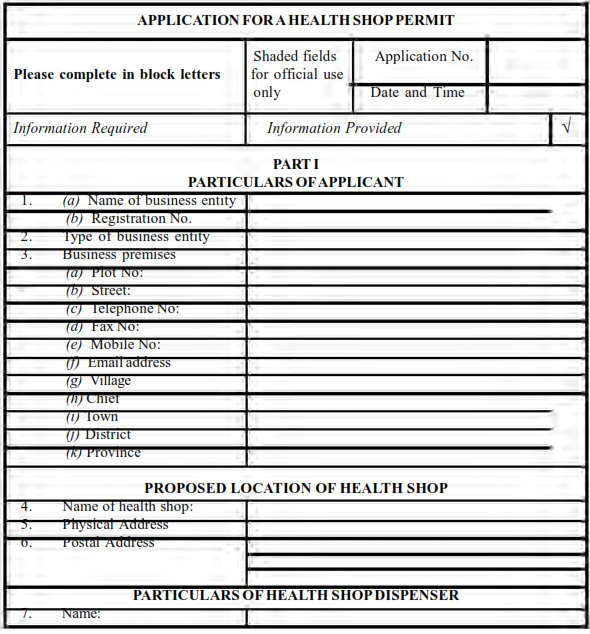
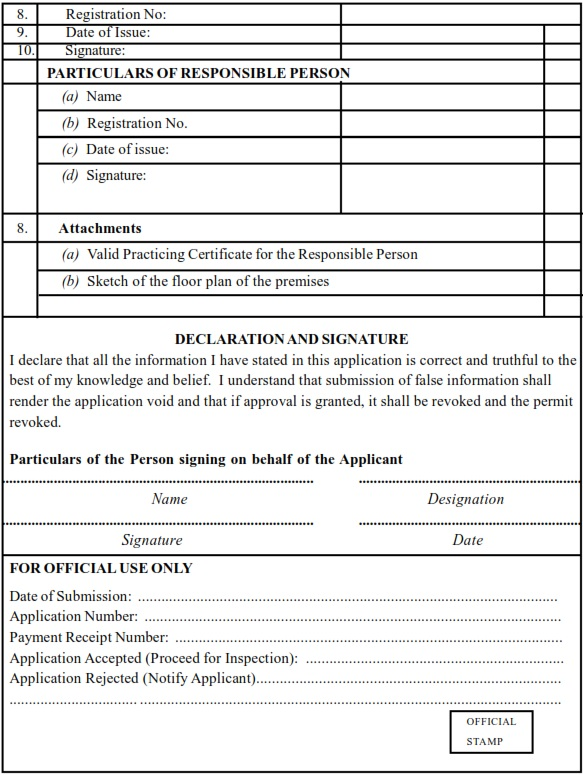
Form II
[Regulation 4]
|
|
|
The Medicines and Allied Substances Act, 2013 |
|
(Act No. 3 of 2013) |
|
The Medicines and Allied Substances (Health Shops) Regulations, 2016 |
|
REQUEST FOR INFORMATION |
|
To: …………………………………………………………………………………………………………………. |
|
Address: …………………………………………………………………………………………………………….. |
|
Application No.: …………………………………………………………………………………………………….. |
|
You are requested to furnish the following information or documents in respect of your application |
|
for ……………………………………………………………………………………………………………………. |
|
(a) …………………………………………………………………………………………………………………….. |
|
(b) …………………………………………………………………………………………………………………….. |
|
(c) …………………………………………………………………………………………………………………….. |
|
(d) …………………………………………………………………………………………………………………….. |
|
within ……………………………… days of this notice. |
|
If you fail to furnish the requested information within the stipulated period, your application will be treated as invalid and shall be rejected. |
|
Dated this ………….. day of …………………….. 20…. |
|
|
|
……………………………… |
|
|
Form III
[Regulations 5(2) and 8(5)]
|
|
|
THE ZAMBIA MEDICINES REGULATORY AUTHORITY |
|
The Medicines and Allied Substances Act, 2013 |
|
(Act No. 3 of 2013) |
|
The Medicines and Allied Substances (Health Shops) Regulations, 2016 |
|
NOTICE OF REJECTION OF APPLICATION |
|
(1) Here insert the full names and address of the applicant |
To (1) …………………………………………………………………………………….. |
|
……………………………………………………………………………………………… |
|
|
(2) Here insert the reference no. of the application |
IN THE MATTER OF (2) …………………………………………………… you are notified that your application for a health shop permit has been rejected by the Authority on the following grounds: |
|
(a) …………………………………………………………………………………………. |
|
|
(b) …………………………………………………………………………………………. |
|
|
(c) …………………………………………………………………………………………. |
|
|
(d) …………………………………………………………………………………………. |
|
|
|
|
|
|
Dated this ………….. day of ………………….., 20….. |
|
|
|
|
|
………………………………………. |
|
|
|
Form IV
[Regulation 6(1)]
|
|
|
THE ZAMBIA MEDICINES REGULATORY AUTHORITY |
|
The Medicines and Allied Substances Act, 2013 |
|
(Act No. 3 of 2013) |
|
The Medicines and Allied Substances (Health Shops) Regulations, 2016 |
|
HEALTH SHOP PERMIT |
|
Registration No.: ……………………………………………………………… HS/…… |
|
Permit No.: HS/…………………………………………………………………….. |
|
This is to certify that (Name of Health Shop) …………………………………………………………………… |
|
……………………………………………………………………………………………………………………………. |
|
of (Physical Address) ………………………………………………………………………………………………. |
|
……………………………………………………………………………………………………………………………. |
|
……………………………………………………………………………. is registered to operate a health shop |
|
Name of responsible person: ……………………………………………………………………………………… |
|
The conditions of the health shop permit are overleaf. |
|
Valid until …………………………………………………………… 20…… |
|
|
|
……………………………… |
|
|
|
Conditions for Health Shop Permit |
|
1. Any change in the ownership, name and location of the health shop shall be approved by the Authority. |
|
2. The health shop shall only sell medicines that are on the prescribed list. |
|
3. The premises and the manner in which the business is to be conducted must comply with the requirements of the Medicines and Allied Substances Act, No. 3 of 2013, and any other relevant written law. |
|
4. The health shop permit is not transferable without the written approval of the Authority. |
|
5. The health shop permit shall, upon grant, be displayed conspicuously at the front shop in a place visible to the public. |
Form V
[Regulation 7]
(To be completed in triplicate)
|
|
|
THE ZAMBIA MEDICINES REGULATORY AUTHORITY |
|
The Medicines and Allied Substances Act, 2013 |
|
(Act No. 3 of 2013) |
|
The Medicines and Allied Substances (Health Shops) Regulations, 2016 |
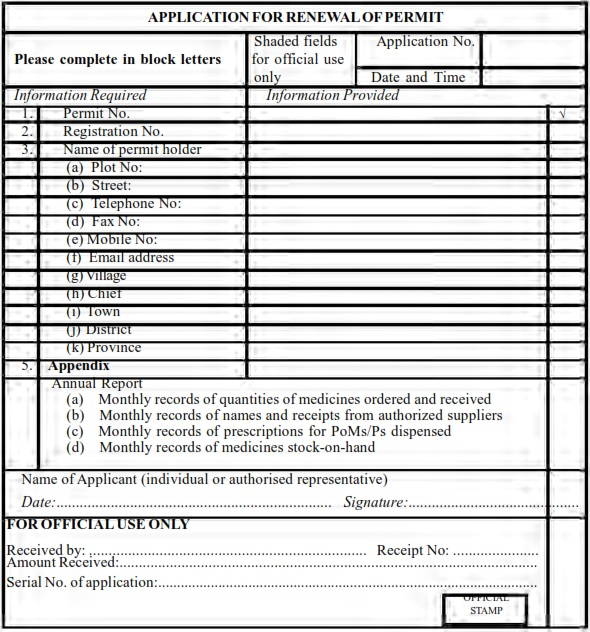
Form VI
[Regulation 8(2)]
(To be completed in triplicate)
|
|
|
THE ZAMBIA MEDICINES REGULATORY AUTHORITY |
|
The Medicines and Allied Substances Act, 2013 |
|
(Act No. 3 of 2013) |
|
The Medicines and Allied Substances (Health Shops) Regulations, 2016 |
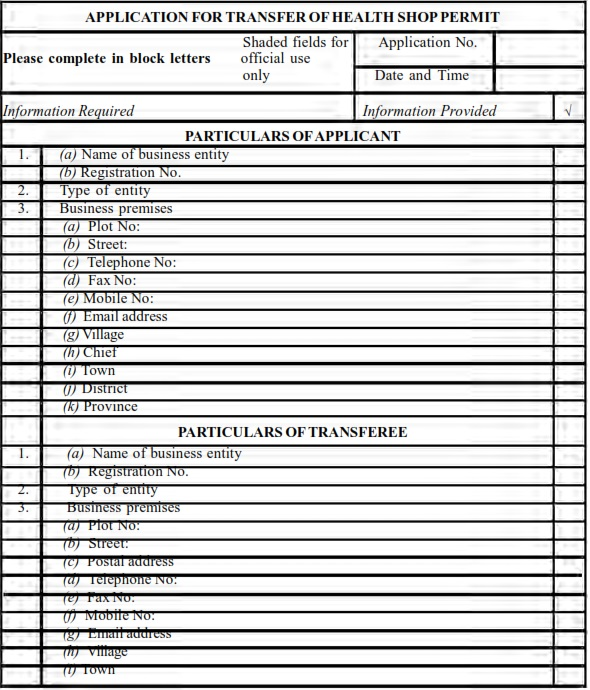
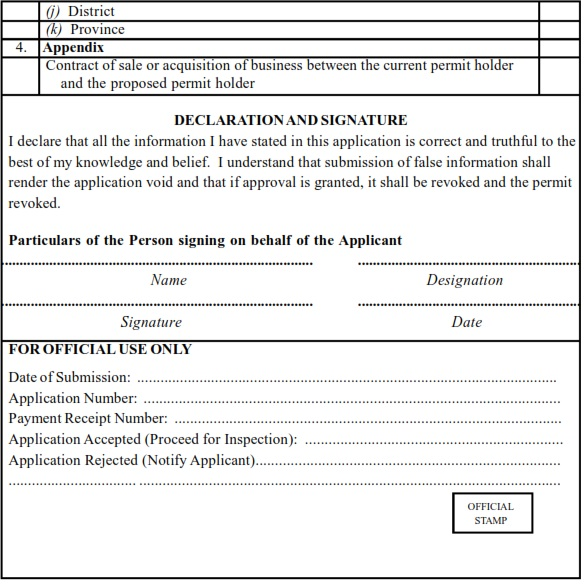
Form VII
[Regulation 9]
(To be completed in triplicate)
|
|
|
THE ZAMBIA MEDICINES REGULATORY AUTHORITY |
|
The Medicines and Allied Substances Act, 2013 |
|
(Act No. 3 of 2013) |
|
The Medicines and Allied Substances (Health Shops) Regulations, 2016 |
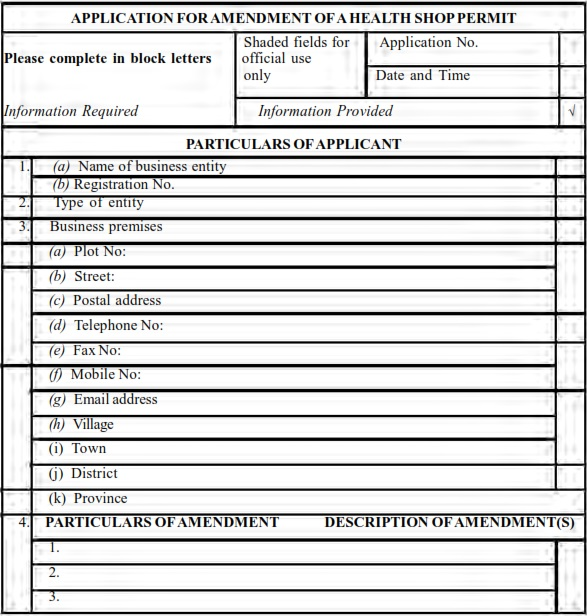
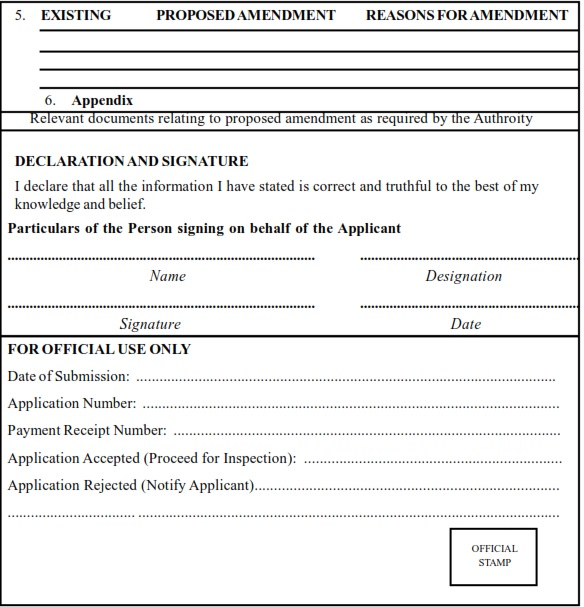
Form VIII
[Regulation 10]
(To be completed in triplicate)
|
|
|
THE ZAMBIA MEDICINES REGULATORY AUTHORITY |
|
The Medicines and Allied Substances Act, 2013 |
|
(Act No. 3 of 2013) |
|
The Medicines and Allied Substances (Health Shops) Regulations, 2016 |
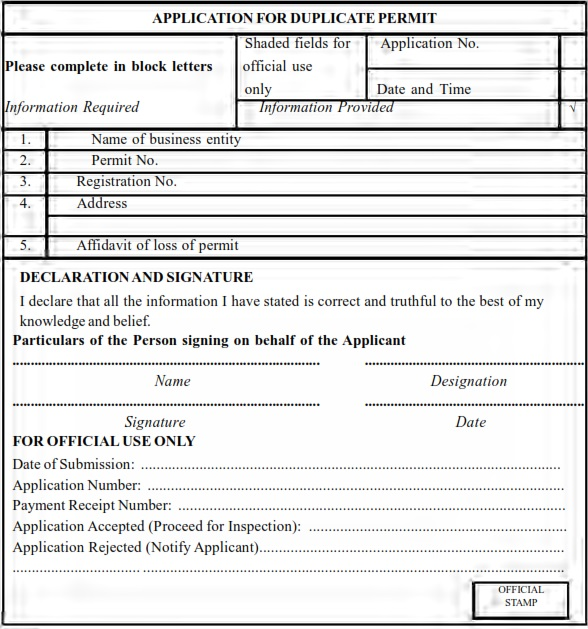
Form IX
[Regulations 11(3) and 12(3)]
|
|
|
THE ZAMBIA MEDICINES REGULATORY AUTHORITY |
|
The Medicines and Allied Substances Act, 2013 |
|
(Act No. 3 of 2013) |
|
The Medicines and Allied Substances (Health Shops) Regulations, 2016 |
|
NOTICE OF INTENTION TO SUSPEND/REVOKE HEALTH SHOP PERMIT |
|
(1) Here insert the full names and address of holder of permit |
To (1) …………………………………………………………………………………….. |
|
……………………………………………………………………………………………… |
|
|
……………………………………………………………………………………………… |
|
|
(2) Here insert the Permit No. |
IN THE MATTER OF (2) …………………………………… you are notified that the Authority intends to |
|
(a) …………………………………………………………………………………………. |
|
|
(b) …………………………………………………………………………………………. |
|
|
(c) …………………………………………………………………………………………. |
|
|
(d) …………………………………………………………………………………………. |
|
|
(3) Here insert the number of days stipulated |
Accordingly, you are requested to show cause why your permit should not be |
|
|
|
|
|
Dated this ………….. day of ………………………, 20….. |
|
|
|
|
(4) Signature of Director-General |
(4) …………………………………… |
|
|
Form X
[Regulations 11(5) and 12(5)]
|
|
|
THE ZAMBIA MEDICINES REGULATORY AUTHORITY |
|
The Medicines and Allied Substances Act, 2013 |
|
(Act No. 3 of 2013) |
|
The Medicines and Allied Substances (Health Shops) Regulations, 2016 |
|
NOTICE OF SUSPENSION OR REVOCATION OF HEALTH SHOP PERMIT |
|
(1) Here insert the full names and address of holder of permit |
To (1) …………………………………………………………………………………….. |
|
……………………………………………………………………………………………… |
|
|
……………………………………………………………………………………………… |
|
|
(2) Here insert the permit no. |
IN THE MATTER OF (2) ……………………………… you are notified that the Authority intends to |
|
(a) …………………………………………………………………………………………. |
|
|
(b) …………………………………………………………………………………………. |
|
|
(c) …………………………………………………………………………………………. |
|
|
(d) …………………………………………………………………………………………. |
|
|
|
|
|
|
Dated this …………. day of ………………….., 20….. |
|
|
|
|
|
(4) ………………………………….. |
|
|
Form XI
[Regulation 19]
|
|
|
THE ZAMBIA MEDICINES REGULATORY AUTHORITY |
|
The Medicines and Allied Substances Act, 2013 |
|
(Act No. 3 of 2013) |
|
The Medicines and Allied Substances (Health Shops) Regulations, 2016 |
|
REGISTER OF HEALTH SHOP PERMITS |
|||||
|
No. |
Name and address of business |
Permit number |
Registration number |
Date of issue |
Expiry date |
|
1. |
|
|
|
|
|
|
2. |
|
|
|
|
|
|
3. |
|
|
|
|
|
|
4. |
|
|
|
|
|
|
5. |
|
|
|
|
|
|
6. |
|
|
|
|
|
|
7. |
|
|
|
|
SECOND SCHEDULE
[Regulation 14]
PRESCRIBED LIST OF MEDICINES FOR HEALTH SHOPS
|
PART A |
|||
|
|
Item |
Strength |
Pack size |
|
|
Medicines for Asthma |
|
|
|
1 |
Salbutamol tablets |
2 mg |
Patient pack |
|
2 |
Salbutamol Inhaler |
100 mcg/dose |
Patient pack |
|
|
|||
|
|
Antibiotics |
|
|
|
3 |
Amoxycillin tablets/capsules |
250 mg |
Patient pack |
|
4 |
Amoxycillin oral suspension |
125 mg/5 ml |
Patient pack |
|
5 |
Co-trimoxazole tablets |
400/80 mg |
Patient pack |
|
6 |
Co-trimoxazole suspension |
200/40 mg/5 ml |
Patient pack |
|
7 |
Doxycycline capsules/tablets |
100 mg |
Patient pack |
|
8 |
Metronidazole tablets |
200 mg |
Patient pack |
|
9 |
Tetracycline hyclate ointment |
1% |
Patient pack |
|
10 |
Silver sulfadiazine cream |
10 g |
Patient pack |
|
|
|||
|
|
Antihelmentics |
|
|
|
11 |
Albendazole tablets |
400 mg |
Patient pack |
|
|
Anti-inflammatory/Analgesics |
|
|
|
12 |
Ibuprofen tablets |
200 mg |
Patient pack |
|
13 |
Hydrocortisone ointment/cream |
1% |
Patient pack |
|
14 |
Paracetamol tablets |
100 mg, 500 mg |
Patient pack |
|
15 |
Acetylsalicylic acid (Aspirin) tablets |
300 mg |
Patient pack |
|
|
|||
|
|
Anti-fungal Agents |
|
|
|
16 |
Nystatin oral suspension |
50 mg/5 ml, 100,000 UI/ml |
Patient pack |
|
17 |
Clotrimazole cream |
1%, 10% |
Patient pack |
|
18 |
Clotrimazole vaginal tablets |
100 mg, 500 mg |
Patient pack |
|
|
Anti-malarials |
|
|
|
19 |
Artemether-lumefantrine tablets |
20/120 mg |
Patient pack |
|
|
|||
|
|
Laxatives |
|
|
|
20 |
Bisacodyl tablets |
5 mg |
Patient pack |
|
|
|||
|
|
Anti-histamines |
|
|
|
21 |
Cetirizine hydrochloride tablets |
10 mg |
Patient pack |
|
22 |
Cetirizine hydrochloride oral solution |
5 mg/5 ml |
Patient pack |
|
23 |
Chlorpheniramine maleate tablets |
4 mg |
Patient pack |
|
24 |
Chlorpheniramine maleate syrup |
2 mg/5 ml |
Patient pack |
|
|
|||
|
|
Oral Contraceptives |
|
|
|
25 |
Ethinylestardiol + Northisterone tablets |
0.03 mg/0.3 mg |
Patient pack |
|
26 |
Ethinylestardiol + Levonogestrel tablets |
0.03 mg/0.15 mg |
Patient pack |
|
|
|
||
|
|
Minerals/Vitamins |
|
|
|
27 |
Vitamin B complex tablets |
|
Patient pack |
|
28 |
Zinc sulfate tablets |
20 mg |
Patient pack |
|
|
|||
|
|
Fluids and Electrolytes |
|
|
|
29 |
Normal saline IV |
|
0.90% 1 litre |
|
30 |
Ringers lactate IV |
|
1 litre |
PART B
All general sale medicines.
Note: Patient pack means a quantity of medicines sufficient to treat a single patient for a specified condition.
MEDICINES AND ALLIED SUBSTANCES (FEES) REGULATIONS
[Sections 19, 39 and 69]
Arrangement of Regulations
Regulation
1. Title
2. Prescribed fees
SI 38 of 2016.
These Regulations may be cited as the Medicines and Allied Substances (Fees) Regulations.
The fees set out in the Schedule are prescribed for the matters specified therein.
SCHEDULE
[Regulation 2]
PRESCRIBED FEES
|
PART I |
|||
|
No. |
Item |
Fee Units |
|
|
|
|
City or Municipal Councils |
Other District Councils |
|
1. |
Hospital, Pharmacy and Retail |
|
|
|
|
(a) Application for certificate of registration |
15,833 |
7,917 |
|
|
(b) Re-inspection of premises in relation to an application for a certificate of registration |
12,000 |
6,000 |
|
|
(c) Annual returns or no change returns |
8,000 |
5,567 |
|
|
(d) Application for change of premises for retail pharmacy |
15,833 |
7,917 |
|
|
(e) Application for change of location for hospital pharmacy— |
|
|
|
|
(i) within the hospital premises |
2,900 |
1,450 |
|
|
(ii) new premises |
15,833 |
7,917 |
|
2. |
Dispensing Certificate |
|
|
|
|
(a) Application for dispensing certificate |
4,000 |
2,000 |
|
|
(b) Re-inspection of a facility in relation to an application for a dispensing certificate |
2,500 |
1,167 |
|
|
(c) Renewal of dispensing certificate |
2,500 |
1,167 |
|
|
(d) Application for change of premises for dispensing certificate |
4,000 |
2,000 |
|
3. |
Agro-Veterinary Shop |
|
|
|
|
(a) Application for agro-veterinary shop permit— |
|
|
|
|
(i) Class 1 |
15,833 |
7,917 |
|
|
(ii) Class 2 |
6,833 |
3,500 |
|
|
(iii) Class 3 |
4,000 |
2,000 |
|
|
(b) Re-inspection of premises in relation to an application for an agro-veterinary shop permit— |
|
|
|
|
(i) Class 1 |
12,000 |
6,000 |
|
|
(ii) Class 2 |
4,000 |
2,000 |
|
|
(iii) Class 3 |
2,500 |
1,167 |
|
|
(c) Renewal of agro-veterinary shop permit— |
|
|
|
|
(i) Class 1 |
12,000 |
6,000 |
|
|
(ii) Class 2 |
4,000 |
2,000 |
|
|
(iii) Class 3 |
4,000 |
2,000 |
|
|
(d) Application for change of premises for agro-veterinary shop— |
|
|
|
|
(i) Class 1 |
15,833 |
7,917 |
|
|
(ii) Class 2 |
6,833 |
3,500 |
|
|
(iii) Class 3 |
4,000 |
2,000 |
|
4. |
Health Shop |
|
|
|
|
(a) Application for health shop permit |
6,833 |
3,500 |
|
|
(b) Re-inspection of premises in relation to an application for a health shop |
4,000 |
2,000 |
|
|
(c) Renewal of health shop permit |
4,000 |
2,000 |
|
|
(d) Application for change of premises for health shop |
6,833 |
3,500 |
|
5. |
Pharmaceutical Licence (wholesale) |
|
|
|
|
(a) Application for pharmaceutical licence |
15,367 |
7,700 |
|
|
(b) Re-inspection of premises in relation to an application for a pharmaceutical licence |
11,533 |
5,867 |
|
|
(c) Renewal for pharmaceutical licence |
11,533 |
5,867 |
|
|
(d) Application for change of premises |
15,367 |
7,700 |
|
PART II |
||
|
No. |
Item |
Fee Units |
|
1. |
Pharmaceutical Licence |
|
|
|
(a) Complete manufacture— |
|
|
|
(i) Application for pharmaceutical license |
64,533 |
|
|
(ii) Re-inspection of premises in relation to an application for a pharmaceutical licence |
47,867 |
|
|
(iii) Re-locating to new premises |
64,533 |
|
|
(iv) Inspection of additional production line |
25,400 |
|
|
(v) Inspection of additional production block |
47,867 |
|
|
(vi) Renewal of pharmaceutical licence |
47,867 |
|
|
(b) Primary repackage of medicine— |
|
|
|
(i) Application for pharmaceutical licence |
35,400 |
|
|
(ii) Re-inspection of premises in relation to an application for a pharmaceutical license |
24,400 |
|
|
(iii) Re-locating to new premises |
35,400 |
|
|
(iv) Inspection of additional/modification of production line |
12,200 |
|
|
(v) Inspection of additional/modification of production block |
25,400 |
|
|
(vi) Renewal of pharmaceutical license |
25,400 |
|
|
(c) Secondary repackage of medicine— |
17,700 |
|
|
(i) Application for pharmaceutical licence |
|
|
|
(ii) Re-inspection of premises in relation to an application for a pharmaceutical licence |
12,200 |
|
|
(iii) Inspection of additional/modification of production line |
7,000 |
|
|
(iv) Inspection of additional/modification of production block |
12,200 |
|
|
(v) Renewal of pharmaceutical license |
12,200 |
|
|
(d) Local manufacture of natural remedies— |
|
|
|
(i) Application for pharmaceutical licence |
35,400 |
|
|
(ii) Re-inspection of premises in relation to an application for a |
24,400 |
|
|
(iii) Inspection of additional or modification of production line pharmaceutical license |
25,400 |
|
|
(iv) Inspection of additional or modification of production block |
25,400 |
|
|
(v) Renewal of pharmaceutical license |
25,400 |
|
|
(vi) Re-location to new premises |
25,400 |
|
2. |
Import and Export Permits |
|
|
|
(a) Importation of medicines for personal use |
333 |
|
|
(b) Importation of medicines in small quantities |
2,500 |
|
|
(c) Fees for importation of raw materials (APIs and Excipients) |
333 |
|
|
(d) Fees for import or export permit |
333 |
|
3. |
Marketing authorisation for locally manufactured or packaged medicines or allied substances |
|
|
|
(a) Locally manufactured medicines— |
|
|
|
(i) human |
16,667 |
|
|
(ii) veterinary |
16,667 |
|
|
(b) Locally packaged medicines— |
|
|
|
(i) human |
36,667 |
|
|
(ii) veterinary |
25,867 |
|
|
(c) Allied substances |
5,000 |
|
|
(d) Evaluation of additional information where supplied with application for marketing authorisation – inadequate technical information (quality safety or efficacy) |
5,667 |
|
|
(e) Annual retention fees— |
|
|
|
(i) human medicines |
8,333 |
|
|
(ii) veterinary medicines |
8,333 |
|
|
(iii) allied substances |
3,333 |
|
|
(f) Renewal of marketing authorisation— |
|
|
|
(i) human medicines |
11,667 |
|
|
(ii) veterinary medicines |
10,000 |
|
|
(iii) allied substances |
4,000 |
|
|
(g) Amendment of marketing authorisation— |
|
|
|
(i) minor amendment |
1,333 |
|
|
(ii) major amendment |
6,500 |
|
4. |
Advertising and Promotion of Medicines and Allied Substances |
|
|
|
(a) Advertising medicines to the general public |
16,667 |
|
|
(b) Promotional medicines to the health care professional fees |
3,333 |
|
|
(c) Exhibition of medicines at a public event fees |
6,667 |
|
5. |
Clinical Trials involving a Locally Manufactured Investigational Product |
|
|
|
(a) Clinical trial certificate involving investigational products without marketing authorisation— |
|
|
|
(i) human |
48,333 |
|
|
(ii) veterinary |
34,333 |
|
|
(b) Clinical trial certificate involving investigational products with marketing authorisation |
|
|
|
(i) human |
46,667 |
|
|
(ii) veterinary |
32,667 |
|
|
(c) Amendment of clinical trial certificate for a locally manufactured investigational product— |
|
|
|
(i) minor amendment |
1,333 |
|
|
(ii) major amendment |
6,500 |
|
6. |
Good Clinical Practice Inspection for Local Sites |
|
|
|
GCP inspection fee per site local sites |
50,000 |
|
7. |
Other Fees |
|
|
|
(a) Pre-clearance fees for quality assurance of imports for commercial consignments, Government ministries, departments, programmes, projects and similar institutions |
1.5% of FOB invoice value |
|
|
(b) Pre-clearance fees for quality assurance of imports for unregistered medicines and allied substance for commercial consignments, Government ministries departments, programs projects and similar institutions |
5% of FOB invoice value |
|
|
(c) Pre-clearance fees for quality assurance of imports for donations |
1% of FOB invoice value |
|
|
(d) Pre-clearance fees for quality assurance of imports for active pharmaceutical ingredients (API), bulk finished products and intermediates |
1% of FOB invoice value |
|
|
(e) Amendment to licences, certificates and permits |
167 |
|
|
(f) Duplicate licences, certificates and permits |
167 |
|
|
(g) Transfer of licences, certificates and permits |
167 |
|
|
(h) Issue of certificate of a pharmaceutical product(CPP) |
333 |
|
|
(i) Application for import of Narcotic drugs and psychotropic substances |
333 |
|
|
(j) Inspection of premises for issue of a GMP certificate (local manufacture) |
20,000 |
|
|
(k) Inspection and supervision for disposal of expired products |
3,333 |
|
|
(l) Fast track fees |
Double the applicable application fee |
|
|
(m) Restoration of marketing authorisation medicines |
|
|
|
(i) medicines |
20,000 |
|
|
(ii) allied substances |
4,000 |
|
|
(n) Inspection of register |
167 |
|
|
(o) Late submission of application for renewal of marketing authorisation in respect of locally manufactured medicines or allied substances |
33 for each day application is late |
|
PART III |
||
|
No. |
Item |
Amount |
|
1. |
Application for Marketing Authorisation of Human Medicines Imported as Finished Products |
|
|
|
(a) Generics |
2,000.00 |
|
|
(b) New chemical entities |
2,800.00 |
|
|
(c) Biologicals |
2,800.00 |
|
|
(d) Abridged Applications |
1,700.00 |
|
2. |
Application for Marketing Authorisation of Veterinary Medicines Imported as Finished Products |
|
|
|
(a) Generics |
1,750.00 |
|
|
(b) New chemical entities |
2,100.00 |
|
|
(c) Biologicals |
2,100.00 |
|
|
(d) Abridged applications |
1,550.00 |
|
3. |
Application for Marketing Authorisation Allied Substances Imported as Finished Products |
|
|
|
(a) Allied substances |
500 |
|
4. |
Evaluation of Additional Information for an Application of Medicines and Allied Substances Imported as Finished Products |
|
|
|
(a) Inadequate technical information (quality safety or efficacy) |
400.00 |
|
5. |
Annual Retention Fees for Medicines or Allied Substances Imported as Finished Products |
|
|
|
(a) Human medicines generics |
800.00 |
|
|
(b) Human medicines NCEs |
800.00 |
|
|
(c) Biologicals |
800.00 |
|
|
(d) Veterinary medicines |
700.00 |
|
|
(e) Allied substances |
200.00 |
|
6. |
Renewal of Marketing Authorisation for Medicines or Allied Substances Imported as Finished Products |
|
|
|
(a) Human medicines generics |
1,200.00 |
|
|
(b) Human medicines NCEs |
1,200.00 |
|
|
(c) Biologicals |
1,200.00 |
|
|
(d) Veterinary medicines |
1,000.00 |
|
|
(e) Allied substances |
350.00 |
|
|
(f) Late submission of application for renewal of marketing authorisation in respect of imported medicines or allied substance |
5.00 for each day application is late |
|
7. |
Amendment of Marketing Authorisation for Medicines and Allied Substances Imported as Finished Products |
|
|
|
(a) Minor amendment |
100.00 |
|
|
(b) Major amendment |
500.00 |
|
8. |
Good Manufacturing Practices Inspection for Foreign-Based Manufacturers in Support of Applications for Marketing Authorisation per Manufacturing Site up to Five Production Lines Where all the Manufacturing Process is Carried on One Site |
|
|
|
(a) Full site: Southern Africa |
3,500.00 |
|
|
(b) Full site: Rest of Africa |
5,000.00 |
|
|
(c) Full site: Far East or Asia |
6,500.00 |
|
|
(d) Full site: Europe, America and Australia |
7,500.00 |
|
|
(e) Additional production line |
1,500.00 |
|
|
(f) Fees for GMP documents evaluation (Desk Audits) per manufacturing site |
3,500.00 |
|
9. |
Good Manufacturing Practices Inspection for Foreign-Based Manufacturers in Support of Applications for Marketing Authorisation per Manufacturing Where the Manufacturing Process Carried Out in More Than One Site in the Country Where the Main Site is Located |
|
|
|
(a) Each additional site such as warehousing for raw materials, final packaging, quality control and final release |
1,500.00 |
|
10. |
Clinical Trials involving Imported Investigational Products |
|
|
|
(a) Human clinical trial certificate involving investigational products without marketing authorisation |
3,000.00 |
|
|
(b) Human clinical trial certificate involving investigational products with marketing authorisation |
2,000.00 |
|
|
(c) Veterinary clinical trial certificate involving investigational products without marketing authorisation |
2,100.00 |
|
|
(d) Veterinary clinical trial certificate involving investigational products with marketing authorisation |
2,000.00 |
|
|
(e) Amendment of clinical trial certificate involving an imported investigational product |
|
|
|
(i) minor amendment |
100 |
|
|
(ii) major amendment |
50 |
|
11. |
Good Clinical Practice Inspection Foreign-based Bioequivalence Sites |
|
|
|
(a) Full site – per site per inspection: Southern Africa |
3,500.00 |
|
|
(b) Full site – per site per inspection: Rest of Africa |
5,000.00 |
|
|
(c) Full site – per site per inspection: Far East or Asia |
6,500.00 |
|
|
(d) Full site – per site per inspection: Europe, America and Australia |
7,500.00 |
MEDICINES AND ALLIED SUBSTANCES (IMPORTATION AND EXPORTATION) REGULATIONS
[Sections 35 and 36]
Arrangement of Regulations
Regulation
1. Title
2. Interpretation
3. Application for permit
4. Application for permit to import medicine or allied substance for personal use
5. Request for additional information
6. Rejection of application for permit
7. Issuance of permit
8. Permit not transferable
9. Amendment of permit
10. Duplicate permit
11. Suspension of permit
12. Revocation of permit
13. Exemption of certain travellers from requirement to obtain permit
14. Disposal of medicines or allied substances stocked under insanitary conditions
15. Register of permits
SI 57 of 2017.
These Regulations may be cited as the Medicines and Allied Substances (Importation and Exportation) Regulations.
In these Regulations unless the context otherwise requires—
“competent authority”, in relation to a traveller entering Zambia with a medicine or allied substance for that traveller’s use, means the medicines and allied substances regulatory authority in the country where the medicine or allied substance was prescribed for use by the traveller;
“dental surgeon” means a health practitioner registered as such under the Health Professions Act, 2009, or duly registered in a foreign country;
“insanitary conditions” means conditions or circumstances that could cause contamination of a medicine or allied substance with dirt or filth or could render the medicine or allied substance injurious or dangerous to health;
“medical doctor” means a health practitioner registered as such under the Health Professions Act, 2009, or duly registered in a foreign country;
“permit” means an importation permit issued under section 35 or an exportation permit issued under section 36 of the Act;
“personal use” includes use by a person’s relative or animal; and
“veterinary surgeon” has the meaning assigned to the term in the Veterinary and Veterinary Para-Professions Act, 2010, and includes a veterinary surgeon duly registered in a foreign country.
(1) A person that intends to import or export any medicine or allied substance shall apply to the Authority for a permit in Form I set out in the Schedule upon payment of the prescribed fee.
(2) An applicant for a permit to import any medicine or allied substance shall, before being issued with a permit under this regulation, pay the applicable pre-clearance fee prescribed for quality assurance in respect of the medicine or allied substance.
(3) The Authority shall, within 14 days of the receipt of an application, notify the applicant of the decision of the Authority in respect of the application.
(4) The Authority may inspect the premises where medicines or allied substances in respect of which an application for a permit is made are kept in order to determine if the applicant meets the requirements of the Act and the guidelines issued by the Authority from time to time.
(5) The Authority shall, in considering an application under this regulation, take into account—
(a) the availability on the market in the Republic of the medicines and allied substances and reasons for the intended importation or exportation;
(b) the marketing authorisation status in respect of the medicines or allied substances, where applicable;
(c) the quantities of the medicines or allied substances intended to be imported or exported; and
(d) provisions of any other relevant law.
(6) A person applying for a permit is not required to be a holder of a pharmaceutical licence.
4. Application for permit to import medicine or allied substance for personal use
(1) A person who intends to import any medicine or allied substance for personal use shall apply to the Authority for a permit to import the medicine or allied substance in Form II set out in the Schedule upon payment of the prescribed fee.
(2) The Authority shall within seven days from the date of receipt of an application under this regulation, notify the applicant of the decision of the Authority in respect of the application.
5. Request for additional information
The Authority may request an applicant to submit additional information in relation to an application for a permit in Form III set out in the Schedule.
6. Rejection of application for permit
(1) The Authority shall reject an application for a permit if the applicant—
(a) fails to comply with any condition precedent to the issue of the permit; or
(b) does not meet the requirements of the Act and guidelines issued by the Authority from time to time.
(2) The Authority may reject an application for a permit if the applicant has been convicted of an offence under the Act or any other relevant law and has been sentenced to imprisonment for a period exceeding six months during the last three years.
(3) The Authority shall, where it rejects an application under sub-regulation (1) or (2), inform the applicant of the reasons for the rejection of the application in Form IV set out in the Schedule.
(1) The Authority shall, where the applicant under regulation 3 meets the requirements of the Act, issue a permit in Form V set out in the Schedule.
(2) The Authority shall, where the applicant under regulation 4 meets the requirements of the Act, issue a permit in Form VI set out in the Schedule.
(3) A permit is valid for one year from the date of issue and only in respect of the consignment of medicines or allied substances specified in the permit.
(4) A permit holder that is not able to import or export the medicines or allied substances in respect of which the permit was issued during the period that the permit remains valid may apply for another permit in accordance with regulation 5.
(5) A permit is not renewable.
Except as otherwise provided in these Regulations, a permit holder shall not transfer the permit to another person.
(1) A permit holder that intends to amend that permit holder’s permit shall apply to the Authority for amendment of the permit in Form VII set out in the Schedule upon payment of the prescribed fee.
(2) The Authority may amend a permit where—
(a) the name of a business changes;
(b) the port of entry or exit for the medicines or allied substances in respect of which the permit was issued changes; or
(c) there is a change of address of the permit holder.
(3) The Authority shall, within 14 days of the receipt of an application for amendment of a permit, inform the permit holder of its decision.
(4) A permit holder shall, where the Authority grants the application for amendment of the permit, surrender the permit to the Authority and the Authority shall issue an amended permit for the remainder of the permit’s validity period in Form V set out in the Schedule.
A permit holder may, where a permit is lost, damaged or defaced, apply to the Authority for a duplicate permit in Form VIII set out in the Schedule upon payment of the prescribed fee.
(1) The Authority shall suspend a permit if the permit holder—
(a) fails to obtain any clearance or permission under any other relevant written law, where required;
(b) contravenes the terms and conditions of the permit or the provisions of the Act or any other relevant written law; or
(c) obtained the permit by fraud or deliberate or negligent submission of false information.
(2) The Authority shall, before suspending a permit, give notice to the permit holder of the intention to suspend the permit and request the permit holder to show cause, within a specified period, why the permit should not be suspended.
(3) A notice of intention to suspend a permit shall be in Form IX set out in the Schedule.
(4) The Authority shall suspend a permit if the permit holder fails to take remedial measures within the period specified in the notice issued under sub-regulation (2).
(5) A notice of suspension of a permit shall be in Form X set out in the Schedule.
(6) A permit holder shall, where the permit is suspended, immediately surrender the permit to the Authority.
(7) A permit holder shall, during the period that the permit remains suspended, quarantine at the permit holder’s cost medicines or allied substances affected by that suspension.
(1) The Authority shall revoke a permit if—
(a) the permit holder contravenes the provisions of the Act or breaches the terms and conditions of the permit;
(b) the permit holder fails to take corrective measures following the suspension of the permit;
(c) it comes to the attention of the Authority that the medicines or allied substances in respect of which the permit was issued are not suitable or have become known to be dangerous or contain substances dangerous to human health, animal health or the environment;
(d) the permit holder fails to comply with any other relevant written law; or
(e) the permit holder obtained the permit by fraud or deliberate or negligent submission of false information or statements.
(2) The Authority shall, before revoking a permit, give notice to the permit holder of the intention to revoke the permit and request the permit holder to show cause, within a specified period, why the permit should not be revoked.
(3) A notice of intention to revoke a permit shall be in Form IX set out in the Schedule.
(4) The Authority shall revoke a permit if the permit holder fails to take remedial measures within the period specified in the notice issued under sub-regulation (2).
(5) A notice of revocation of a permit shall be in Form X set out in the Schedule.
(6) A permit holder shall, where a permit is revoked, immediately surrender the permit to the Authority.
(7) Where a permit is revoked, the medicines or allied substances affected by the revocation of the permit shall be quarantined and disposed of as directed by the Authority at the permit holder’s cost.
13. Exemption of certain travellers from requirement to obtain permit
(1) Subject to sub-regulation (2), these Regulations do not apply to the importation by a traveller entering Zambia of a medicine or allied substance for that traveller’s use.
(2) A traveller entering Zambia with a medicine or allied substance for that traveller’s use shall furnish an inspector at the port of entry with written confirmation from the competent authority that the medicine or allied substance was prescribed for use by the traveller.
14. Disposal of medicines or allied substances stocked under insanitary conditions
The Authority shall, where it establishes that the permit holder stocks medicines or allied substances under insanitary conditions, direct the permit holder to dispose of the medicines or allied substances at the permit holder’s cost.
(1) The Authority shall keep and maintain a register of permits in Form XI set out in the Schedule.
(2) The register referred to in sub-regulation (1) shall be kept at the offices of the Authority and shall be open to inspection by the public at such times as the Authority may specify and upon payment of the prescribed fee.
SCHEDULE
[Regulations 3, 4, 5, 6, 7, 9, 10, 11, 12 and 15]
PRESCRIBED FORMS
Form I
[Regulation 3(1)]
|
|
|
The Medicines and Allied Substances Act, 2013 |
|
The Medicines and Allied Substances (Importation and Exportation) Regulations, 2017 |

|
APPLICATION FOR IMPORTATION/EXPORTATION PERMIT FOR MEDICINE OR ALLIED SUBSTANCE |
||
|
Please complete in block letters |
Shaded fields for official use only |
Application No. |
|
Date/Time |
||
|
Information Required |
Information Provided |
|
|
PART I – PARTICULARS OF THE APPLICANT |
|
|
|
1. Name of business: |
|
|
|
2. Physical address: |
||
|
3. Postal address: |
||
|
4. Business premises: |
||
|
(a) Telephone number: |
||
|
(b) Fax number: |
||
|
(c) Mobile: |
||
|
(d) E-mail: |
||
|
PART II – PARTICULARS OF IMPORTATION/EXPORTATION |
||
|
5. Port of entry/exit |
|
|
|
(a) by rail to/from: …………..…………………………..……..…………………………… station |
||
|
(b) by road via: …………………………………………….…………..….. (state port of entry/exit) |
||
|
(c) by parcel post to/from: ……………..…………….…..…….…………..…… (state post office) |
||
|
(d) by parcel post to/from: ……………………………….………………………… (state airport) |
||
|
6. Reason for importation/exportation (please tick what is applicable below) |
||
|
Commercial |
||
|
Donation |
||
|
Other |
||
|
………………………………………………………………………………….. |
||
|
………………………………………………………………………………….. |
||
|
7. Attachments (supporting documents) |
|
|
|
(a) Copy of pharmaceutical licence (where applicant is holder thereof) |
||
|
(b) Copy of practitioners licence (if applicable) |
||
|
(c) Permits under other relevant laws (if applicable) |
||
|
(d) Inventory of medicines or allied substance to be imported/exported (particulars and quantities) |
||
|
8. Conditions for an application for import or export permit |
|
|
|
Applications must always be made by the actual importer or exporter or their authorised agent: |
||
|
(a) A proforma invoice must accompany each application |
||
|
(b) A separate application is required in respect of each consignment of medicines to be imported or exported |
||
|
(c) The prescribed fees shall be paid for an import permit and must be forwarded with application |
||
|
PART III — DECLARATION AND SIGNATURE |
|
|
|
I declare that the information I have stated in this application is correct and truthful to the best of my knowledge and belief. I acknowledge that making a false or misleading statement in connection with a medicine or allied substance is an offence punishable by fine or imprisonment. |
|
|
|
(i) Name: …………………………………………………………………………………………….. |
||
|
(b) Designation: …………………………………………………………………..………………… |
||
|
(c) Signature: ……….……………………… Date: ………/…….…/…………. (dd/mm/yyyy) |
||
|
FOR OFFICIAL USE ONLY |
|
|
|
Date of Submission: ……………………………………………………………………………………….. |
||
|
Application No.: …………………………………………………………………………………………….. |
||
|
Payment Receipt No.: ……………………………………………………………………………………… |
||
|
Application in Order (Proceed for inspection): ……………………………….…………………….…… |
||
|
Application Deficient (Notify applicant on deficiencies): ……………………….………………….…… |
||
|
|


Form II
[Regulation 4(1)]
|
|
|
The Medicines and Allied Substances Act, 2013 |
|
The Medicines and Allied Substances (Importation and Exportation) Regulations, 2017 |
|
APPLICATION FOR PERMIT TO IMPORT MEDICINE OR ALLIED SUBSTANCE FOR PERSONAL USE |
|||
|
Please complete in block letters |
Shaded fields for official use only |
Application No. |
|
|
Date and Time |
|||
|
Information Required |
Information Provided |
|
|
|
PART I: PARTICULARS OF THE APPLICANT |
|
||
|
1. |
Name: |
|
|
|
2. |
Contact details: |
|
|
|
|
(a) Physical address |
|
|
|
|
(b) Postal address |
|
|
|
|
(c) Telephone No. |
|
|
|
|
(d) Mobile phone No. |
|
|
|
|
(e) E-mail address |
|
|
|
|
PART II: PARTICULARS OF MEDICINE(S) OR ALLIED SUBSTANCE(S) |
|
|
|
3. |
Name(s) |
Quantity |
|
|
|
(a) |
|
|
|
|
(b) |
|
|
|
|
(c) |
|
|
|
4. |
Attachment(s): |
|
|
|
|
Prescription issued by a medical doctor, dental surgeon (where the prescription is for medicine or allied substance connected to dental practice) or veterinary surgeon (where the prescription is for medicine or allied substance connected to veterinary practice) as the case may be |
|
|
|
|
PART III: DECLARATION AND SIGNATURE |
|
|
|
|
I declare that the information I have stated in this application is correct and truthful to the best of my knowledge and belief. I acknowledge that making a false or misleading statement in connection with a medicine or allied substance is an offence punishable by fine or imprisonment. |
|
|
|
(a) Name: …………………………………………………………………………………………… |
|
||
|
(b) Signature: …………………..…… Date: ………..…/…….….…/………….. (dd/mm/yyyy) |
|
||
|
FOR OFFICIAL USE ONLY |
|||
|
Date of Submission: ……………………………………………………………………………………..………. |
|||
|
Application No.: …………………………………………………………………………………….……….…… |
|||
|
Payment Receipt No.: ……………………………………………………………………………………….….. |
|||
|
Application Complete (Proceed to issue) ………………………………………………………………….….. |
|||
|
Application Deficient (Notify applicant on deficiencies): …………………………………………………….. |
|||
|
|
Form III
[Regulation 5]
|
|
|
The Medicines and Allied Substances Act, 2013 |
|
The Medicines and Allied Substances (Importation and Exportation) Regulations, 2017 |
|
REQUEST FOR ADDITIONAL INFORMATION |
|
To: ……………………………………………………………………………………………………………………………….. |
|
Physical address: …………………………………………………………………………………………………………….. |
|
Application No.: ……………………………………………………………………………………………………………….. |
|
Street: …………………………………………………………………………………………………………………………… |
|
Postal address: ……………………………………………………………………………………………………………….. |
|
District: ………………………………………………………………………………………………………………………….. |
|
Province: ………………………………………………………………………………………………………………………… |
|
You are requested to furnish, the following information or documents in respect of your application for …………………………………………………………………….. within ………………….. days of this request. |
|
(a) ………………………………………………………………………………………………………………………… |
|
(b) ………………………………………………………………………………………………………………………… |
|
(c) ………………………………………………………………………………………………………………………… |
|
(d) ………………………………………………………………………………………………………………………… |
|
(e) ………………………………………………………………………………………………………………………… |
|
If you fail to furnish the requested information within the stipulated period, your application will be treated as invalid and be rejected. |
|
Dated this ………… day of …………………., 20…….. |
|
|
|
………………………………………………….. |
|
|
Form IV
[Regulation 6(3)]
|
|
|
The Medicines and Allied Substances Act, 2013 |
|
The Medicines and Allied Substances (Importation and Exportation) Regulations, 2017 |
|
NOTICE OF REJECTION OF APPLICATION |
|
1. Here insert the full names and address of the applicant |
To (1) ……………………………………………………………………………………………….. |
|
………………………………………………………………………………………………………… |
|
|
………………………………………………………………………………………………………… |
|
|
2. Here insert the reference No. of the application |
IN THE MATTER OF (2) ………………………………………….……………………… you are hereby notified that your application for (3) ………………………..…..……. ..…………………… has been rejected by the Authority on the following grounds: |
|
3. Here insert type of application |
(a) ………………………………………………………………………………… |
|
(b) ………………………………………………………………………………… |
|
|
|
(c) ………………………………………………………………………………… |
|
|
(d) ………………………………………………………………………………… |
|
|
|
|
|
Dated this …………. day of ………………. 20…….. |
|
|
|
|
4. Signature of Director-General |
(4) …………………………….. |
|
|
|
Form V
[Regulation 7(1)]
|
|
|
ZAMBIA MEDICINES REGULATORY AUTHORITY |
|
Permit No. ……………. |
|
The Medicines and Allied Substances |
|
|
|
This is to certify that (Name of permit holder) …………………………………………………………… of (Physical |
|
Address) ………………………………………………………………………………………………………………………… |
|
……………………………………………………………………………………………………………………………………… |
|
……………………………………………………………………………………………………………………………………… |
|
is authorised to: |
|
[ ] |
|
1. ………………………………………………………….. …………………………………… |
|
2. ………………………………………………………….. …………………………………… |
|
3. ………………………………………………………….. …………………………………… |
|
4. ………………………………………………………….. …………………………………… |
|
[ ] Port of |
|
This permit is valid until …………………………. 20………. |
|
|
|
Terms and conditions imposed by the Zambia Medicines Regulatory Authority (refer to notes overleaf) |
|
|
|
…………………………………….. (Seal) ………………………….. |
|
TERMS AND CONDITIONS OF IMPORTATION/EXPORTATION PERMIT |
|
1. This permit is not transferable or renewable. |
|
2. The holder of the permit shall produce the permit together with other approved or endorsed documents to an inspector and customs officer at the time of importation or exportation. |
|
3. The holder of the permit shall keep records relating to the importation or exportation of medicines or allied substances and avail the records to an inspector for inspection. |
|
4. Non-compliance with any of the terms and conditions of the permit shall result in suspension or revocation of permit. |
Form VI
[Regulation 7(2)]
|
|
|
ZAMBIA MEDICINES REGULATORY AUTHORITY |
|
Permit No. …………….. |
|
The Medicines and Allied Substances |
|
IMPORTATION (PERSONAL USE) PERMIT |
|
This is to certify that (Name of permit holder) ………………………………………………………………………… of |
|
(Physical address) …………………………………………………………………………………………………………… |
|
……………………………………………………………………………………………………………………………………… |
|
……………………………………………………………………………………………………………………………………… |
|
is authorised to: |
|
[ ] import the following |
|
1. ………………………………………………………….. …………………………………… |
|
2. ………………………………………………………….. …………………………………… |
|
3. ………………………………………………………….. …………………………………… |
|
4. ………………………………………………………….. …………………………………… |
|
[ ] Port of entry ……………………………………………………………………………………………………………… |
|
This permit is valid until ……………………………… 20…… |
|
|
|
…………………………………….. (Seal) ……………………………….. |
Form VII
[Regulation 9(1)]
(To be completed in triplicate)
|
|
|
The Medicines and Allied Substances Act, 2013 |
|
The Medicines and Allied Substances (Importation and Exportation) Regulations, 2017 |
|
APPLICATION FOR AMENDMENT OF PERMIT |
|||
|
Please complete in block letters |
Shaded fields for official use only |
Application No. |
|
|
Date and Time |
|||
|
Information Required |
Information Provided |
|
|
|
PART I: PARTICULARS OF THE APPLICANT |
|
||
|
1. |
Licence No.: |
|
|
|
2. |
Name(s) of applicant: |
|
|
|
3. |
Business address (Head Office): |
|
|
|
4. |
(a) Telephone No.: |
|
|
|
|
(b) Fax No.: |
|
|
|
|
(c) Operations: |
|
|
|
|
(d) E-mail address: |
|
|
|
5. |
PART II: PARTICULARS OF AMENDMENT |
|
|
|
|
No. Current Information |
Description of Amendment(s) |
Reasons for Amendment |
|
1. |
|
||
|
2. |
|
||
|
3. |
|
||
|
4. |
|
||
|
5. |
|
||
|
6. |
|
||
|
6. |
Attachment(s) |
|
|
|
Attach supporting document(s) where applicable: |
|||
|
1. |
|||
|
2. |
|||
|
3. |
|||
|
|
PART III: DECLARATION AND SIGNATURE |
|
|
|
|
I declare that the information I have stated in this application is correct and truthful to the best of my knowledge and belief. I acknowledge that making a false or misleading statement in connection with a medicine or allied substance is an offence punishable by fine or imprisonment. |
||
|
(a) Name: …………………………………………………………………………………………… |
|||
|
(b) Designation: ….………………………………………………………………………………… |
|||
|
(c) Signature: ……………………… Date: ………..…/…….….…/……………. (dd/mm/yyyy) |
|||
|
FOR OFFICIAL USE ONLY |
|||
|
Date of Submission: ……………………………………………………………………………………..………. |
|||
|
Application No.: ………………………………………………………………………….………….……….…… |
|||
|
Payment Receipt No.: ……………………………………………………………………….……………….….. |
|||
|
Application Complete (Proceed to issue) ………………………………………………………………………. |
|||
|
Application Deficient (Notify applicant on deficiencies): …………………………..…………………..…….. |
|||
|
|
Form VIII
[Regulation 10]
(To be completed in triplicate)
|
|
|
The Medicines and Allied Substances Act, 2013 |
|
The Medicines and Allied Substances (Importation and Exportation) Regulations, 2017 |
|
APPLICATION FOR DUPLICATE PERMIT |
|||
|
Please complete in block letters |
Shaded fields for official use only |
Application No. |
|
|
Date and Time |
|||
|
Information Required |
Information Provided |
|
|
|
PART I: PARTICULARS OF THE APPLICANT |
|
||
|
1. |
Permit No.: |
|
|
|
2. |
Name(s) of applicant: |
|
|
|
3. |
Business address (Head Office): |
|
|
|
4. |
Permit holder/Responsible person: |
|
|
|
Operations: |
|
|
|
|
|
PART II: SUPPORTING DOCUMENTATION |
|
|
|
5. |
Submit an affidavit of loss or damage, of permit and police report |
|
|
|
|
PART III: DECLARATION AND SIGNATURE |
|
|
|
I declare that the information I have stated in this application is correct and truthful to the best of my knowledge and belief. I acknowledge that making a false or misleading statement in connection with a medicine or allied substance is an offence punishable by fine or imprisonment. |
|||
|
(a) Name: …………………………………………………………………………………………… |
|||
|
(b) Designation: ….………………………………………………………………………………… |
|||
|
(c) Signature: ……………………… Date: ………..…/…….….…/……..……. (dd/mm/yyyy) |
|||
|
FOR OFFICIAL USE ONLY |
|||
|
Date of Submission: ……………………………………………………………………………………..………. |
|||
|
Application No.: ………………………………………………………………………………………..…….…… |
|||
|
Payment Receipt No.: …………………………………………………………………………………..…….….. |
|||
|
Application Complete (Proceed to issue) ……………………………………………………………………….. |
|||
|
Application Deficient (Notify applicant on deficiencies): …………………………………………………..…. |
|||
|
|
Form IX
[Regulation 10]
(To be completed in triplicate)
|
|
|
The Medicines and Allied Substances Act, 2013 |
|
The Medicines and Allied Substances (Importation and Exportation) Regulations, 2017 |
|
NOTICE OF INTENTION TO |
|
(1) Here insert the full names and address of the permit holder |
To (1) …………………………………………………………………………………………….. |
|
…………………………………………………………………………………………………………. |
|
|
(2) Here insert the Permit No. |
IN THE MATTER OF (2) ………………………………………… you are hereby notified that the Board intends to |
|
|
(a) …………………………………………………………………………………… |
|
|
(b) …………………………………………………………………………………… |
|
|
(c) …………………………………………………………………………………… |
|
|
(d) …………………………………………………………………………………… |
|
(3) Here insert the number of days stipulated |
Accordingly, you are requested to show cause why your permit should not be |
|
|
|
|
|
Dated this …………. day of ……………………., 20……….. |
|
(4) Signature of Director- General |
(4) ……………………………………….. |
|
|
|
Form X
[Regulations 11(5) and 12(5)]
(To be completed in triplicate)
|
|
|
The Medicines and Allied Substances Act, 2013 |
|
The Medicines and Allied Substances (Importation and Exportation) Regulations, 2017 |
|
NOTICE OF |
|
(1) Here insert the full names and address of permit holder |
To: (1) ……………………………………………………………………………………………….. |
|
…………………………………………………………………………………………………………. |
|
|
(2) Here insert the Permit No. |
IN THE MATTER OF (2) ………………………………. you are hereby notified that your permit has been suspended for a period (3) …………………… |
|
|
(a) …………………………………………………………………………………… |
|
|
(b) …………………………………………………………………………………… |
|
|
(c) …………………………………………………………………………………… |
|
|
(d) …………………………………………………………………………………… |
|
(3) Here insert the number of days stipulated |
You are required to surrender the permit to the Authority immediately. |
|
|
|
|
Dated this ………. day of ………………………, 20……. |
|
|
(4) Signature of Director-General |
(4) ……………………………………….. |
|
|
|
Form XI
[Regulation 15(1)]
|
|
|
The Medicines and Allied Substances Act, 2013 |
|
The Medicines and Allied Substances (Importation and Exportation) Regulations, 2017 |
|
REGISTER OF IMPORTATION AND EXPORTATION PERMITS |
|
No. |
Name of Permit Holder |
Permit Number |
|
Date of Issue |
Expiry Date |
|
1. |
|
|
|
|
|
|
2. |
|
|
|
|
|
|
3. |
|
|
|
|
|
|
4. |
|
|
|
|
|
|
5. |
|
|
|
|
|
|
6. |
|
|
|
|
|
|
7. |
|
|
|
|
MEDICINES AND ALLIED SUBSTANCES (CERTIFICATE OF REGISTRATION) REGULATIONS
[Section 69]
Arrangement of Regulations
Regulation
1. Title
2. Application for certificate of registration
3. Request for additional information
4. Issue of certificate of registration
5. Rejection of application
6. Annual return
7. Transfer of certificate of registration
8. Amendment of certificate of registration
9. Suspension or cancellation of certificate of registration
10. Application for re-registration
11. Duplicate certificate of registration
12. Register of certificates of registration
SI 58 of 2017.
These Regulations may be cited as the Medicines and Allied Substances (Certificate of Registration) Regulations.
2. Application for certificate of registration
A person who intends to operate a pharmacy shall apply to the Authority for a certificate of registration in Form I set out in the Schedule upon payment of the prescribed fee.
3. Request for additional information
The Authority may request an applicant to submit additional information, in relation to an application, in Form II set out in the Schedule.
4. Issue of certificate of registration
The Authority shall, where the applicant meets the requirements of the Act, issue a certificate of registration in Form III set out in the Schedule.
The Authority shall, where it rejects an application, inform the applicant of the rejection in Form IV set out in the Schedule.
(1) The holder of a certificate of registration shall file with the Authority an annual return or where there has been no change in the information provided in an annual return, a no change return in Form V set out in the Schedule upon payment of the prescribed fee.
(2) The annual return shall cover the period 1st January to 31st December of the preceding financial year and the holder of a certificate of registration shall submit the return or no change return by 31st March of the following financial year.
7. Transfer of certificate of registration
An application for the transfer of a certificate of registration shall be made in Form VI set out in the Schedule upon payment of the prescribed fee.
8. Amendment of certificate of registration
A holder of a certificate of registration shall, where a change is made to the registered particulars, notify the Authority within 14 days of the change in Form VII set out in the Schedule.
9. Suspension or cancellation of certificate of registration
(1) The Authority shall, before it suspends or cancels a certificate of registration, notify the holder of the certificate of registration of the intention to suspend or cancel the certificate in Form VIII set out in the Schedule.
(2) Where the holder of a certificate of registration who is notified of the intention to suspend or cancel the certificate of registration under sub-regulation (1) fails to show cause or does not take any remedial measures to the satisfaction of the Authority within the specified time, the Authority shall suspend or cancel the certificate of registration and inform the applicant in Form IX set out in the Schedule.
10. Application for re-registration
A person whose certificate of registration is cancelled may apply for re-registration one year from the date of the cancellation of the certificate in Form I set out in the Schedule upon payment of the prescribed fee.
11. Duplicate certificate of registration
(1) A holder of a certificate of registration may apply for a duplicate certificate in Form X set out in the Schedule upon payment of the prescribed fee.
(2) The Authority may, within 14 days of receipt of an application under sub-regulation (1), issue the applicant with a duplicate certificate in Form XI set out in the Schedule.
12. Register of certificates of registration
(1) The Authority shall keep and maintain a register of certificates of registration in Form XII set out in the Schedule.
(2) The register referred to in sub-regulation (1) shall be kept at the offices of the Authority and shall be open to inspection by the public at such times as the Authority may determine and upon payment of the prescribed fee.
SCHEDULE
[Regulations 2, 3, 4, 5, 6, 7, 8, 9,10, 11 and 12]
PRESCRIBED FORMS
Form I
[Regulations 2 and 10]
|
|
|
The Medicines and Allied Substances Act, 2013 |
|
The Medicines and Allied Substances (Certificate of Registration) Regulations, 2017 |

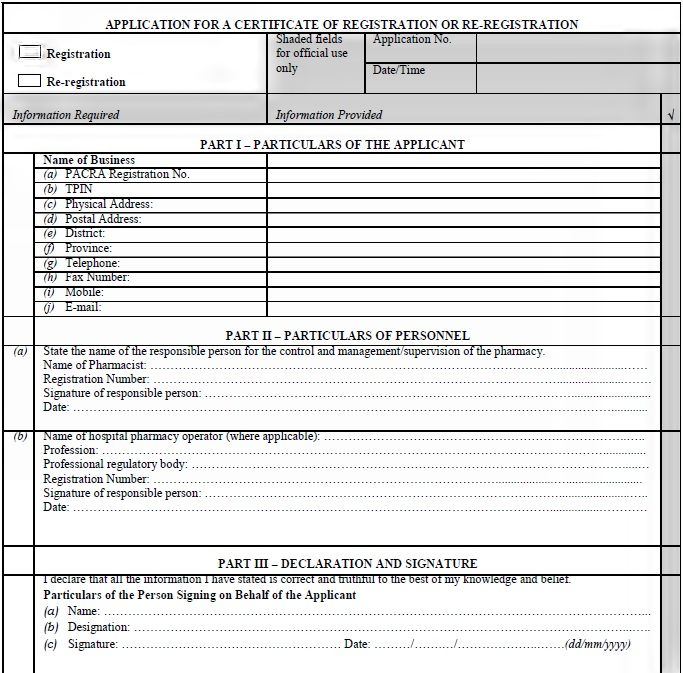
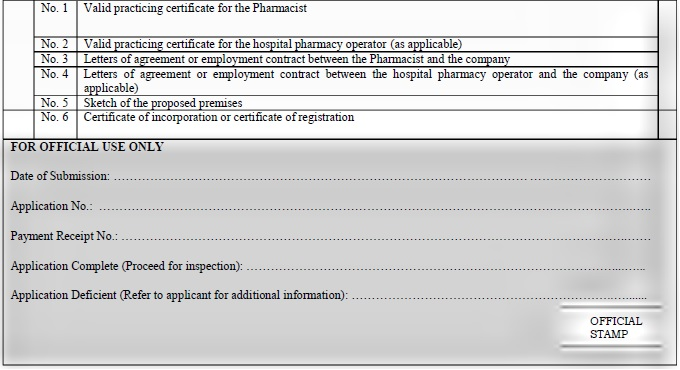
Form II
[Regulation 3]
|
|
|
The Medicines and Allied Substances Act, 2013 |
|
The Medicines and Allied Substances (Certificate of Registration) Regulations, 2017 |
|
REQUEST FOR ADDITIONAL INFORMATION |
|
Application No.: ……………… |
|
To: ………………………………………………………………………………………………………………………………. |
|
Physical address: |
|
Plot No.: ……………………………………………………………………………………………………………………….. |
|
Street: ………………………………………………………………………………………………………………………….. |
|
Postal address: ………………………………………………………………………………………………………………. |
|
District: ………………………………………………………………………………………………………………………… |
|
Province: ……………………………………………………………………………………………………………………….. |
|
You are requested to furnish, within ……………………….. days of this Notice, the following information or documents in respect of your application for …………………………………. |
|
(a) ………………………………………………………………………………………………………………………. |
|
(b) ………………………………………………………………………………………………………………………. |
|
(c) ………………………………………………………………………………………………………………………. |
|
(d) ………………………………………………………………………………………………………………………. |
|
(e) ………………………………………………………………………………………………………………………. |
|
If you fail to furnish the requested information within the stipulated period, your application will be treated as invalid and be rejected. |
|
|
|
Dated this …………. day of ……………………, 20…….. |
|
|
|
………………………………………. |
|
|
Form III
[Regulation 4]
|
|
|
The Medicines and Allied Substances Act, 2013 |
|
The Medicines and Allied Substances (Certificate of Registration) Regulations, 2017 |
|
CERTIFICATE OF REGISTRATION |
|
Application No.: ………………. |
|
|
|
This is to certify that (Name of Pharmacy): ……………………………………………………………………………. |
|
of (physical address) ……………………………………………………………………………………………………….. |
|
…………………………………………………………………………………………………………………………………… |
|
is registered as a Pharmacy. |
|
The terms and conditions of the certificate of registration are attached herewith. |
|
This Certificate is issued on the ………….. day of ……………………., 20……….. |
|
|
|
……………………………………….. |
|
|
|
(OVERLEAF) |
|
TERMS AND CONDITIONS |
|
1. The certificate of registration shall be displayed conspicuously on the premises. |
|
2. The holder of the certificate of registration shall, within 14 days of the changes occurring, notify the Authority of any changes in the ownership, physical address, structure of the place of business, name and location of the pharmacy, change of personnel responsible for the management or control of the pharmacy. |
|
3. The holder of the certificate of registration shall submit annual returns or no change returns by 31st March of the following financial year. |
|
4. The certificate of registration is not transferable without the written approval of the Authority. |
|
5. Where the certificate of registration is surrendered, the certificate of registration shall be considered cancelled. |
|
6. Where the certificate of registration is cancelled, the holder of the certificate shall surrender it to the Authority. |
|
7. Non-compliance with the terms and conditions of the certificate of registration shall result in the suspension or cancellation of the certificate. |

Form IV
[Regulation 5]
|
|
|
The Medicines and Allied Substances Act, 2013 |
|
The Medicines and Allied Substances (Certificate of Registration) Regulations, 2017 |
|
NOTICE OF REJECTION OF APPLICATION |
|
1. Here insert the full names and address of the applicant |
To (1) …………………………………………………………………………………………….. |
|
……………………………………………………………………………………………………. |
|
|
2. Here insert the reference No. of the application |
IN THE MATTER OF (2) …………………………..…………….…………….. you are hereby notified that your application for (3) ………………… has been rejected on the following grounds: |
|
3. Here insert type of application |
(a) ……………………………………………………………………………………………….. |
|
(b) ……………………………………………………………………………………………….. |
|
|
(c) ……………………………………………………………………………………………….. |
|
|
(d) ……………………………………………………………………………………………….. |
|
|
Dated this ………… day at …………………., 20……… |
|
|
|
|
|
………………………………………. |
|
|
|
Form V
[Regulation 6(1)]
|
|
|
The Medicines and Allied Substances Act, 2013 |
|
The Medicines and Allied Substances (Certificate of Registration) Regulations, 2017 |
|
ANNUAL RETURN ( ) NO CHANGE RETURN ( ) |
|
PART I: PARTICULARS OF CERTIFICATE HOLDER |
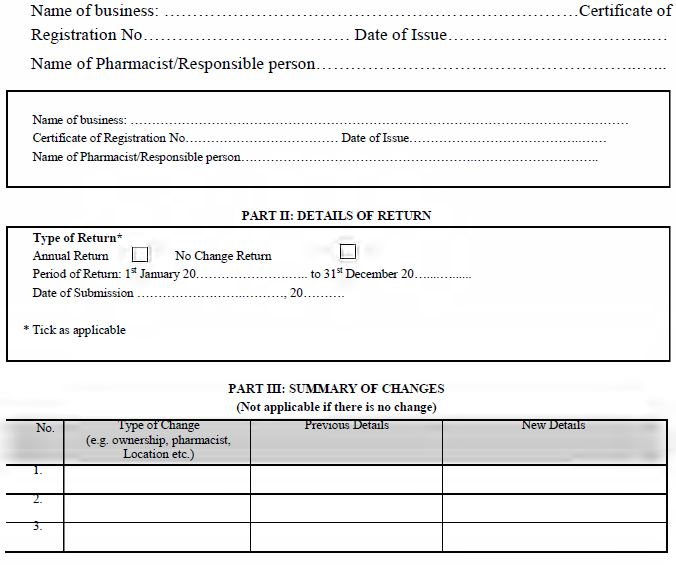
Form VI
[Regulation 7]
|
|
|
The Medicines and Allied Substances Act, 2013 |
|
The Medicines and Allied Substances (Certificate of Registration) Regulations, 2017 |
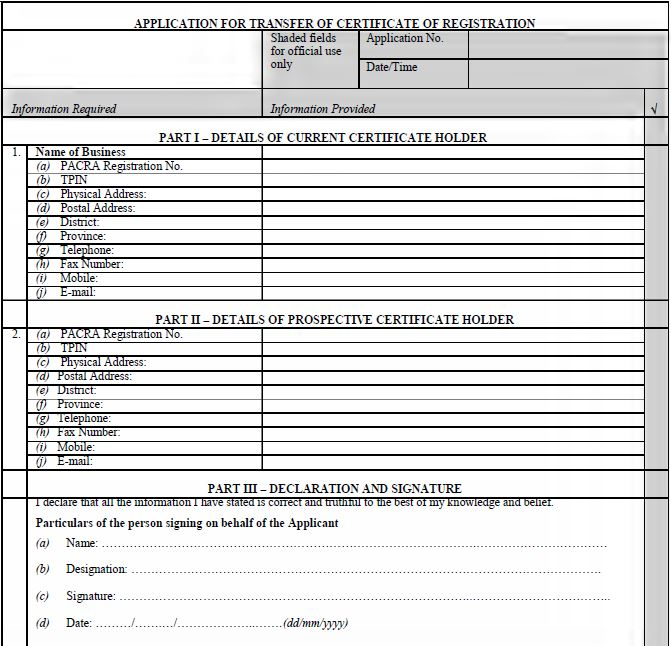
|
PART IV – ENCLOSURES |
|
Evidence of transfer between certificate holder and the prospective certificate holder |
|
FOR OFFICIAL USE ONLY |
|
Date of Submission: ……………………………………………………………………………………………………… |
|
Application No.: …………………………………………………………………………………………………………… |
|
Payment Receipt No.: …………………………………………………………………………………………………… |
|
Application Complete (Proceed for evaluation): ……………………………………………………………………. |
|
Application Deficient (Refer to applicant for additional information): ……………………………………………. |
|
|
Form VII
[Regulation 8]
|
|
|
The Medicines and Allied Substances Act, 2013 |
|
The Medicines and Allied Substances (Certificate of Registration) Regulations, 2017 |
|
NOTIFICATION OF AMENDMENT OF CERTIFICATE OF REGISTRATION |
|
PART I: PARTICULARS OF CERTIFICATE HOLDER |
|
Name of business: …………………………………………………………………………………………….. |
|
Certificate of Registration No.: ……..…………………………… Date of issue ………………………….. |
|
Name of Pharmacist/Responsible person …………………………………………………………………… |
|
PART I: PARTICULARS OF AMENDMENT |
|
|
No. |
Description of amendment(s) |
|
1. |
|
|
2. |
|
|
3. |
|
SUMMARY OF THE AMENDMENT |
|||
|
EXISTING |
PROPOSED AMENDMENT |
DATE OF AMENDMENT |
REASONS FOR AMENDMENT |
|
|
|
|
|
|
|
|
|
|
|
|
|
|
|
|
|
|
|
|
|
PART III: SUPPORTING DOCUMENTATION |
|||
|
Please submit documents, where applicable, to support your application for amendment. |
|||
|
PART IV: DECLARATION AND SIGNATURE |
|
I declare that all the information I have stated is correct and truthful to the best of my knowledge and belief. |
|
Particulars of the Person Signing on Behalf of the Applicant |
|
(a) Name: …………………………………………………………………………………………………………… |
|
(b) Designation: ……………………………………………………………………………………………………. |
|
(c) Signature: ………………………………. (d) Date: …………./………./…………….. (dd/mm/yyyy) |
|
FOR OFFICIAL USE ONLY |
|
Date of Submission: ……………………………………………………………………………………………………… |
|
Application No.: …………………………………………………………………………………………………………… |
|
Payment Receipt No.: …………………………………………………………………………………………………… |
|
Application Complete (Proceed for evaluation): ……………………………………………………………………. |
|
Application Deficient (Refer to applicant for additional information): ……………………………………………. |
|
|
Form VIII
[Regulation 9(1)]
|
|
|
The Medicines and Allied Substances Act, 2013 |
|
The Medicines and Allied Substances (Certificate of Registration) Regulations, 2017 |
|
NOTICE OF INTENTION TO SUSPEND OR CANCEL CERTIFICATE OF REGISTRATION |
|
Certificate of Registration No.: ……………… |
|
To: ………………………………………………………………………………………………………. |
|
…………………………………………………………………………………………………………… |
|
IN THE MATTER OF ………………………………………….. you are hereby notified that the Authority intends to |
|
(a) …………………………………………………………………………………………………………………… |
|
(b) …………………………………………………………………………………………………………………… |
|
(c) …………………………………………………………………………………………………………………… |
|
(d) …………………………………………………………………………………………………………………… |
|
Accordingly, you are requested to show cause why your certificate of registration should not be |
|
Dated this ………. day of ……………………., 20……. |
|
|
|
…………………………………… |
|
|
Form IX
[Regulation 9(2)]
|
|
|
The Medicines and Allied Substances Act, 2013 |
|
The Medicines and Allied Substances (Certificate of Registration) Regulations, 2017 |
|
NOTICE OF |
|
Certificate of Registration No.: ……………. |
|
To: ………………………………………………………………………………………………………. |
|
…………………………………………………………………………………………………………… |
|
IN THE MATTER OF ……………………… you are hereby notified that your certificate of registration has been |
|
(a) …………………………………………………………………………………………………………………… |
|
(b) …………………………………………………………………………………………………………………… |
|
(c) …………………………………………………………………………………………………………………… |
|
(d) …………………………………………………………………………………………………………………… |
|
In case of cancellation, you are required to surrender the certificate of registration to the Authority within seven days from the date of cancellation. |
|
Dated this ……….. day of ……………………., 20……… |
|
|
|
……………………………………. |
|
|
Form X
[Regulation 11(1)]
|
|
|
The Medicines and Allied Substances Act, 2013 |
|
The Medicines and Allied Substances (Certificate of Registration) Regulations, 2017 |
|
APPLICATION FOR DUPLICATE CERTIFICATE OF REGISTRATION |
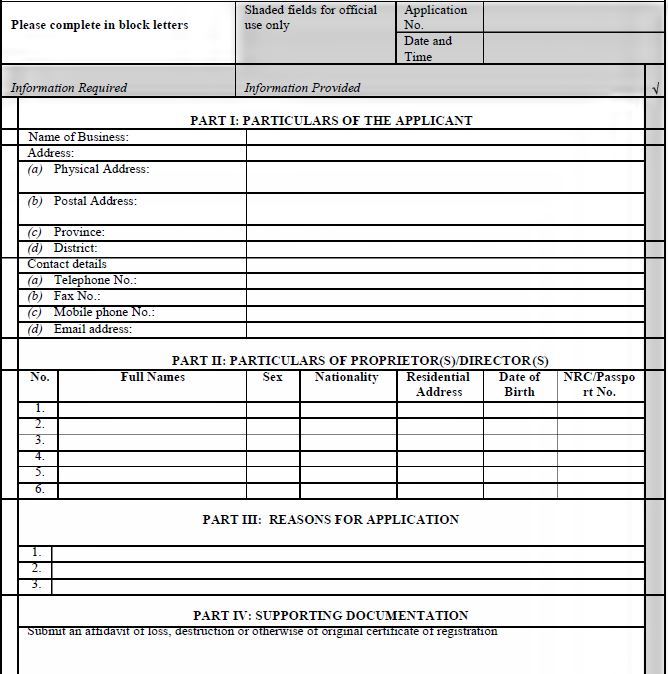
Form XI
[Regulation 11(2)]
|
|
|
The Medicines and Allied Substances Act, 2013 |
|
The Medicines and Allied Substances (Certificate of Registration) Regulations, 2017 |
|
DUPLICATE CERTIFICATE OF REGISTRATION |
|
No.: ……………. |
|
This is to certify that (Name of Pharmacy) ………………………………………………………………………….. |
|
………………………………………………………………………………………………………………………………… |
|
of (physical address) ……………………………………………………………………………………………………. |
|
………………………………………………………………………………………………………………………………… |
|
is registered as a Pharmacy. |
|
The conditions of the certificate of registration are attached herewith. |
|
This certificate is issued on ………. day of ……………….., 20…….. |
|
|
|
…………………………………. |
|
|
Form XII
[Regulation 12(1)]
|
|
|
The Medicines and Allied Substances Act, 2013 |
|
The Medicines and Allied Substances (Certificate of Registration) Regulations, 2017 |
|
REGISTER OF CERTIFICATES OF REGISTRATION |
|
No. |
Name and Address of Pharmacy |
Certificate Number |
Date of Issue |
Date of Suspension/Cancellation |
|
1. |
|
|
|
|
|
2. |
|
|
|
|
|
3. |
|
|
|
|
|
4. |
|
|
|
|
|
5. |
|
|
|
|
|
6. |
|
|
|
|
|
7. |
|
|
|
MEDICINES AND ALLIED SUBSTANCES (PHARMACEUTICAL LICENCE) REGULATIONS
[Section 34]
Arrangement of Regulations
Regulation
1. Title
2. Interpretation
3. Application for licence
4. Request for additional information
5. Rejection of application for licence
6. Issuance of licence
7. Renewal of licence
8. Transfer of licence
9. Amendment of licence
10. Duplicate licence
11. Suspension of licence
12. Revocation of licence
13. Handling of expired, withdrawn, obsolete or unwanted medicines
14. Inspection
15. Exemption
16. Register of licences
17. Distribution and wholesale by manufacturer
18. Personnel in wholesale premises
19. General penalty
SI 91 of 2018.
These Regulations may be cited as the Medicines and Allied Substances (Pharmaceutical Licence) Regulations.
In these Regulations unless the context otherwise requires—
“authorised product” means a product for which marketing authorisation has been granted in accordance with section 39 of the Act;
“good manufacturing practice” means quality assurance that ensures that a pharmaceutical product is produced and controlled to the quality standards appropriate for its intended use and as required by the marketing authorisation;
“insanitary condition” means a condition or circumstance that could cause contamination of a medicine or allied substance with dirt or filth or could render the medicine or allied substance injurious or dangerous to health;
“licence” means a pharmaceutical licence issued under section 34 of the Act;
“licensee” means a holder of a licence;
“pharmacist” means a person registered as a pharmacist in accordance with the Health Professions Act, 2009;
“pharmacy technologist” means a person registered as a pharmacy technologist in accordance with the Health Professions Act, 2009;
“phase I clinical trial” means the first trial of a new active ingredient or new formulation in humans or target animal species, often carried out in healthy participants or volunteers to establish a preliminary evaluation of safety, and a first outline of the pharmacokinetic and, where possible, a pharmacodynamic profile of the active ingredient in humans or target animal species;
“phase II clinical trial” means a pilot clinical trial undertaken in selected populations of patients with the disease or condition intended to be prevented, diagnosed or treated in order to evaluate the safety and efficacy of the medicine or allied substance being tried;
“primary repackaging” means the part of manufacturing that involves packing of the finished dosage form or device into its primary packaging material;
“repacking of medicine” means the act of removing a preparation from its original primary container and placing it into a patient pack, but does not include the act of cutting a blister pack;
“responsible person” means a pharmacist, veterinary surgeon, veterinary para professional or pharmacy technologist;
“secondary repackaging” means the part of manufacturing that involves repacking of medicines into secondary or tertiary packaging material which does not come in direct contact with the finished dosage form or device;
“suitably qualified person” means a pharmacist or veterinary surgeon providing supervisory services to a wholesale outlet;
“veterinary biological” means a virus, vaccine, serum or analogous products used for the purpose of diagnosis or treatment of animal diseases;
“veterinary para professional” means a person registered as a livestock officer or veterinary assistant in accordance with the Veterinary and Veterinary Para Professions Act, 2010;
“veterinary surgeon” means a person registered as a veterinary surgeon in accordance with the Veterinary and Veterinary Para Professions Act, 2010; and
“wholesale” means the buying of medicines or allied substances in bulk for the purpose of reselling to authorised pharmaceutical wholesale dealers, retail pharmacy outlets, hospital pharmacies, agro-veterinary shops, health shops or other health facilities for human beings or animals.
(1) A person who intends to manufacture, distribute or deal in any medicine or allied substance shall apply to the Authority for a licence in Form I set out in the Schedule, on payment of the prescribed fee.
(2) A person who intends to manufacture, distribute or deal in any medicine or allied substance at more than one premises shall apply for a licence in respect of each of the premises.
(3) The Authority shall inspect the premises in respect of which an application for a licence is made to determine if the applicant meets the requirements of the Act and the guidelines issued by the Authority from time to time.
4. Request for additional information
The Authority may request an applicant to submit additional information in relation to an application for a licence in Form II set out in the Schedule.
5. Rejection of application for licence
(1) The Authority shall reject an application for a licence if the—
(a) applicant fails to comply with a condition precedent to the issue of the licence;
(b) applicant fails to meet the requirements of the Act;
(c) licence previously issued to the applicant was revoked by the Authority within the period of five years preceding the date of application; or
(d) applicant is convicted of an offence under the Act or any other relevant written law within a period of two years preceding the date of the application.
(2) The Authority shall, where it rejects an application under sub-regulation (1), inform the applicant of the reason for that rejection in Form III set out in the Schedule.
(1) The Authority shall, where the applicant meets the requirements of the Act, issue a licence in Form IV set out in the Schedule.
(2) A licence is valid for two years from the date of issue.
(3) A responsible person shall manage the premises in respect of which a licence has been issued.
(1) A licensee who intends to renew that licensee’s licence shall, at least 90 days before the expiry of the licence, apply to the Authority for renewal of the licence in Form V set out in the Schedule, on payment of the prescribed fee.
(2) The Authority may renew a licence in respect of an application if the applicant meets the requirements of the Act and complies with the terms and conditions of the earlier licence.
(3) The Authority shall, where it renews a licence, issue a new licence.
(4) A licence that is not renewed by the Authority shall lapse on its date of expiry.
(1) A licence shall be used solely by the licensee and is not transferable to any other person without the prior approval of the Authority.
(2) A licensee who intends to transfer the licensee’s licence shall apply to the Authority for approval to transfer the licence in Form VI set out in the Schedule, on payment of the prescribed fee.
(3) The Authority shall, where it approves the transfer of a licence, issue the transferee with a licence for the remainder of the validity period of the licence issued to the transferor.
(4) The Authority shall reject an application for the transfer of a licence if the applicant fails to comply with the conditions for the grant of the licence and the provisions of the Act and the guidelines issued by the Authority.
(5) The Authority shall, where it rejects an application to transfer a licence in accordance with sub-regulation (4), inform the applicant of the reasons for the rejection in Form III set out in the Schedule.
(1) A licensee who intends to amend the licensee’s licence shall apply to the Authority for amendment of the licence in Form VII set out in the Schedule, upon payment of the prescribed fee.
(2) The Authority may amend a licence where the name of the business or the suitably qualified person changes.
(3) The Authority shall, within 14 days of receipt of the application for amendment of the licence, approve or reject the amendment.
(4) Where the Authority fails to inform the licensee of its decision within 14 days, the amendment shall be considered to be approved.
A licensee may, where a licence is lost, damaged or defaced, apply to the Authority for a duplicate licence in Form VIII set out in the Schedule, upon payment of the prescribed fee.
(1) The Authority shall suspend a licence if the licensee—
(a) operates the business in respect of which it is issued under insanitary conditions;
(b) obtains or sells medicine from an unauthorised supplier or stock or sell an unauthorised product;
(c) fails to maintain the required records on medicines or allied substances; or
(d) contravenes the terms and conditions of the licence or the provisions of the Act or any other relevant written law.
(2) The Authority shall, before suspending a licence, give notice to the licensee of the intention to suspend the licence and request the licensee to show cause, within a specified period, why the licence should not be suspended.
(3) A notice of intention to suspend a licence shall be in Form IX set out in the Schedule.
(4) The Authority shall suspend a licence if the licensee fails to take remedial measures within the period specified in the notice issued in accordance with sub-regulation (2).
(5) A notice of suspension of a licence shall be in Form X set out in the Schedule.
(6) A product affected by the suspension of the licence shall be quarantined at the cost of the licensee during the period of the suspension of the licence.
(7) The Authority shall, where it is established that the licensee manufactures, distributes or deals in a medicine or allied substance under insanitary conditions, direct the licensee to dispose of that medicine or allied substance.
(1) The Authority shall revoke a licence if the licensee—
(a) contravenes the provisions of the Act or breaches the terms and conditions of the licence;
(b) fails to take corrective measures following the suspension of the licence;
(c) changes the business premises without authorisation;
(d) fails to comply with any other relevant written law; or
(e) obtained the licence by fraud or deliberate or negligent submission of false information or statements.
(2) The Authority shall, before revoking a licence, give notice to the licensee of the intention to revoke the licence and request the licensee to show cause, within a specified period, why the licence should not be revoked.
(3) A notice of intention to revoke a licence shall be in Form IX set out in the Schedule.
(4) The Authority shall revoke a licence if the licensee fails to take remedial measures during the period specified by the Authority.
(5) A notice of revocation of a licence shall be in Form X set out in the Schedule.
(6) Where a licence is revoked, the products on the premises and the recalled products shall be quarantined as directed by the Authority at the former licensee’s cost, including the disposal of the products.
(7) The Authority may, where the former licensee fails to comply with a directive issued by the Authority in accordance with sub-regulation (6), deal with the products in a manner the Authority may consider appropriate.
13. Handling of expired, withdrawn, obsolete or unwanted medicines
(1) A licensee shall store a withdrawn, obsolete, unwanted, expired medicines or allied substance in an appropriate container clearly labelled “for destruction within a specified period of time” as stipulated in the guidelines.
(2) A person who contravenes sub-regulation (1) commits an offence and is liable, upon conviction, to a fine not exceeding two thousand five hundred penalty units, and in the case of a continuing offence to a fine not exceeding twenty-five penalty units for each day that the offence continues.
(3) In addition to the penalty provided in sub-regulation (2), the court before which a person is convicted of an offence in accordance with this regulation may order—
(a) that any medicine or allied substance in respect of which the offence is committed be forfeited to the State; and
(b) that the costs for disposal of a medicine or allied substance be borne by the convict.
The Authority may conduct an inspection to ensure compliance with the minimum prescribed requirements for the manufacture, distribution or dealing of a medicine or allied substance.
These Regulations do not apply to a medicine or allied substance manufactured in accordance with guidelines issued by the Authority if the medicine is—
(a) for a pre-clinical trial, phase I clinical trial or phase II clinical trial;
(b) compounded by a—
(i) pharmacist for supply within the pharmacy or hospital setting; or
(ii) veterinary surgeon for supply within an agro veterinary shop or health facility for animals;
(c) a human or veterinary biological medicine manufactured by a Government institution for purposes of disease prevention and control; or
(d) a blood product prepared by a veterinary surgeon for administration to animals under that veterinary surgeon’s care.
(1) The Authority shall keep and maintain a register of licences in Form XI set out in the Schedule.
(2) The register referred to in sub-regulation (1) shall be kept at the offices of the Authority and shall be open to inspection by the public at such times and upon payment of the prescribed fee.
(3) A person may, upon payment of the prescribed fee, require a copy or extract of any particulars from the register to be certified by the Director General.
(4) Any document purported to be an extract or copy of any entry in the register and duly certified to be a true copy or extract under the hand of the Director General shall be received in evidence as to the matters stated therein in any legal proceedings.
17. Distribution and wholesale by manufacturer
(1) A licensee that is a manufacturer may distribute or undertake the wholesale of medicines or allied substances manufactured under that licence.
(2) Despite sub-regulation (1), a licensee that is a manufacturer dealing in medicines or allied substances manufactured by another manufacturer shall not undertake the wholesale of the medicines or allied substances manufactured by the other manufacturer.
(3) A manufacturer that intends to undertake the wholesale of a medicine or allied substance manufactured by another manufacturer shall apply to the Authority for a separate licence.
18. Personnel in wholesale premises
(1) A licensee that is a wholesale dealer in medicines or allied substances for the use in or on humans or animals shall employ a pharmacist on a full time basis for purposes of the wholesale of the medicines or allied substances and may, in addition to the pharmacist, employ a pharmacy technologist.
(2) A licensee that is a wholesale dealer in medicines or allied substances for use in or on animals shall employ a veterinary surgeon on a full time basis for the purposes of the wholesale of the medicines or allied substances and may, in addition to the veterinary surgeon, employ a veterinary para professional.
(3) A licensee that is a wholesale dealer and employs a pharmacist or veterinary surgeon on a part time basis for purposes of the wholesale of medicines or allied substances shall, in addition to the veterinary surgeon or pharmacist, employ a pharmacy technologist or veterinary para professional on a full time basis, as the case may be.
A person who contravenes a provision of these Regulations for which a penalty is not provided commits an offence and is liable, upon conviction, to a fine not exceeding two thousand five hundred penalty units, and in the case of a continuing offence to a fine not exceeding twenty-five penalty units for each day that the offence continues.
SCHEDULE
[Regulations 3, 4, 5, 6, 7, 8, 9, 10, 11, 12 and 16]
PRESCRIBED FORMS
FORM I
[Regulation 3(1)]
|
|
|
ZAMBIA MEDICINES REGULATORY AUTHORITY |
|
The Medicines and Allied Substances Act, 2013 |
|
The Medicines and Allied Substances (Pharmaceutical Licence) Regulations, 2018 |

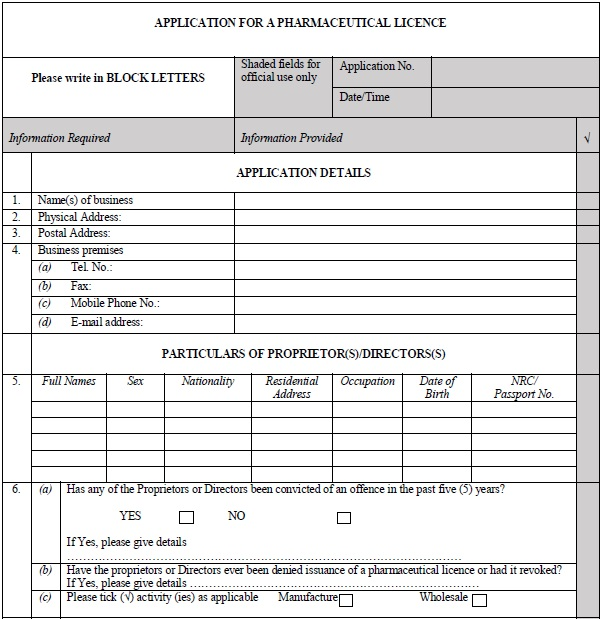
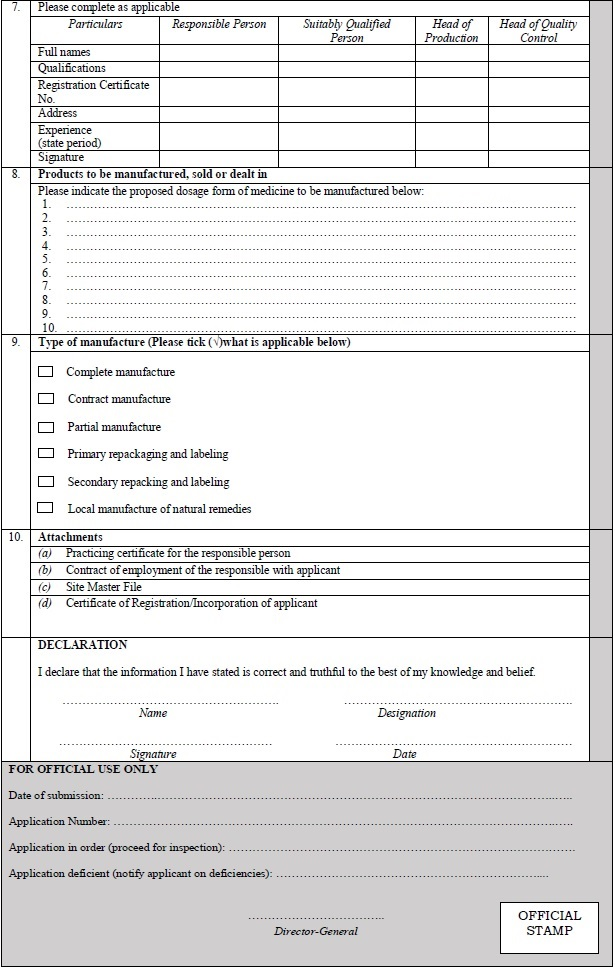
FORM II
[Regulation 4]
|
|
|
ZAMBIA MEDICINES REGULATORY AUTHORITY |
|
The Medicines and Allied Substances Act, 2013 |
|
The Medicines and Allied Substances (Pharmaceutical Licence) Regulations, 2018 |
|
REQUEST FOR ADDITIONAL INFORMATION |
|
To: ………………………………………………………………………..……..……………………………. |
|
Address: …………………………………………………………….…..……..……………………………. |
|
Application No.: ……………………………………………………………………………………………… |
|
You are requested to furnish the following information or documents in respect of your application for .………………………… within …………..….. days of this notice. |
|
(a) …………………………………………………………………………………………………………. |
|
(b) …………………………………………………………………………………………………………. |
|
(c) …………………………………………………………………………………………………………. |
|
(d) …………………………………………………………………………………………………………. |
|
If you fail to furnish the requested information within the stipulated period, your application will be treated as invalid and be rejected. |
|
|
|
Dated this …………. day of ……………………….. 20…… |
|
|
|
…………………………….. |
|
|
FORM III
[Regulations 5(2) and 8(5)]
|
|
|
ZAMBIA MEDICINES REGULATORY AUTHORITY |
|
The Medicines and Allied Substances Act, 2013 |
|
The Medicines and Allied Substances (Pharmaceutical Licence) Regulations, 2018 |
|
NOTICE OF REJECTION OF APPLICATION |
|
(1) Here insert name and address of the applicant |
To (1) …………………………………………………………………………………… |
|
…………………………………………………………………………………………… |
|
|
(2) Here insert the reference No. of the application |
IN THE MATTER OF (2) ………………………………………….. you are notified that your application for (3) …………………………… has been rejected by the Authority on the following grounds: |
|
(3) Here insert type of application |
(a) ………………………………………………………………………………………. |
|
(b) ………………………………………………………………………………………. |
|
|
|
(c) ………………………………………………………………………………………. |
|
|
(d) ………………………………………………………………………………………. |
|
|
|
|
|
Dated this …………. day of ………………………… 20…… |
|
|
|
|
(4) Signature of Director-General |
(4) ………………………………………. |
|
|
FORM IV
[Regulation 6(1)]
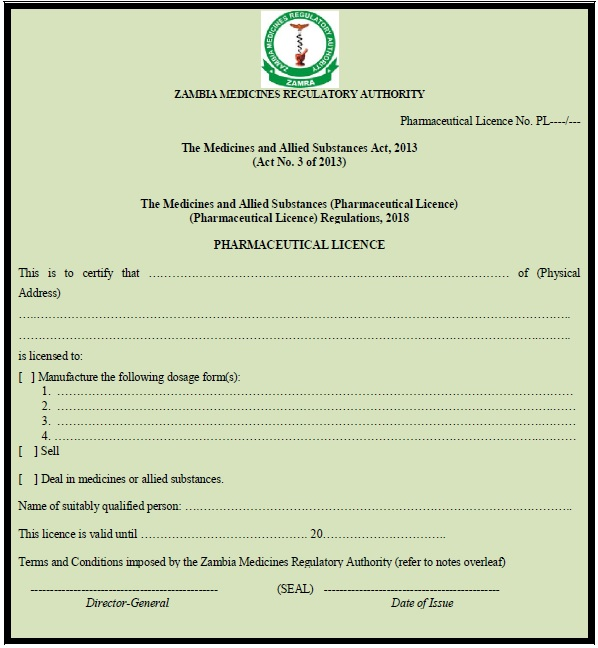
|
PHARMACEUTICAL LICENCE TERMS AND CONDITIONS |
|
Non-compliance with any of the conditions stated below will result in suspension or revocation of licence. |
|
The licensee shall— |
|
(a) comply with the minimum current good manufacturing practice (cGMP) or Good Distribution Practices (GDP) as may be applicable and cause to be obtained marketing authorisation in Zambia (where applicable) of all such products as are manufactured and conform to such other standards as may be specified by the Authority from time to time; |
|
(b) comply with relevant regulations and guidelines specific to the licence; |
|
(c) conspicuously display the licence at the premises where the activities conducted; |
|
(d) maintain such staff, premises, equipment and facilities for manufacture, or distribution of the medicinal products as applicable at the time of grant of the licence; |
|
(e) where the licensee is licensed to manufacture medicines or allied substances and wishes to manufacture additional dosage forms not included in the attached list, submit an application to the Authority for the inclusion of the additional dosage forms and this licence shall be deemed to extend to the dosage form so included; |
|
(f) keep readily available for inspection by an inspector of the Authority, durable records of documentation as specified in the guidelines; |
|
(g) notify the Authority of any changes that require an amendment to the licence; and |
|
(h) where the licence is revoked surrender it to the Authority immediately. |
FORM V
[Regulation 7(1)]
|
|
|
ZAMBIA MEDICINES REGULATORY AUTHORITY |
|
The Medicines and Allied Substances Act, 2013 |
|
The Medicines and Allied Substances (Pharmaceutical Licence) Regulations, 2018 |
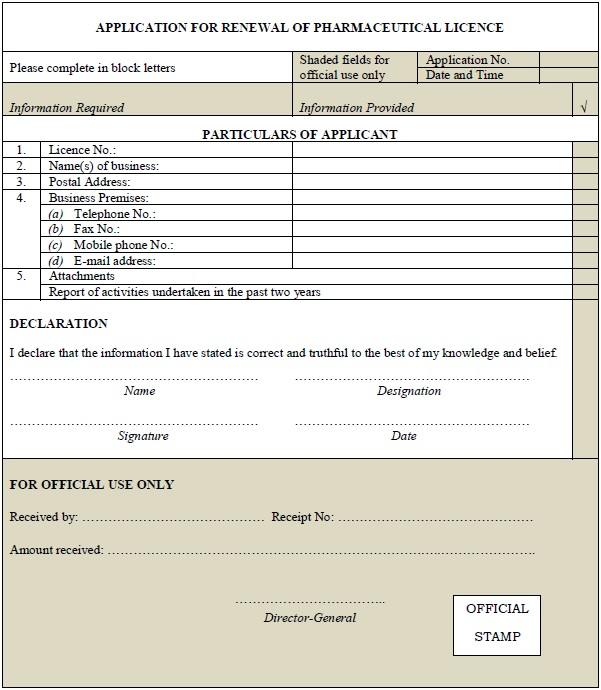
FORM VI
[Regulation 8(2)]
|
|
|
ZAMBIA MEDICINES REGULATORY AUTHORITY |
|
The Medicines and Allied Substances Act, 2013 |
|
The Medicines and Allied Substances (Pharmaceutical Licence) Regulations, 2018 |
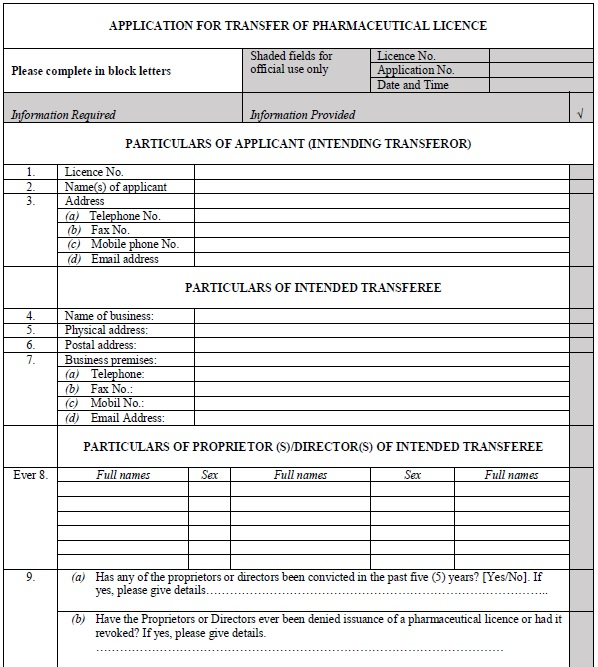
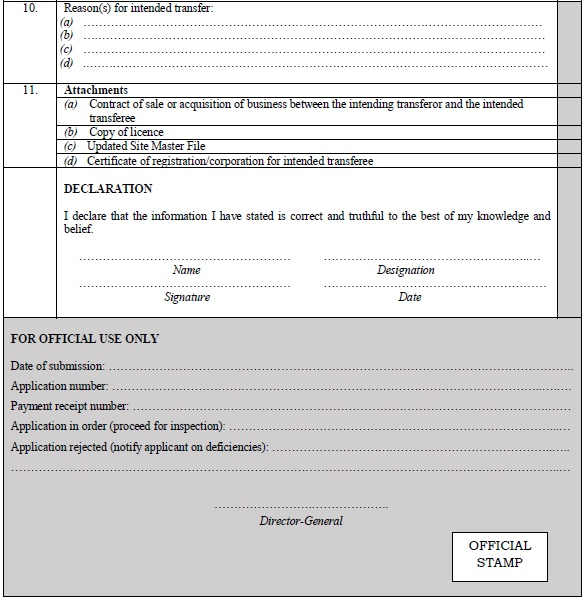
FORM VII
[Regulation 9(1)]
|
|
|
ZAMBIA MEDICINES REGULATORY AUTHORITY |
|
The Medicines and Allied Substances Act, 2013 |
|
The Medicines and Allied Substances (Pharmaceutical Licence) Regulations, 2018 |
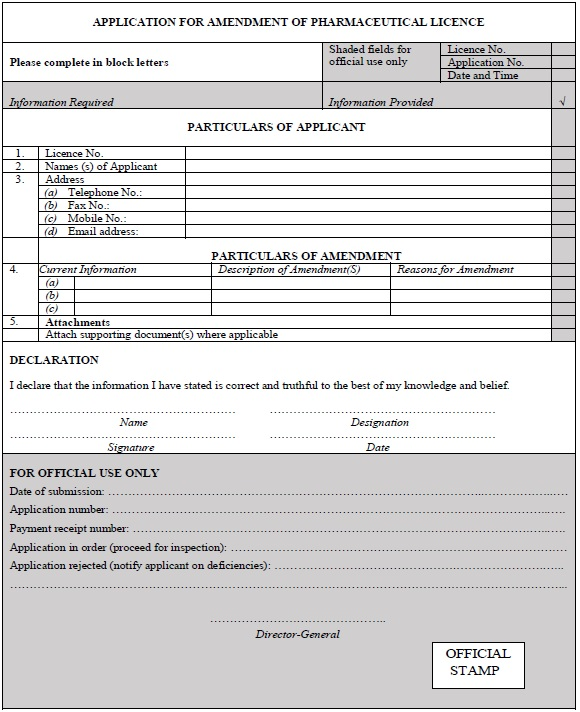
FORM VIII
[Regulation 10]
|
|
|
ZAMBIA MEDICINES REGULATORY AUTHORITY |
|
The Medicines and Allied Substances Act, 2013 |
|
The Medicines and Allied Substances (Pharmaceutical Licence) Regulations, 2018 |
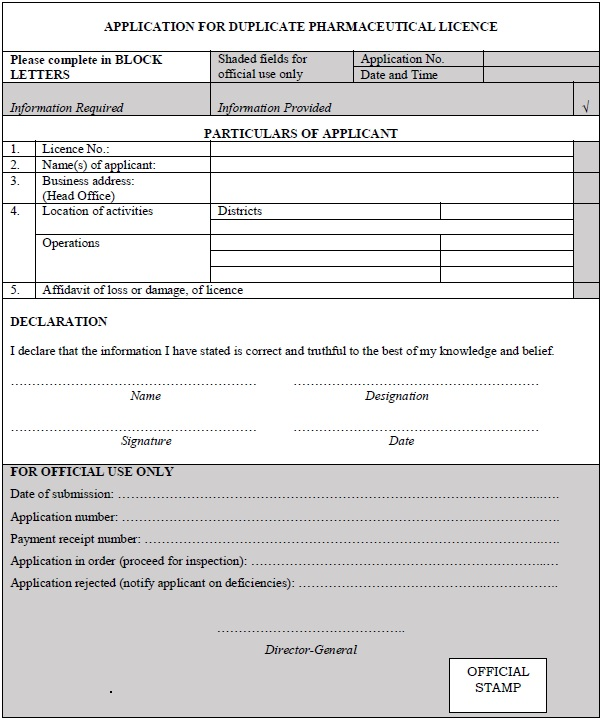
FORM IX
[Regulations 11(3) and 12(3)]
|
|
|
ZAMBIA MEDICINES REGULATORY AUTHORITY |
|
The Medicines and Allied Substances Act, 2013 |
|
The Medicines and Allied Substances (Pharmaceutical Licence) Regulations, 2018 |
|
NOTICE OF INTENTION TO |
|
(1) Here insert the full names and address of the licensee |
To (1) ………………………………………………………………………………………….. |
|
………………………………………………………………………………………………….. |
|
|
(2) Here insert the licence No. |
IN THE MATTER OF (2) ……………………………………… you are notified that the Authority intends to |
|
|
(a) …………………………………………………………………………………………….. |
|
|
(b) …………………………………………………………………………………… |
|
|
(c) ……………………………………………………………………………………. |
|
|
(d) …………………………………………………………….…………………….. |
|
|
Accordingly, you are requested to show cause why your licence should not be |
|
(3) Here insert type of application |
|
|
|
|
|
|
Dated this …………. day of …………………… 20…….. |
|
|
|
|
(4) Signature of Director-General |
(4) …………………………………….. |
|
|
|
FORM X
[Regulations 11(5) and 12(5)]
|
|
|
ZAMBIA MEDICINES REGULATORY AUTHORITY |
|
The Medicines and Allied Substances Act, 2013 |
|
The Medicines and Allied Substances (Pharmaceutical Licence) Regulations, 2018 |
|
NOTICE OF |
|
(1) Here insert the full names and address of the licensee |
To (1) ………………………………………………………………………………………….. |
|
………………………………………………………………………………………………….. |
|
|
(2) Here insert the licence No. |
IN THE MATTER OF (2) …………………………………………………….. you are notified that your licence has been |
|
(3) Here insert number of days stipulated |
(a) ……………………………………………………………………………………………. |
|
(b) ………………………………………………………………………………….. |
|
|
(c) ………………………………………………………………………………….. |
|
|
(d) …………………………………………………………………………………… |
|
|
|
Dated this ………….. day of …………………. 20…….. |
|
|
|
|
(4) Signature of Director-General |
(4) ………………………………… |
|
|
|
FORM XI
[Regulation 16(1)]
|
|
|
ZAMBIA MEDICINES REGULATORY AUTHORITY |
|
The Medicines and Allied Substances Act, 2013 |
|
The Medicines and Allied Substances (Pharmaceutical Licence) Regulations, 2018 |
|
REGISTER OF PHARMACEUTICAL LICENCES |
|
No. |
Name of Licensee |
Licence Number |
Date of Issue |
Expiry Date |
|
1. |
|
|
|
|
|
2. |
|
|
|
|
|
3. |
|
|
|
|
|
4. |
|
|
|
|
|
5. |
|
|
|
|
|
6. |
|
|
|
|
|
7. |
|
|
|
MEDICINES AND ALLIED SUBSTANCES (MARKETING AUTHORISATION OF MEDICINES) REGULATIONS
[Sections 39 and 69]
Arrangement of Regulations
Regulation
PART I
PRELIMINARY PROVISIONS
1. Title
2. Interpretation
PART II
MARKETING AUTHORISATION OF MEDICINES
3. Application for marketing authorisation
4. Request for additional information
5. Grant of marketing authorisation
6. Rejection of application
7. Validity of marketing authorisation
8. Annual retention fee
9. Amendment of marketing authorisation
10. Surrender of marketing authorisation
11. Transfer of marketing authorisation
12. Suspension of marketing authorisation
13. Restoration of marketing authorisation
14. Revocation of marketing authorisation
15. Application for duplicate marketing authorisation
16. Renewal of marketing authorisation
17. Local responsible person
PART III
CATEGORY OF DISTRIBUTION OF MEDICINE
18. Categories of distribution of medicines
19. Recategorisation of medicine
PART IV
LABELLING AND PACKAGING
20. Labelling and packaging requirements for medicine
21. Package insert for medicine
22. Patient information leaflet
23. Revocation of S.I. No. 47 of 1993
SI 79 of 2019.
PART I
PRELIMINARY PROVISIONS
These Regulations may be cited as the Medicines and Allied Substances (Marketing Authorisation of Medicines) Regulations.
In these Regulations, unless the context otherwise requires—
“active pharmaceutical ingredient” means a substance intended to exert pharmacological activity or other direct effect in the diagnosis, cure, mitigation, treatment or prevention of disease or to affect the structure and function of the body, and may be used as is or in the manufacture of a pharmaceutical dosage form;
“batch” means a defined quantity of a starting material, packaging or medicinal product processed in a single process or series of processes and expected to be homogeneous;
“bio-availability” means the rate and extent of availability of an active pharmaceutical ingredient from a dosage form as determined by its concentration time curve in the systemic circulation or by its excretion in urine;
“bio-equivalence data” means the absence of a significant difference in the rate and extent to which the active ingredient or active moiety in pharmaceutical alternatives becomes available at the site of drug action administered;
“commercial pack” means the presentation of a finished medicinal product as it will be placed on market;
“composition” means a tabulation of ingredients represented in form of proportion, degree of strength, quality and purity in which the ingredients are contained in a medicinal product;
“container” means a bottle, jar, box, packet, sachet or other receptacle, not being a capsule or other article, in which the product is or is to be administered or consumed, and where the receptacle is or is to be contained in another receptacle, includes the former receptacle but not the latter receptacle;
“description of the product” means a full visual description of the medicinal product, including colour, size, shape and other relevant features;
“dosage form” means the form in which a medicinal product is presented, such as solution, suspension, elixir, eye drop, emulsion, ointment, suppository, tablet or capsule;
“excipient” means a substance intended to be used as is or in the manufacture of a medicinal product for a specific function, but does not exert pharmacological activity;
“expiry date” means the date given by the manufacturer and placed on the container of a medicinal product up to which the product is expected to remain within the given specifications if stored according to manufacturer’s instructions;
“finished pharmaceutical product” means a product that has undergone all the stages of production, including packaging in its final container and labelling;
“formulation” means the composition of a dosage form, including the characteristics of its raw materials and the operations required to process it;
“general sale medicine (GS)” means a medicine which is intended to be supplied or sold without a prescription with or without the supervision of a registered pharmacist in a pharmacy or in any other licensed premises;
“general sale medicines veterinary (GSV)” means veterinary medicine which is intended to be supplied by any retailer approved by the Authority;
“herbal medicine” includes a herb, herbal material, herbal preparation and finished herbal product that contains as an active ingredient, a part of a plant or other plant material or combination;
“holder of marketing authorisation” means a person to whom a medicinal product has been issued a market authorisation and is responsible for all aspects of the medicinal product including quality, safety, efficacy and compliance with conditions of marketing authorisation;
“international non proprietary name” means a unique name of a medicine that is globally recognised and is public property;
“labelling” means affixing to or displaying on a container or package, the product information, ingredients and content of the product;
“local responsible person” means a person residing in Zambia and appointed in accordance with regulation 17;
“marketing authorisation number” means an identification number issued to a medicinal product granted marketing authorisation;
“pharmacy medicine (P)” means a medicine which is intended to be supplied or sold without a prescription but under the supervision of a registered pharmacist;
“pharmacy medicines veterinary (PV)” means veterinary medicine which is intended to be supplied by a registered veterinary surgeon, pharmacist or veterinary para professional with or without a prescription;
“prescription only medicine (POM)” means a medicine which is intended to be supplied, sold or dispensed only under a prescription issued by an authorised prescriber;
“prescription only medicine veterinary (POM V)” means veterinary medicines which is intended to be supplied on prescription by a veterinary surgeon;
“proprietary name” means the trade or brand name that is unique to a particular medicine and by which it is generally identified;
“quality standard” means the specifications used to control the nature, strength, purity, composition, quantity or other characteristics of an ingredient or finished pharmaceutical product to ensure that it is fit for its purpose;
“shelf life” means the period of time during which an active pharmaceutical ingredient or medicinal product, if stored correctly, is expected to comply with the approved specification as determined by stability studies on a number of batches of the active pharmaceutical ingredient or medicinal product;
“stability” means the ability of a medicine to retain its properties within approved specifications throughout its shelf life;
“WHO type certificate of a pharmaceutical product” means a certificate of the type defined in the World Health Organisation certification scheme on the quality of pharmaceutical products in international commerce; and
“veterinary medicine” means a substance or mixture of substances manufactured, sold or presented for use in—
(a) the diagnosis, treatment, mitigation or prevention of a disease, disorder, abnormal physical or mental state, or the symptoms thereof, in an animal;
(b) restoring, correcting or beneficial modification of organic or mental functions in an animal; and
(c) an article intended for use as a component of any article specified in paragraphs (a) or (b), but does not include a medical device or its component, part or accessory.
PART II
MARKETING AUTHORISATION OF MEDICINES
3. Application for marketing authorisation
(1) A person who intends to place a medicine on the market shall apply to the Authority for a marketing authorisation in Form I set out in the Schedule on payment of the fee set out in the Medicines and Allied Substances (Fees) Regulations, 2016.
(2) The application referred to in sub-regulation (1) shall be accompanied by—
(a) at least two samples of the product in the smallest proposed commercial pack size;
(b) a dossier which shall contain—
(i) a summary and overview of quality, non-clinical and clinical data;
(ii) chemical, pharmaceutical and biological data relevant to the application;
(iii) non-clinical data, where applicable; and
(iv) clinical or bio-equivalence data;
(c) in the case of a herbal medicine, documentation relating to the quality assessment, safety assessment and efficacy assessment of the herbal medicine; and
(d) any other information relating to the safety, quality and efficacy of the medicine in respect of which the application is made.
(3) The Authority shall, on receipt of an application for a marketing authorisation, conduct an assessment to evaluate the safety, quality and efficacy of the medicine in respect of which the application is made.
4. Request for additional information
The Authority may request an applicant to submit additional information or samples in relation to an application in Form II set out in the Schedule on payment of a prescribed fee.
5. Grant of marketing authorisation
The Authority shall grant a marketing authorisation in Form III set out in the Schedule, if the Authority is satisfied—
(a) with the information submitted on the safety, quality and efficacy of the medicine;
(b) with the labeling and packaging of the medicine;
(c) with the indications, dosage form, dosage and route of administration of the medicine; and
(d) that the medicine is manufactured in compliance with the requirements of current good manufacturing practices as recommended by the World Health Organisation or any other recognised entity.
(1) The Authority shall reject an application for marketing authorisation if—
(a) the applicant fails to meet the requirements for the issue of the marketing authorisation;
(b) there is insufficient data to support the safety, quality and efficacy of the product;
(c) in the case of a local manufacturer, the pharmaceutical licence to manufacture is suspended or revoked;
(d) an ingredient contained in the medicine is banned or not recommended for any other reason as determined by the Authority;
(e) the medicine in respect of which the application is made is considered unregistrable based on treatment guidelines or disease patterns in the Republic; and
(f) the applicant provides false information in the application.
(2) The Authority shall, where it refuses a marketing authorisation under sub-regulation (1), inform the applicant in Form IV set out in the Schedule.
7. Validity of marketing authorisation
A marketing authorisation is valid for five years, subject to the terms and conditions of the market authorisation.
(1) The holder of a marketing authorisation shall pay an annual retention fee to the Authority in respect of the following year at the end of every year during which the authorisation is valid, except the year when the authorisation is granted.
(2) The annual retention fee for the following year shall be—
(a) effective from 1st January of the year following the grant of the marketing authorisation; and
(b) paid to the Authority by 31st December of each year.
(3) Where a marketing authorisation is granted during the last quarter of a calendar year, the holder of the marketing authorisation shall be exempted from paying the annual retention fee for the following year.
(4) Where the holder of a marketing authorisation fails to pay the annual retention fee by 31st December for a particular product—
(a) the marketing authorisation issued in respect of that product shall be suspended;
(b) the Authority shall not authorise the importation of the product;
(c) in case of locally manufactured products, the Authority shall not authorise the continued manufacture of the product; and
(d) the marketing authorisation in respect of the product may be revoked by the Authority.
9. Amendment of marketing authorisation
(1) A person who wishes to amend a marketing authorisation shall apply to the Authority in Form V set out in the Schedule on payment of a prescribed fee.
(2) The Authority shall, within 90 days from the date of receipt of an application for the amendment of a marketing authorisation, consider the application and notify the holder of the marketing authorisation of its decision.
10. Surrender of marketing authorisation
Where the holder of a marketing authorisation decides not to continue with the business to which the marketing authorisation relates, the holder shall notify the Authority and surrender the marketing authorisation.
11. Transfer of marketing authorisation
(1) A marketing authorisation is solely for use by the holder of the marketing authorisation and is not transferable to any other person without the prior approval of the Authority.
(2) A person who wishes to transfer a marketing authorisation shall apply to the Authority in Form VI set out in the Schedule on payment of a prescribed fee.
(3) The Authority shall, within 60 days from the date of receipt of the application for the transfer of the marketing authorisation, notify the applicant of the decision of the Authority in respect of the application.
(4) Where the Authority approves the transfer of a marketing authorisation, it shall issue a new marketing authorisation to the transferee.
12. Suspension of marketing authorisation
(1) The Authority may suspend a marketing authorisation if—
(a) there are concerns regarding the safety, quality or efficacy of the medicine to which it relates;
(b) the holder of the marketing authorisation fails to pay the annual retention fee;
(c) the holder of the marketing authorisation fails to comply with any term or condition of the marketing authorisation; or
(d) the medicine in respect of which the marketing authorisation was issued poses a risk or threat to public health.
(2) The Authority shall, before suspending a marketing authorisation, give notice to the holder of a marketing authorisation of the intention to suspend the marketing authorisation in Form VII set out in the Schedule.
(3) The Authority shall, if the holder of a marketing authorisation fails to remedy the defects within the period specified by the Authority in the notice issued in sub-regulation (2), suspend the marketing authorisation and notify the holder of the marketing authorisation in Form VIII set out in the Schedule.
(4) The holder of a marketing authorisation shall, during the period of suspension of a marketing authorisation, quarantine the affected medicine as directed by the Authority at the holder of the marketing authorisation’s cost.
13. Restoration of marketing authorisation
(1) The Authority may restore a suspended marketing authorisation if the Authority is satisfied that corrective measures have been taken by the holder of the marketing authorisation as directed by the Authority.
(2) The Authority shall issue the notice of restoration of a suspended marketing authorisation in Form IX set out in the Schedule.
14. Revocation of marketing authorisation
(1) The Authority may revoke a marketing authorisation if the holder—
(a) contravenes the terms and conditions of the marketing authorisation;
(b) manufactures medicine that does not comply with the quality standard for that medicine;
(c) fails to comply with current good manufacturing practices;
(d) fails to comply with the terms and conditions for the suspension under regulation 12; or
(e) obtained the authorisation on the basis of fraud, negligence or misrepresentation.
(2) The Authority shall, before revoking a marketing authorisation, give notice to the holder of the marketing authorisation of the intention to revoke the marketing authorisation in Form X set out in the Schedule.
(3) The Authority shall, where the holder of a marketing authorisation fails to remedy the breaches specified in the notice within the period specified by the Authority, revoke the marketing authorisation and notify the holder in Form XI set out in the Schedule.
(4) The holder of a marketing authorisation shall, on the revocation of the marketing authorisation, recall and quarantine or dispose of the medicine to which the revocation relates as directed by the Authority at the holder of the marketing authorisation’s cost.
15. Application for duplicate marketing authorisation
(1) A holder of a marketing authorisation whose marketing authorisation is lost, defaced or damaged may apply for a duplicate marketing authorisation in Form XII set out in the Schedule on payment of a prescribed fee.
(2) The Authority shall, within 14 days of receipt of an application under sub-regulation (1), issue a duplicate marketing authorisation to the applicant.
16. Renewal of marketing authorisation
(1) A person who wishes to renew a marketing authorisation shall apply to the Authority at least 180 days before the expiry date of the marketing authorisation in Form XIII set out in the Schedule on payment of a prescribed fee.
(2) An application for the renewal of a marketing authorisation shall be accompanied by—
(a) a consolidated report of any amendments made to the marketing authorisation, including adverse drug reaction reports and safety updates; and
(b) the product quality review report.
(3) The Authority shall renew a marketing authorisation if the holder has complied with the terms and conditions of the marketing authorisation.
(4) The Authority shall, where the Authority refuses to renew a marketing authorisation, notify the applicant in Form IV set out in the Schedule.
(5) A holder of a marketing authorisation whose application for renewal has been rejected may submit an application for a marketing authorisation in accordance with regulation 3.
(1) Subject to the Companies Act, 2017 and any other relevant written law, a foreign based applicant shall appoint a local responsible person to—
(a) submit an application, document and sample of products to the Authority on behalf of the applicant or holder of the marketing authorisation; and
(b) receive the decision of the Authority relating to the application on behalf of the applicant or holder of the marketing authorisation.
(2) Subject to sub-regulation (1), where the application is granted, the holder of the marketing authorisation shall ensure that a local responsible person implements the pharmacovigilance plan on behalf of the foreign holder of the marketing authorisation.
PART III
CATEGORY OF DISTRIBUTION OF MEDICINE
18. Categories of distribution of medicines
(1) The Authority shall, where it grants a marketing authorisation, specify the appropriate category of distribution of the medicine which relates to the marketing authorisation.
(2) A person may sell or supply medicine for human use under the following categories—
(a) prescription only medicine;
(b) pharmacy medicine; and
(c) general sale medicine.
(3) A person may sell or supply veterinary medicine under the following categories—
(a) prescription only medicine-veterinary;
(b) pharmacy medicine veterinary; and
(c) general sale medicine veterinary.
19. Recategorisation of medicine
The Authority shall take into consideration the safety profile of the medicine when determining the category of distribution and may move certain medicines from one category to another.
PART IV
LABELLING AND PACKAGING
20. Labelling and packaging requirements for medicine
(1) A holder of a marketing authorisation shall label the primary package or container of a medicine to show—
(a) the name and dosage form of the medicine;
(b) the name and quantity of active pharmaceutical ingredient or in case of a herbal medicine, a botanical, English or other name, and the quantity of each ingredient;
(c) the quantity or volume of the medicine per unit pack;
(d) the indications and directions for use, including the target species in case of veterinary medicine;
(e) the storage instructions;
(f) the expiry date;
(g) the batch number;
(h) the marketing authorisation number;
(i) the name and address of the holder of the marketing authorisation;
(j) suitable coding;
(k) the name of the manufacturer, if different from the holder of the marketing authorisation;
(l) the category of distribution;
(m) a precautionary statement “Keep away from the reach of children”;
(n) in case of a veterinary medicine, a statement “For Veterinary Use Only”; and
(o) any other information required by the Authority for purposes of the Act.
(2) Where the space on a primary container of medicine is not adequate to accommodate the information specified in sub-regulation (1), the holder of a marketing authorisation shall label the primary container to indicate the—
(a) name and dosage form of the medicine;
(b) quantity or volume of the medicine per unit pack;
(c) expiry date;
(d) name and quantity of active ingredient, or in case of a herbal medicine, a botanical, English or other name, and the quantity of each ingredient;
(e) marketing authorisation number;
(f) storage instructions; and
(g) batch number, except that all the particulars specified under sub-regulation (1) shall be set out on the secondary package.
(3) A holder of a marketing authorisation shall, where the container of medicine is unable to accommodate the information under sub-regulation (2), indicate the details of labelling requirements for each type of container as may be determined by the Authority.
(4) This regulation does not apply to medicine that is repackaged for dispensing.
(5) Despite the other provisions of this regulation, the Authority may waive the labeling requirements, as appropriate, to ensure the safety, quality and efficacy of the medicine.
21. Package insert for medicine
An original container of a medicine shall be accompanied by a package insert printed in legible letters in English stating the—
(a) name and dosage form of the medicine;
(b) name and quantity of active pharmaceutical ingredient, or in case of a herbal medicine, a botanical, English or other name, and the quantity of each ingredient;
(c) indications, in case of a veterinary medicine, specifying target species;
(d) dosage and directions for use, in case of a veterinary medicine, specific to each target species;
(e) contra-indications;
(f) side effects;
(g) drug interactions;
(h) precautions and warnings, including withdrawal periods, in case of a veterinary medicine used in food producing animals;
(i) symptoms, signs, treatment and management of overdose;
(j) presentation of the medicine;
(k) description of packaging and container closure system;
(l) storage instructions;
(m) shelf life;
(n) name and address of the holder of the marketing authorisation; and
(o) name of the manufacturer, if different from the holder of the marketing authorisation.
22. Patient information leaflet
A holder of a marketing authorisation shall provide a patient information leaflet for general sale medicine and medicine used in chronic conditions.
23. Revocation of S.I. No. 47 of 1993
The Pharmacy and Poisons (Medicines) (Importation, Manufacture and Sale) Order, 1993, is revoked.
SCHEDULE
[Regulations 3, 4, 5, 6, 9, 11, 12, 13, 14, 15, 16 and 18]
PRESCRIBED FORMS
FORM I
[Regulations 3(1) and 16(5)]
(To be completed in triplicate)
|
|
|
The Medicines and Allied Substances Act, 2013 |
|
The Medicines and Allied Substances |

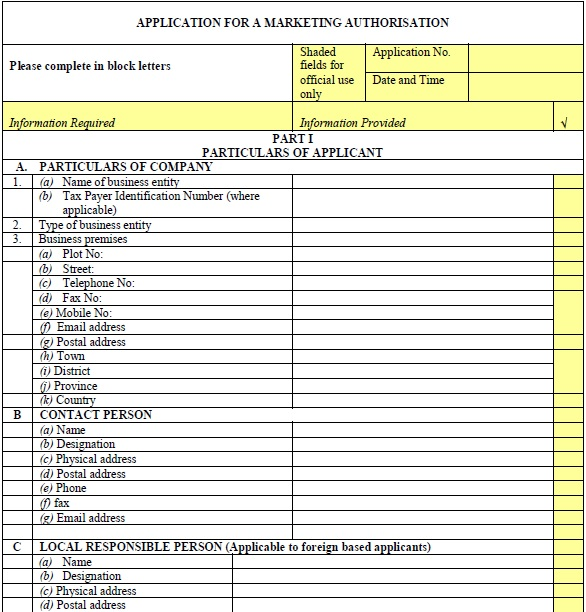
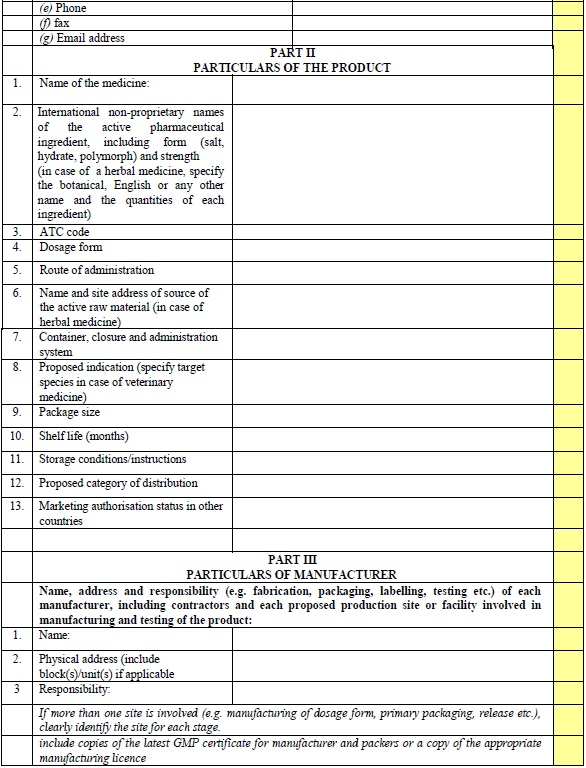
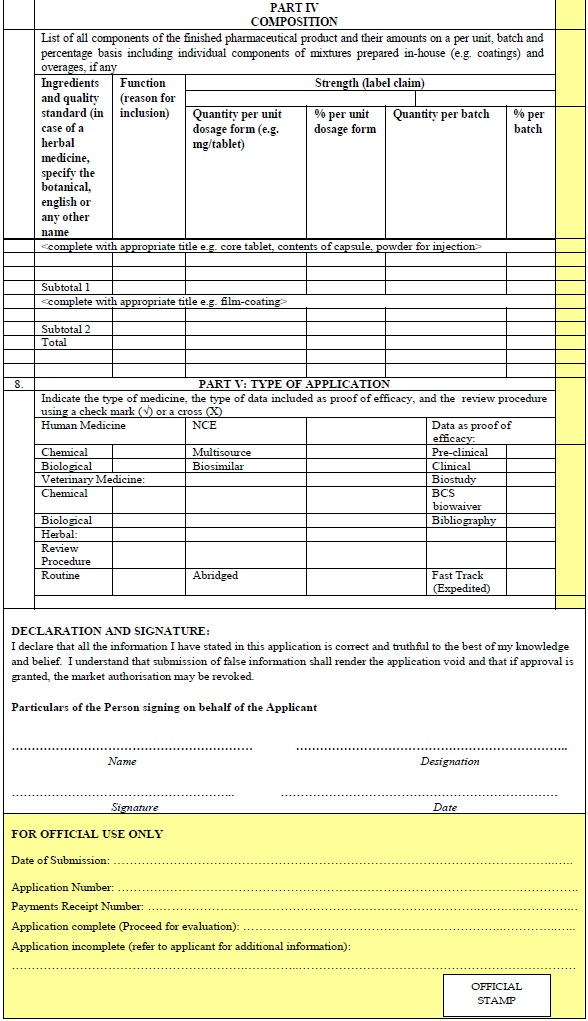
FORM II
[Regulation 4]
|
|
|
The Medicines and Allied Substances Act, 2013 |
|
The Medicines and Allied Substances |
|
REQUEST FOR ADDITIONAL INFORMATION |
|
Application No: ………………… |
|
To: ……………………………………………………………………………………………………………………… |
|
Address: ………………………………………………………………………………………………………………. |
|
You are requested to furnish, within ……………………………………. days of this Notice, the following information or documents in respect of your application for ………………………………………………… |
|
(a) ……………………………………………………………………………………………………………… |
|
(b) ……………………………………………………………………………………………………………… |
|
(c) ……………………………………………………………………………………………………………… |
|
(d) ……………………………………………………………………………………………………………… |
|
If you fail to furnish the requested information within the stipulated period, your application will be treated as invalid and shall be rejected. |
|
Dated this ………… day of ………………….., 20…… |
|
|
|
……………….…………………. |
|
|
FORM III
[Regulation 5]
|
|
|
The Medicines and Allied Substances Act, 2013 |
|
The Medicines and Allied Substances |
|
MARKETING AUTHORISATION |
|
Marketing Authorisation No. MA ……/…… |
|
Name of Medicine: ………………………………………………………………………………………. |
|
Dosage form: …………………………………………………………………………………………….. |
|
Pack size |
Shelf life (Months) |
Category of distribution |
|
…………………………..…. |
…………………………..…. |
…………………………..…. |
|
…………………………..…. |
…………………………..…. |
…………………………..…. |
|
…………………………..…. |
…………………………..…. |
…………………………..…. |
|
Name of active ingredient |
Quality standards |
Strength |
|
…………………………..…. |
…………………………..…. |
…………………………..…. |
|
…………………………..…. |
…………………………..…. |
…………………………..…. |
|
…………………………..…. |
…………………………..…. |
…………………………..…. |
|
Name and address of holder of marketing authorisation: |
||
|
………………………………………………………………………………………………………..………. |
||
|
………………………………………………………………………………………………………..………. |
||
|
………………………………………………………………………………………………………..………. |
||
|
………………………………………………………………………………………………………..………. |
||
|
Valid until …………………………………………………………..…………….……………….……. |
||
|
The terms and conditions of the marketing authorisation are attached herewith. |
||
|
……………….………………… |
…………………….…… |
|
|
|
|
|
|
|
|
|

|
TERMS AND CONDITIONS OF THE MARKETING AUTHORISATION |
|
The holder of a marketing authorisation shall— |
|
(a) ensure that the medicine— |
|
(i) is manufactured in compliance with the current Good Manufacturing Practices (cGMP) as recommended by the World Health Organisation (WHO) or any other recognised entity; |
|
(ii) conforms with the quality standards, safety and efficacy and is suitable for the purpose for which it is intended; |
|
(iii) conforms to the summary of product characteristics; |
|
(b) ensure compliance with good distribution practices and that the medicine is supplied in accordance with the requirements applicable to the categories of distribution specified on this marketing authorisation and with regulations on labeling of medicine; |
|
(c) maintain an appropriate pharmacovigilance system for monitoring, detecting and reporting adverse drug reactions and the performance of products granted marketing authorisation; |
|
(d) pay to the Authority the annual retention fees, sample analysis fees and other fees as prescribed; |
|
(e) ensure that the marketing authorisation is not transferred without the written approval of the Authority; |
|
(f) for a foreign-based holder of marketing authorisation, appoint a local responsible person; |
|
(g) notify the Authority of any change that requires an amendment to a marketing authorisation; |
|
(h) when necessary or as directed by the Authority, withdraw any product from the market that is injurious to, or is likely to be injurious to public health; and |
|
(i) provide additional information or product sample when required to do so by the Authority for purposes of the Act. |
|
NOTE: |
|
Non-compliance with any of the terms or conditions of a marketing authorisation will result in suspension or revocation of the marketing authorisation. |
FORM IV
[Regulations 6(2) and 16(4)]
|
|
|
The Medicines and Allied Substances Act, 2013 |
|
The Medicines and Allied Substances |
|
NOTICE OF REJECTION OF APPLICATION FOR A MARKETING |
|
Application No.: …………… |
|
(1) Here insert the full names and address of the applicant |
To (1) ……………………………………………………………………………….. |
|
……………………………………………………………………………………………… |
|
|
|
|
|
(2) Here insert the reference No. of the application and the product name |
IN THE MATTER OF (2) ……………………………………………….. you are notified that your application for (3) a marketing authorisation/renewal of a marketing authorisation has been rejected by the Authority on the following grounds: |
|
(3) Here insert the applicable application |
(a) …………………………………………………………………………………………. |
|
(b) …………………………………………………………………………………………. |
|
|
(c) …………………………………………………………………………………………. |
|
|
(d) …………………………………………………………………………………………. |
|
|
|
|
|
|
Dated this ………… day of ……………..…… 20…… |
|
|
|
|
|
………………………………….. |
|
|
|
FORM V
[Regulation 9(1)]
(To be completed in triplicate)
|
|
|
The Medicines and Allied Substances Act, 2013 |
|
The Medicines and Allied Substances |
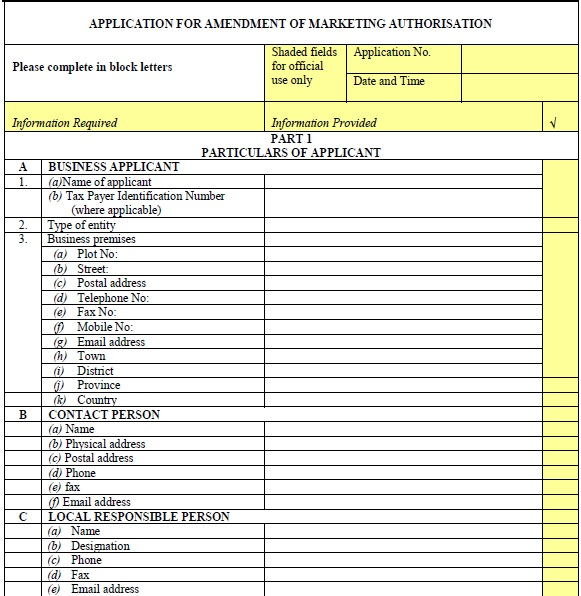
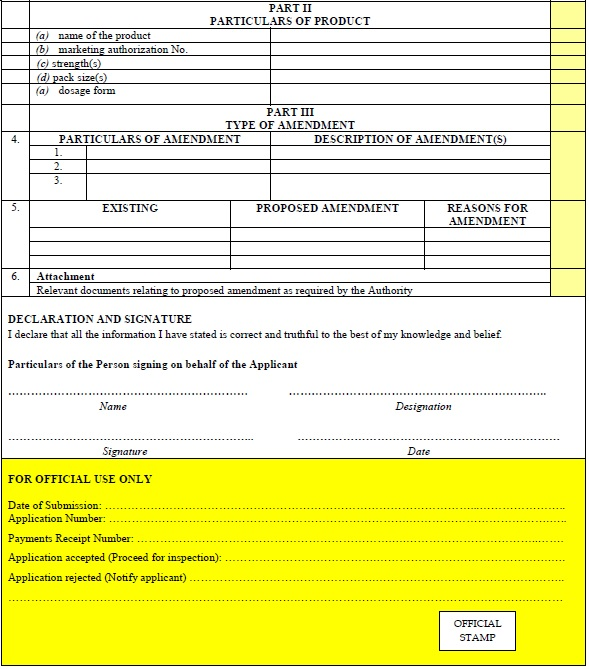
FORM VI
[Regulation 11(2)]
(To be completed in triplicate)
|
|
|
The Medicines and Allied Substances Act, 2013 |
|
The Medicines and Allied Substances |
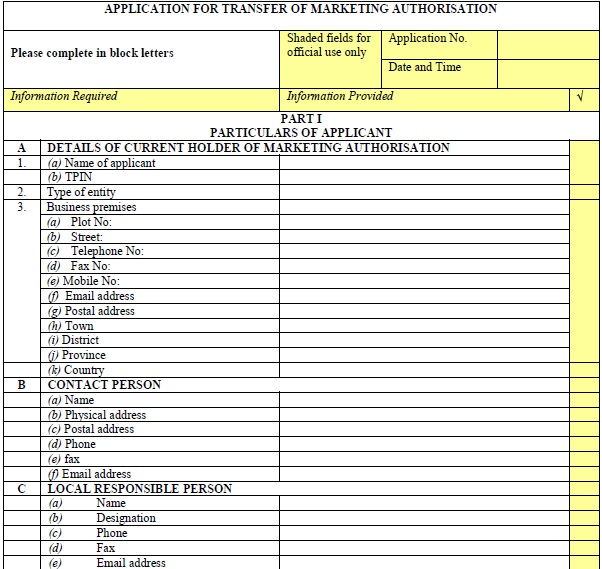
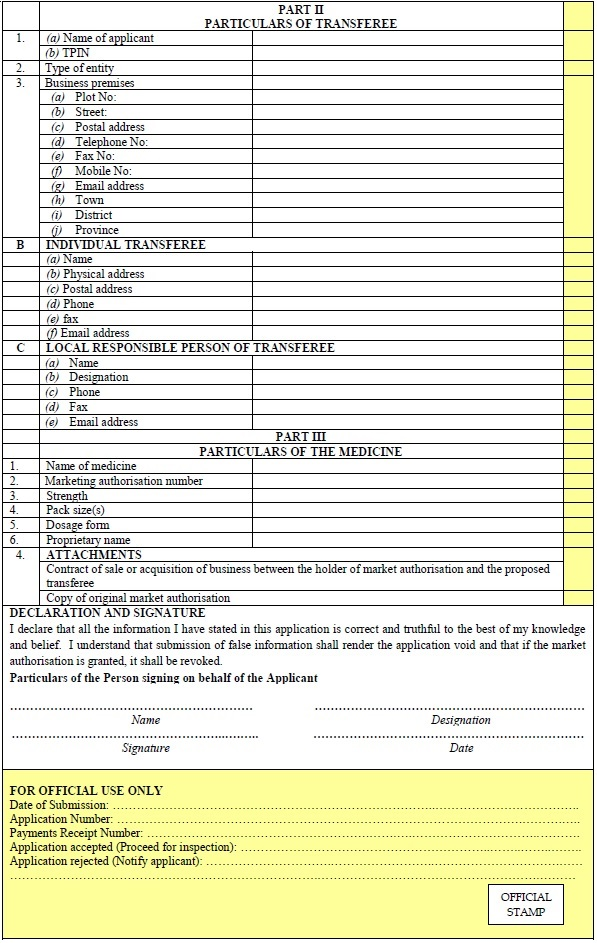
FORM VII
[Regulation 12(2)]
|
|
|
The Medicines and Allied Substances Act, 2013 |
|
The Medicines and Allied Substances |
|
NOTICE OF INTENTION TO SUSPEND A MARKETING AUTHORISATION |
|
Application No.: ……………… |
|
(1) Here insert name of holder of marketing authorisation |
To (1) ……………………………………………………………………………….. |
|
……………………………………………………………………………………………… |
|
|
(2) Here insert name of medicine and marketing authorisation number |
IN THE MATTER OF (2) ………………………………………….. you are hereby notified that the Authority intends to suspend your marketing authorisation on the following grounds— |
|
|
(a) …………………………………………………………………………………………. |
|
|
(b) …………………………………………………………………………………………. |
|
|
(c) …………………………………………………………………………………………. |
|
|
(d) …………………………………………………………………………………………. |
|
|
|
|
(3) Here insert number of days |
Accordingly, you are requested to show cause why your marketing authorisation should not be suspended and to take action to remedy the breaches set out in paragraphs ………. (above) within (3) ……….. days of receiving this notice. Failure to remedy the said breaches shall result in the suspension of your marketing authorisation. |
|
|
|
|
|
Dated this ……..… day of …………………… 20……. |
|
|
|
|
|
……………………………………. |
|
|
|
FORM VIII
[Regulation 12(3)]
|
|
|
The Medicines and Allied Substances Act, 2013 |
|
The Medicines and Allied Substances |
|
NOTICE OF SUSPENSION OF MARKETING AUTHORISATION |
|
(1) Here insert name of holder of marketing authorisation |
To (1) ……………………………………………………………………………… |
|
……………………………………………………………………………………………… |
|
|
(2) Here insert name of medicine and marketing authorisation number |
IN THE MATTER OF (2) ……………………………………………. you are hereby notified that your marketing authorisation has been suspended for (3) ……………………..…….. on the following grounds: |
|
(3) Here insert period of suspension |
(a) …………………………………………………………………………………………. |
|
(b) …………………………………………………………………………………………. |
|
|
(c) …………………………………………………………………………………………. |
|
|
(4) Here insert period of days |
Accordingly, you are requested to take action to remedy the breaches set out in paragraphs …………………… (above) within (4) ……………… days of receiving this Notice. Failure to remedy the said breaches shall result in the revocation of your marketing authorisation. |
|
|
Dated this ………….. day of ………………… 20……… |
|
|
|
|
|
………………………………….. |
|
|
|
FORM IX
[Regulation 13(2)]
|
|
|
The Medicines and Allied Substances Act, 2013 |
|
The Medicines and Allied Substances |
|
NOTICE OF RESTORATION OF MARKETING AUTHORISATION |
|
(1) Here insert name of holder of marketing authorisation |
To (1) ……………………………………………………………………………………. |
|
……………………………………………………………………………………………… |
|
|
|
|
|
(2) Here insert name of medicine and marketing authorisation number |
IN THE MATTER OF (2) …………………………………………… you are hereby notified that your marketing authorisation has been restored. |
|
Note that you are required to comply with the terms and conditions attached to the marketing authorisation. |
|
|
|
|
|
|
Dated this ……… day of …………..……… 20…… |
|
|
|
|
|
…………………………………. |
|
|
|
FORM X
[Regulation 14(2)]
|
|
|
The Medicines and Allied Substances Act, 2013 |
|
The Medicines and Allied Substances |
|
NOTICE OF INTENTION TO REVOKE MARKETING AUTHORISATION |
|
(1) Here insert name of holder of marketing authorisation |
To (1) .…………………………………………………………………………….. |
|
……………………………………………………………………………………………… |
|
|
|
|
|
(2) Here insert name of medicine and marketing authorisation number |
IN THE MATTER OF (2) ………………………………………… you are hereby notified that the Authority intends to revoke your marketing authorisation on the following grounds: |
|
|
(a) …………………………………………………………………………………………. |
|
|
(b) …………………………………………………………………………………………. |
|
|
(c) …………………………………………………………………………………………. |
|
|
(d) …………………………………………………………………………………………. |
|
(3) Here insert number of days |
Accordingly, you are requested to show cause why your marketing authorisation should not be revoked for the breaches set out in paragraphs …………………….. (above) within (3) ………………….. days of receiving this notice. Failure to remedy the said breaches shall result in the revocation of your marketing authorisation. |
|
|
|
|
|
Dated this ………… day of ………..……… 20……. |
|
|
|
|
|
…………………………………… |
|
|
|
FORM XI
[Regulation 14(3)]
|
|
|
The Medicines and Allied Substances Act, 2013 |
|
The Medicines and Allied Substances |
|
NOTICE OF REVOCATION OF MARKETING AUTHORISATION |
|
(1) Here insert name of holder of marketing authorisation |
To (1) ……………………………………………………………………………….. |
|
……………………………………………………………………………………………… |
|
|
|
|
|
(2) Here insert name of medicine and marketing authorisation number |
IN THE MATTER OF (2) …………………………….. you are hereby notified that your marketing authorisation has been revoked on the following grounds: |
|
|
(a) …………………………………………………………………………………………. |
|
|
(b) …………………………………………………………………………………………. |
|
|
(c) …………………………………………………………………………………………. |
|
|
(d) …………………………………………………………………………………………. |
|
|
|
|
|
You are therefore required to surrender the marketing authorisation to the Authority within 21 days from the date of revocation. |
|
|
You are also required to comply with the terms and conditions attached. |
|
|
|
|
|
Dated this ………… day of ……………….…… 20…… |
|
|
|
|
|
……………………………….. |
|
|
|
FORM XII
[Regulation 15(1)]
(To be completed in triplicate)
|
|
|
The Medicines and Allied Substances Act, 2013 |
|
The Medicines and Allied Substances |
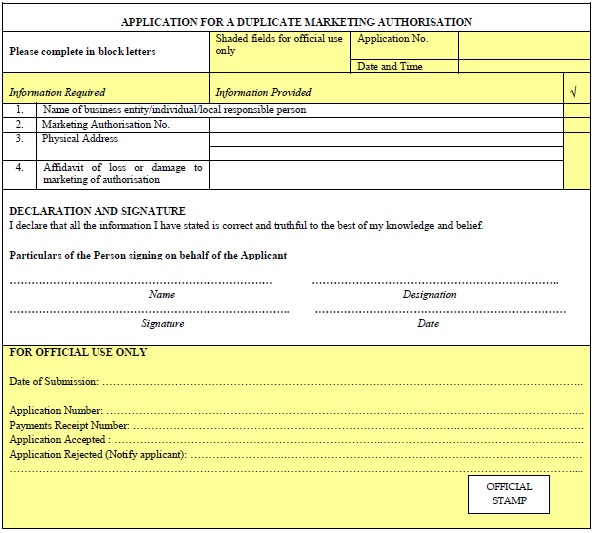
FORM XIII
[Regulation 16(1)]
(To be completed in triplicate)
|
|
|
The Medicines and Allied Substances Act, 2013 |
|
The Medicines and Allied Substances |
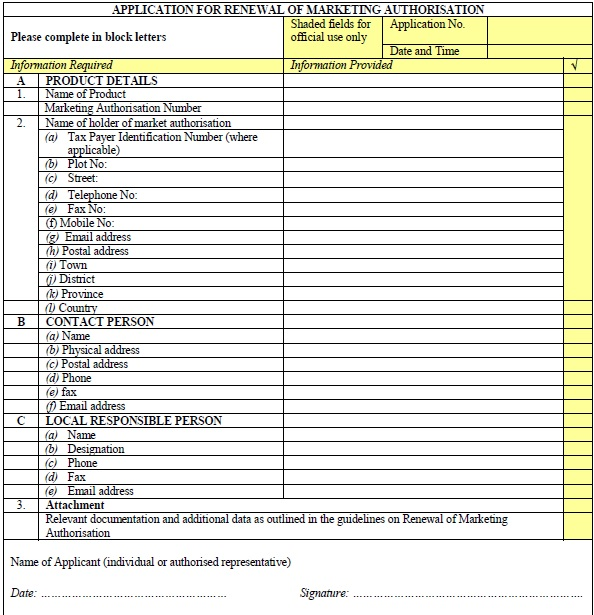
MEDICINES AND ALLIED SUBSTANCES (EXPERT ADVISORY COMMITTEE) REGULATIONS
[Section 9]
Arrangement of Regulations
Regulation
1. Title
2. Interpretation
3. Expert Advisory Committee
4. Qualifications to be appointed as member
5. Tenure of office and vacancy
6. Filling of casual vacancy
7. Proceedings of Committee
8. Allowances of member
9. Disclosure of interest
SI 80 of 2019.
These Regulations may be cited as the Medicines and Allied Substances (Expert Advisory Committee) Regulations.
In these Regulations, unless the context otherwise requires—
“Chairperson” means the person elected as Chairperson by the members;
“Committee” means the Expert Advisory Committee constituted by the Board in accordance with section 9 of the Act; and
“member” means a member of the Expert Advisory Committee.
(1) The Committee consists of the following part-time members—
(a) three persons with expertise in human medicine;
(b) two persons with expertise in veterinary medicine; and
(c) two persons with expertise in allied substances.
(2) The members shall elect the Chairperson and Vice-Chairperson from amongst themselves.
4. Qualifications to be appointed as member
A person qualifies to be appointed as a member if that person—
(a) is a citizen;
(b) is not an undischarged bankrupt;
(c) is not legally disqualified;
(d) has not been convicted of an offence under the Act or any other written law and sentenced to imprisonment for a period exceeding six months without the option of a fine within a period of five years preceding the appointment; and
(e) is not facing disciplinary action relating to professional misconduct.
5. Tenure of office and vacancy
(1) A member shall hold office for a period of three years and may be re-appointed for a further term of three years.
(2) The office of a member becomes vacant if that member—
(a) is absent, without reasonable excuse, from three consecutive meetings of the Committee of which the member has had notice;
(b) is adjudged bankrupt;
(c) is convicted of an offence under the Act or any other law and sentenced to imprisonment for a period exceeding six months;
(d) is found guilty of professional misconduct;
(e) is legally disqualified from performing the duties of a member;
(f) dies; or
(g) resigns.
(3) On the expiration of the period for which member is appointed, the member shall continue to hold office until a successor is appointed, but in no case shall the further period exceed four months.
The Board may, where the office of a member becomes vacant before the expiry of the term of office, appoint another member in place of the member who vacates office but that member shall hold office only for the unexpired part of the term.
(1) Subject to the other provisions of this Act, the Committee may regulate its own procedure.
(2) The Committee shall meet for the transaction of business at least once in every three months at such places and times as the Committee may determine.
(3) A meeting of the Committee may be called by the Chairperson, on giving notice of not less than 14 days, and shall be called by the Chairperson if not less than one-third of the members so request in writing, except that if the urgency of any particular matter does not permit the giving of the notice, a special meeting may be called on giving a shorter notice.
(4) Five members shall constitute a quorum at any meeting of the Committee.
(5) There shall preside at any meeting of the Committee—
(a) the Chairperson;
(b) in the absence of the Chairperson, the Vice-Chairperson; and
(c) in the absence of the Chairperson and the Vice-Chairperson, such other member as the members present may elect for the purpose of that meeting.
(6) A decision of the Committee on any question shall be by a majority of the members present and voting at the meeting and in the event of an equality of votes, the person presiding at the meeting shall have a casting vote in addition to that person’s deliberative vote.
(7) The Committee may invite any person, whose presence is in its opinion desirable, to attend and participate in the deliberations of the meeting of the Committee, but that person shall not have any vote.
(8) Where a member is for any reason unable to attend a meeting of the Committee, that member may, in writing, nominate another person from the same organisation to attend the meeting in that member’s stead and that person shall be deemed to be a member for the purposes of that meeting.
(9) The validity of any proceedings, acts or decisions of the Committee shall not be affected by any vacancy in the membership of the Committee or by any defect in the appointment of any member or by reason that any person not entitled to do so, took part in the proceedings.
(10) The Committee shall cause minutes to be kept of proceedings in every meeting of the Committee.
There shall be paid to a member of the Committee such allowances as the Minister may determine, subject to the approval of the Emoluments Commission.
(1) If a person is present at a meeting of the Committee at which any matter is the subject of consideration, and in which matter that person or that person’s relative is directly or indirectly interested in a private capacity, that person shall, as soon as is practicable after the commencement of the meeting, declare that interest and shall not, unless the Committee otherwise directs, take part in any consideration or discussion of, or vote on, any question relating to that matter.
(2) A declaration of interest made under sub-paragraph (1) shall be recorded in the minutes of the meeting at which it is made.
(3) In this regulation, “relative” has the meaning assigned to the word in the Anti-Corruption Commission Act, 2012.