
MARKETS AND BUS STATION ACT: INDEX TO SUBSIDIARY LEGISLATION
Local Authority Market Regulations
National Markets and Bus Stations Development Fund Regulations
ESTABLISHMENT OF MARKETS
[RETAINED AS PER SECTION 15 OF THE INTERPRETATION AND GENERAL PROVISIONS ACT]
[Section 3]
[Orders by the Minister]
A. MARKETS UNDER THE CONTROL AND MANAGEMENT OF LOCAL AUTHORITIES
[Section 4(a)]
|
Local Authority |
Description of Market |
Government Notices or Statutory Instruments |
|
BUTONDO MINE Township Management Board |
BUTONDO MINE TOWNSHIP MARKET |
179 of 1962 |
|
|
CHELSTON MARKET |
148 of 1969 |
|
|
CHIBULUMA MARKET |
43 of 1950 |
|
|
CHILILABOMBWE MARKET LUBENGELE MARKET |
62 of 1963 |
|
Municipal Council of CHINGOLA |
CHINGOLA MARKET |
159 of 1963 |
|
Municipal Council of CHINGOLA |
CHINGOLA MARKET MAITENEKE MARKET |
159 of 1963 |
|
CHINSALI Township Council |
CHINSALI MARKET |
181 of 1963 |
|
CHIPATA Township Council |
CHIPATA SUBURB MARKET CHIPATA TOWNSHIP MARKET |
59 of 1950 |
|
CHIPATA Rural Council |
CHITANDIKA MARKET MWAMI MARKET |
139 of 1979 |
|
|
KAULEMBE MARKET |
|
|
|
KAZIMULE MARKET |
|
|
|
MTENGULENI MARKET |
139 of 1979 |
|
|
NGUBUDU MARKET |
|
|
CHIPATA District Council |
MAMBWE MARKET |
112 of 1981 |
|
CHOMA Township Council |
CHOMA MARKET |
116 of 1963 |
|
Municipal Council of KABWE |
KABWE MARKET |
139 of 1963 |
|
|
BWACHA MARKET |
|
|
|
CHIMANININI MARKET |
|
|
GWEMBE Rural Council |
MAAMBA MARKET |
50 of 1972 |
|
|
SINAZEZE MARKET |
50 of 1972 |
|
|
MUNYUMBWE MARKET |
50 of 1972 |
|
|
CHIPEPO HARBOUR MARKET |
50 of 1972 |
|
|
NANCHANVWA MARKET |
50 of 1972 |
|
|
GWENA FISH MARKET |
50 of 1972 |
|
|
SIAVONGA MARKET |
50 of 1972 |
|
|
LUSITU MARKET |
50 of 1972 |
|
|
SINAZONGWE MARKET |
50 of 1972 |
|
KAFUE Township Council |
KAFUE MARKET |
201 of 1969 |
|
|
KAFUE TOWNSHIP MARKET |
|
|
KALABO Rural Council |
KALABO MARKET |
333 of 1970 |
|
KAPUTA Rural Council |
KASONGOLE MARKET |
82 of 1979 |
|
|
CHILOMWA MARKET |
82 of 1979 |
|
|
KAPUTA MARKET |
82 of 1979 |
|
|
KASHIKISHI MARKET |
82 of 1979 |
|
|
MIKOSE MARKET |
82 of 1979 |
|
|
LIBONDA MARKET |
|
|
KALOMO Township Council |
KALOMO MARKET |
114 of 1963 |
|
KALULUSHI Division |
KALULUSHI (LUATO ROAD) MARKET |
72 of 1963 |
|
|
KALULUSHI (PRAIN DRIVE) MARKET |
427 of 1964 |
|
KANSUSWA Township Council |
KANSUSWA MARKET |
383 of 1958 |
|
KOMA Rural Council |
KAOMA MARKET * A description of the area of this former township is contained in the Declaration of Townships made under section 3 of the Townships Act, Chapter 120 of the 1963 Edition of the Laws. |
307 of 1950 |
|
KASAMA Township Council |
KASAMA MARKET |
52 of 1939 |
|
KATETE Rural Council |
KATETE BOMA MARKET |
143 of 1980 |
|
|
KATETE STORES MARKET |
143 of 1980 |
|
|
MARAMBA MARKET |
143 of 1980 |
|
Municipal Council of LIVINGSTONE |
LINDA MARKET |
115 of 1963 |
|
Municipal Council of LUANSHYA |
LUANSHYA MARKET All that portion of the Luanshya Municipality being a triangular plot bounded on the west by 15th Street, on the south by the railway, and on the north by Market Street. |
80 of 1963 |
|
LUNDAZI Rural Council |
LUNDAZI MARKET |
119 of 1963 |
|
City Council of LUSAKA |
CHILENJE MARKET |
63 of 1963 |
|
|
LONGACRES MARKET |
27 of 1981 |
|
|
NORTHMEAD MARKET |
27 of 1981 |
|
|
KAUNDA SQUARE STAGE I MARKET |
27 of 1981 |
|
|
CHUNGA MARKET All that area approximately 1,380 square metres in extent and shown bordered red on Plan No. D.188, a copy of which is deposited in the office of the District Executive Secretary, Lusaka District Council. |
27 of 1981 |
|
|
CHIBOLYA MARKET |
27 of 1981 |
|
|
LIBALA MARKET |
27 of 1981 |
|
|
KASAMA TOWN MARKET |
120 of 1961 |
|
KASEMPA Rural Council |
KASEMPA MARKET |
313 of 1970 |
|
*KASOMPE Division |
KASOMPE MARKET |
326 of 1956 |
|
KAWAMBWA Rural Council |
KAWAMBWA MARKET |
84 of 1939 |
|
City Council of KITWE |
BUCHI MARKET Sub 4 of Stand No. 4274 bounded by Beacons HT588, HT589, HT590, HT591 (0.5807445 hectares), Buchi, Kitwe. |
165 of 1963 |
|
|
BULANGILILO TEMPORARY MARKET |
|
|
|
CHIMWEMWE MARKET |
|
|
|
KITWE MARKET |
|
|
MAZABUKA Rural Council |
THE KAFUE GORGE MARKET |
27 of 1971 |
|
MAZABUKA Rural Council |
MAZABUKA MARKET |
117 of 1963 |
|
MKUSHI Rural Council |
MKUSHI MARKET |
319 of 1966 |
|
MONZE Township Council |
MONZE MARKET |
113 of 1963 |
|
MUFULIRA Municipal Council |
MULUNDU MARKET |
86 of 1977 |
|
|
CHIBOLYA MARKET |
86 of 1977 |
|
MUMBWA Rural Council |
MUMBWA MARKET |
67 of 1974 |
|
MUFULIRA Municipal Council |
CHIBOTE MARKET |
56 of 1979 |
|
|
MUFULIRA (MOKAMBO MINI-MARKET) |
107 of 1974 |
|
|
MUFULIRA (CHIKALABWAMBA MINI-MARKET) |
107 of 1974 |
|
Municipal Council of LUANSHYA |
BUSEKO MARKET |
80 of 1963 |
|
|
LUANSHYA MARKET |
100 of 1971 |
|
|
LUANSHYA (MIKOMFWA) MARKET |
|
|
|
TUMFWANE MARKET |
100 of 1971 |
|
LUANSHYA Municipal Council |
KALALA MARKET |
191 of 1977 |
|
|
NDEKE MARKET |
191 of 1977 |
|
|
FISENGE MARKET |
191 of 1977 |
|
|
CHIFUBU MARKET |
|
|
|
CHISOKONE MARKET |
|
|
|
KABUSHI MARKET |
|
|
|
LUBUTO MARKET |
|
|
|
LUBUTO WEST MARKET |
208 of 1977 |
|
|
MAIN MARKET |
|
|
|
MASALA MARKET |
|
|
SOLWEZI Rural Council |
SOLWEZI MARKET * A description of the area of this former township is contained in the Declaration of Townships made under section 3 of the Townships Act, Chapter 120 of the 1963 Edition of the Laws. |
87 of 1959 |
|
TWAPIA Township Council |
TWAPIA MARKET |
43 of 1950 |
|
ZAMBEZI Rural Council |
ZAMBEZI MARKET |
283 of 1960 |
|
MUKUNI Rural Council |
CHISAMBA MARKET |
225 of 1973 |
|
|
KAPIRI MPOSHI MARKET |
225 of 1973 |
|
SENANGA Rural Council |
NANJUCHA MARKET |
118 of 1973 |
|
KALOMO Rural Council |
ZIMBA MARKET |
68 of 1979 |
|
RUFUNSA Rural Council |
CHILANGA FREEDOM COMPOUND MARKET |
11 of 1977 |
|
|
CHAINDA MARKET |
11 of 1977 |
|
|
CHONGWE MARKET |
11 of 1977 |
|
|
CHIMUSANYA MARKET |
11 of 1977 |
|
KATETE Rural Council |
KATETE BOMA MARKET |
143 of 1980 |
|
|
KATETE STORES MARKET |
143 of 1980 |
|
|
SINDA MARKET |
143 of 1980 |
|
|
LUSAKA (INDEPENDENCE AVENUE) MARKET All that area, approximately 1168.7736 hectares in extent, known as Plot No. 3502, Lusaka, situated in the Second Class Trading Area on Independence Avenue in the Lusaka Municipal Area. |
110 of 1960 |
|
|
LUSAKA (KANYAMA) MARKET |
296 of 1966 |
|
|
LUSAKA (LIVINGSTONE ROAD) MARKET |
81 of 1963 |
|
|
MATERO MARKET |
64 of 1963 |
|
LUWINGU Rural Council |
LUWINGU MARKET *A description of the area of this former township is contained in the Declaration of Townships made under section 3 of the Townships Act, Chapter 120 of the 1963 Edition of the Laws. |
25 of 1963 |
|
MANSA Township Council |
MANSA MARKET |
86 of 1939 |
|
|
MANSA NO. 1 MARKET |
54 of 1959 |
|
|
MANSA NO. 2 MARKET |
55 of 1959 |
|
MAZABUKA Township Council |
MAZABUKA MARKET |
117 of 1963 |
|
MBALA Rural Council |
MPULUNGU MARKET |
350 of 1969 |
|
MBALA Township Council |
MBULU MARKET |
243 of 1963 |
|
|
TOWN MARKET |
|
|
MKUSHI Rural Council |
MKUSHI MARKET |
319 of 1966 |
|
MONGU Township Council |
MONGU MARKET |
263 of 1958 |
|
MONZE Township Council |
MONZE MARKET |
113 of 1963 |
|
MPIKA Rural Council |
MPIKA MARKET All that area known as Mpika Market in extent approximately one-sixth of an acre, and shown on Plan No. 418 deposited in the office of the District Secretary, Mpika, and thereon bordered red. |
172 of 1963 |
|
MPOROKOSO Rural Council |
MPOROKOSO MARKET * A description of the area of this former township is contained in the Declaration of Townships made under section 3 of the Townships Act, Chapter 120 of the 1963 Edition of the Laws. |
19 of 1960 |
|
Municipal Council of MUFULIRA |
MUFULIRA MARKET |
77 of 1963 |
|
|
MUFULIRA (CENTRAL) MARKET |
|
|
|
MUFULIRA (KAMUCANGA) MARKET |
|
|
|
MUFULIRA (KWACHA) MARKET |
280 of 1965 |
|
MUKOBEKO Township Council |
MUKOBEKO MARKET |
382 of 1958 |
|
City Council of NDOLA |
CHAMPION MARKET |
359 of 1969 |
B. MARKETS UNDER THE CONTROL AND MANAGEMENT OF
PROVINCIAL LOCAL GOVERNMENT OFFICERS
[Section 4(a)]
|
Local Authority |
Description of Market |
Government Notices |
|
KAPIRI MPOSHI |
KAPIRI MPOSHI MARKET * A description of the area of this former township is contained in the Declaration of Townships made under section 3 of the Townships Act, Chapter 120 of the 1963 Edition of the Laws. |
85 of 1958 |
|
BWILE (Kawambwa) |
KALOBWA MARKET |
146 of 1961 |
|
BWILE (Mporokoso) |
KATETE MARKET |
148 of 1956 |
|
CHAVUMA (Zambezi) |
chavuma market |
149 of 1960 |
|
LUNDA (Kawambwa) |
1. That building known as the Lunda Market building situate in Chief Mulundu’s village in the Lunda Area of Kawambwa District. |
114 of 1952 |
|
2. That building known as the Lunda Market building situate in Chief Kashiba’s village in the Lunda Area of Kawambwa District. |
||
|
3. That building known as the Lunda Market building situate in Chief Lubunda’s village in the Lunda Area of Kawambwa District. |
||
|
4. That building known as the Lunda Market building situate in village Musangu, under Chief Lubunda, in the Lunda Area of Kawambwa District. |
||
|
5. That building known as the Lunda Market building situate in village Lwamfwe, under Chief Lukwesa, in the Lunda Area of Kawambwa District. |
||
|
6. That building known as the Lunda Market building situate in Chipunka village, under Senior Chief Kazembe, in the Lunda Area of Kawambwa District. |
||
|
7. That building known as the Lunda Market building situate in Chipita area, under Senior Chief Kazembe, in the Lunda Area of Kawambwa District. |
||
|
8. That building known as the Lunda Market building situate in Mwansabombwe, under Senior Chief Kazembe, in the Lunda Area of Kawambwa District. |
||
|
9. That building known as the Lunda Market building situate in Chief Kanyembo’s village in the Lunda Area of Kawambwa District. |
||
|
10. That building known as the Lunda Market building situate in Chief Kambwali’s village in the Lunda Area of Kawambwa District. |
||
|
|
KASHIKISHI MARKET |
155 of 1960 |
|
|
NTOTO MARKET |
145 of 1961 |
|
LUNDA (Zambezi) |
MUKANDAKUNDA MARKET |
144 of 1961 |
|
LUNGU (Mbala) |
ISOKA MARKET |
71 of 1954 |
|
LUVALE (Zambezi) |
1. That building known as the Luvale Market building situate in Chief Ndungu’s village in the Luvale Area of Zambezi District. |
1 of 1955 |
|
2. That building known as the Luvale Market building situate in Makinjila village under Chief Ndungu in the Luvale Area of Zambezi District. |
||
|
3. That building known as the Luvale Market building situate in Chief Kucheka’s village in the Luvale Area of Zambezi District. |
||
|
4. That building known as the Luvale Market building situate in Muyembe village under Chief Kucheka in the Luvale Area of Zambezi District. |
||
|
5. That building known as the Luvale Market building situate in Sefu village under Chief Kucheka in the Luvale Area of Zambezi District. |
||
|
6. That building known as the Luvale Market building situate in Chief Chinyama Litapi’s village in the Luvale Area of Zambezi District. |
||
|
7. That building known as the Luvale Market building situate in Mulungu village under Chief Chinyama Litapi in the Luvale Area of Zambezi District. |
||
|
8. That building known as the Luvale Market building situate in Chesita village under Chief Chinyama Litapi in the Luvale Area of Zambezi District. |
||
|
MBALA Rural Council |
MPULUNGU MARKET |
350 of 1969 |
|
MBALA Township Council |
MBALA NEW MBULU MARKET |
101 of 1971 |
|
|
MBALA OLD MBULU MARKET |
101 of 1971 |
|
MBALA Township Council -continued |
MBALA TOWN MARKET |
101 of 1971 |
|
MONGU Rural Council |
LIMULUNGA MARKET |
307 of 1970 |
|
|
LUKULU MARKET |
307 of 1970 |
|
|
NAMUSHEKENDE MARKET |
307 of 1970 |
|
|
USHAA MARKET |
307 of 1970 |
|
MONGU Township Council |
MONGU MARKET |
263 of 1958 329 of 1970 |
|
|
MONGU SUBURBS MARKET |
|
|
MPIKA Rural Council |
CHIBANSA MARKET |
172 of 1963 317 of 1970 |
|
|
MPIKA MARKET |
172 of 1963 |
|
MPOROKOSO Rural Council |
CHISHAMWAMBA MARKET |
19 of 1960 62 of 1971 |
|
|
CHISHELA MARKET |
|
|
KASAMA District Council |
CHIKUMANINO MARKET |
113 of 1991 |
|
|
TAZARA HEAVY INDUSTRIAL AREA MARKET |
113 of 1991 |
|
NDOLA Urban |
NDEKE MARKET |
126 of 1976 |
|
|
NEW TWAPIA MARKET |
126 of 1976 |
|
|
TWAPIA MARKET |
126 of 1976 |
|
|
HILLCREST MARKET |
126 of 1976 |
|
|
MUSHILI MARKET |
126 of 1976 |
|
NDOLA Urban continued |
KAWAMA MARKET |
126 of 1976 |
|
|
CHIPULUKUSU MARKET |
126 of 1976 |
|
|
PAMODZI MARKET |
126 of 1976 |
|
|
SINIA MARKET |
126 of 1976 |
|
NSENGA-AMBO (Petauke) |
KAGONA MARKET |
233 of 1940 |
|
|
MWANJAWANTHU MARKE |
141 of 1940 |
|
SHILA (Kawambwa) |
KABUTA MARKET |
148 of 1961 |
|
|
MUKWAKWA MARKET |
147 of 1961 |
|
LIVINGSTONE Municipal Council |
DAMBWA MARKET |
83 of 1977 |
|
LIVINGSTONE Municipal Council -continued |
LIBUYU MARKET |
83 of 1977 |
|
|
ZIMBA MARKET |
68 of 1979 |
|
ISOKA Rural Council |
ISOKA MARKET |
207 of 1977 |
|
|
NAKONDE MARKET |
207 of 1977 |
LOCAL AUTHORITY MARKET REGULATIONS
[Section 5]
[RETAINED AS PER SECTION 15 OF THE INTERPRETATION AND GENERAL PROVISIONS ACT]
Arrangement of Regulations
Regulation
1. Title
2. Application
3. Interpretation
4. Goods for sale
5. Sale of goods within specified area
6. Times for transaction of business
7. Stallages, rents, tolls and fees
8. Maximum prices
8A. Use of metric weight Reservation of stalls
9. Reservation of stalls
10. General regulation of markets
11. General powers of inspector of markets and health inspectors
12. Removal of goods and waste
13. Publication of resolutions
14. Penalty
SI 215 of 1968,
SI 146 of 1969,
Act 13 of 1994.
[Regulations by the Minister]
These Regulations may be cited as the Local Authority Market Regulations.
After consultation with a local authority, the Minister may, by statutory order, declare that on and after a date specified in the statutory order all or any of these Regulations shall apply, or shall cease to apply, to the whole or any part of the area of that local authority.
(1) In these Regulations, unless the context otherwise requires—
“goods” means—
(a) foodstuffs, livestock and other agricultural and natural products, the growth or produce of Zambia;
(b) articles of handicraft made and sold by or on behalf of the same person not being a company or firm and of which not less than 75 per centum in content or value of the materials used shall have been grown or produced in Zambia;
“health inspector” has the meaning assigned to it by the Public Health Act;
“inspector of markets” means a person appointed by the local authority to be an inspector of markets or authorised by the local authority to discharge the functions of an inspector of markets;
“market” means a market established under the Act in an area or part of an area to which all or any of these Regulations apply;
“stall” means any building, stand, shelter, table, place or plot in a market set aside by the local authority for the sale of goods.
(2) Nothing in these Regulations contained shall be construed as conferring upon a local authority any power in relation to a market which is not within the area of that local authority.
No person shall in a market sell—
(a) anything other than goods as defined by these Regulations; or
(b) game meat; or
(c) beer of any kind.
5. Sale of goods within specified area
No person shall, in any public place within a radius of two miles from the centre of a market, sell any goods except in a market:
Provided that the provisions of this regulation shall not apply in relation to—
(i) the sale of goods in accordance with the provisions of a licence granted under the Trades Licensing Act; or
(ii) the sale of goods by the persons and in the circumstances specified in sub-section (2) of section one of the Trades Licensing Act.
[No. 146 of 1969]
6. Times for transaction of business
(1) The local authority may from time to time determine by resolution the days of the week and the hours during each day of the week during which a market shall be open for business.
(2) No person shall sell or purchase any goods in a market except when the market is open for business.
7. Stallages, rents, tolls and fees
(1) The local authority may from time to time determine by resolution stallages, rents or tolls and fees for the inspection of produce to be paid to the local authority by persons wishing to sell goods in a market:
Provided that no such resolution shall have effect unless and until approved by the Minister.
(2) Any stallages, rents, tolls or fees payable under this regulation shall be collected by the inspector of markets.
(3) No person shall sell any goods in a market unless he has paid the stallages, rents, tolls or fees payable by him in accordance with the provisions of this regulation.
(1) The local authority may from time to time determine by resolution the maximum prices which may be demanded on the sale by retail of any article of food in a market:
Provided that the maximum price determined under these Regulations shall not be higher than the maximum price fixed by any other written law for sale by retail of the same article of food.
(2) No person shall sell by retail any article of food in a market at a price higher than the price determined under this regulation.
[Am by SI 9 of 1989.]
(1) No person shall sell or offer to sell in a market any article of food the price of which is controlled unless the price thereof is quoted and charged by reference to metric weight or to such other unit as is used by the Price Controller.
(2) It shall be the duty of every person selling or offering to sell any article of food in a market to provide and use appropriate scales to comply with this regulation.
[Am by SI 187 of 1974.]
(1) The inspector of markets may reserve any stall in the market for the sale of any particular kind of goods.
(2) No person shall from any stall reserved for the sale of a particular kind of goods sell any other goods.
10. General regulation of markets
(1) No person shall within a market—
(a) erect any building, tent, booth or shelter except with the permission of the local authority; or
(b) keep or use any block, stand, vessel, container or utensil in connection with the sale of any produce or other article, unless it is of a nature or character approved by the inspector of markets; or
(c) gut fish or game or wash or clean vegetables or any other produce or articles except at places provided for that purpose; or
(d) keep any chickens, ducks, doves or other birds for sale except in a cage or crate.
(2) No person shall bring or keep or allow to be brought or kept in a market any dog.
(3) No person shall—
(a) use a market as a sleeping place; or
(b) frequent a market between sunset and sunrise, except with the permission of the inspector of markets.
11. General powers of inspector of markets and health inspectors
(1) The inspector of markets may, subject to the provisions of these Regulations, give to any person using a market or stall such directions as may be reasonably necessary for the purpose of keeping order, preventing obstructions and maintaining cleanliness therein or in the approaches thereto.
(2) The inspector of markets or a health inspector may direct any person selling rotten or dirty produce in a market to destroy such produce or remove it from the market.
(3) No person shall fail to comply with any direction given under this regulation.
12. Removal of goods and waste
(1) Every person renting, holding, occupying or using a stall within a market shall, as soon as practicable after the market has closed for business on any day, remove from the market all goods belonging to him.
(2) All abandoned waste matter, such as loose grain sweepings, remaining at a market after the market has closed for business on any day shall be the property of the local authority, and no person shall remove any such matter from the market except in accordance with the directions of the inspector of markets.
13. Publication of takeover resolutions
No resolution of the local authority for the purposes of these Regulations shall have force and effect unless there is posted up in a conspicuous place in the market to which it relates a copy of the resolution or a notice conveying the purport of the resolution.
Any person who contravenes these Regulations shall be guilty of an offence and shall be liable upon conviction—
(a) in the case of a first offence, to a fine not exceeding twenty five penalty units or to imprisonment for a period not exceeding three months, or both;
(b) in the case of a second or subsequent offence, to a fine not exceeding twenty five penalty units or to imprisonment for a period not exceeding six months, or both.
[Am by SI 9 of 1989 and Act 13 of 1993.]
REGULATION 2 OF THE LOCAL AUTHORITY MARKET REGULATIONS – APPLICATION
Orders by the Minister
The whole of the Regulations apply to—
|
City of Lusaka. |
No. 319 of 197 |
|
City of Ndola. |
No. 361 of 196 |
|
Chingola Municipality. |
No. 314 of 197 |
|
Chinsali Rural Area. |
No. 309 of 197 |
|
Gwembe Rural Area. |
No. 49 of 197 |
|
Kafue Gorge Market. |
|
|
Mazabuka Rural Area. |
No. 28 of 197 |
|
Kafue Township. |
No. 200 of 196 |
|
Kalabo Rural Area. |
No. 332 of 197 |
|
Kaoma Rural Area. |
No. 330 of 197 |
|
Kasempa Rural Area. |
No. 312 of 197 |
|
Mansa Township. |
No. 324 of 197 |
|
Mazabuka Township. |
No. 310 of 197 |
|
Mbala Township. |
No. 104 of 197 |
|
Mongu Rural Area. |
No. 306 of 197 |
|
Mongu Township. |
No. 328 of 197 |
|
Monze Township. |
No. 359 of 196 |
|
Mpika Rural Area. |
No. 316 of 197 |
|
Mukuni Rural Area. |
No. 146 of 197 |
|
Senanga Rural Area. |
No. 123 of 197 |
|
Sesheke Rural Area. |
No. 326 of 197 |
|
Isoka Rural Council. |
No. 57 of 197 |
|
Mwinilunga District Council. |
No. 96 of 198 |
|
Kaputa District Council. |
No. 42 of 198 |
|
Lukuta Rural Council. |
No. 106 of 198 |
|
Mwense District Council. |
No. 41 of 198 |
BUTONDO MARKET BY-LAWS
[RETAINED AS PER SECTION 15 OF THE INTERPRETATION AND GENERAL PROVISIONS ACT]
[Section 5]
GN 10 of 1963,
GN 497 of 1964.
1. These By-laws shall apply to all markets from time to time established by the Butondo Mine Township Management Board in accordance with the Act and may be cited as the Butondo Market Bylaws.
2. In these By-laws, unless the context otherwise requires—
“goods” means—
(a) foodstuffs, livestock and other agricultural and natural products, the growth or produce of Zambia; or
(b) articles of handicraft made of which not less than 75 per centum in content or value of the materials used shall have been grown or produced in Zambia;
“local authority” means the Butondo Mine Township Management Board;
“market” means a market established within the Butondo Mine Township under the Act;
“market area” means the Butondo Mine Township;
“public place” includes any street, passage or way or building and any place or vehicle within an area to which, for the time being, the public are entitled or permitted to have access, either without any conditions, or upon condition of making any payment;
“stall” means any building, stand, shelter, table, place or plot in the market set aside by the local authority for the sale of goods.
3. A market shall be under the control of a Market Master, who shall be appointed by and be responsible to the local authority (the expression Market Master in these By-laws shall include all his duly appointed assistants).
4. The Market Master may reserve any stall in a market for the sale of any specified goods.
5. Every person wishing to sell goods in any market shall pay to the Market Master such stallages, rents or tolls and fees as shall from time to time be determined by resolution of the local authority.
6. All persons using any market shall obey the reasonable directions of the Market Master for the purpose of preserving cleanliness and order in the market.
7. A market shall be open for business on such days and at such times as the local authority may from time to time determine by resolution and the local authority may in fixing such times prescribe different times for the sale of different articles. The local authority may also appoint hours during which certain articles intended for sale on any market may be delivered to the market.
8. No person shall, within the market area, sell or offer for sale or barter any goods in any public place other than in a market, except with the permission of the local authority.
9. No person shall buy or sell or offer for sale or barter any goods in any market except when it is open for business.
10. No person suffering from any communicable disease shall be permitted to sell or offer for sale any produce or any other specified goods in a market.
11. No person shall within any market—
(a) keep or expose for sale any article which the Market Master considers to be of an offensive nature;
(b) wash or clean vegetables or other produce or articles except at places provided for that purpose.
12. No person shall use any market as a sleeping place, nor frequent any market between sunset ad sunrise without the consent of the Market Master. All goods shall be removed from a market during the hours that the market is closed for business.
13. No person renting, holding or occupying a stall within the market shall—
(a) gut fish or game in his stall;
(b) bring into the market or keep or use therein any block, stand, vessel, container or utensil which is not of the nature or character approved by the Market Master.
14. No building, tent, booth or shelter shall be erected in any market without the consent of the local authority.
15. All waste matter such as loose grain sweepings and the like in a market shall be the property of the local authority, and no person shall at any time remove or attempt to remove such waste matter from the market, except as directed by the Market Master.
16. The local authority may from time to time determine by resolution the maximum prices which may be demanded on the sale by retail of any article of food in any market.
17. No person shall within a market sell anything not being goods as defined in these By-laws.
18. No person shall bring, keep or suffer to be brought or kept in a market, any animal without the permission of the local authority.
CHIBULUMA MARKET BY-LAWS
[RETAINED AS PER SECTION 15 OF THE INTERPRETATION AND GENERAL PROVISIONS ACT]
[Section 5]
GN 45 of 1950,
GN118 of 1950,
GN 481 of 1964,
GN 497 of 1964.
1. These By-laws shall apply to the market established within the Chibuluma Township and may be cited as the Chibuluma Market By-laws.
2. In these By-laws, unless the context otherwise requires—
“local authority” means the Chibuluma Township Council;
“market” means the Chibuluma Market established under the Act;
“market area” means the Chibuluma Township Area;
“produce” includes agricultural and forest produce, fish, fruit, meat, poultry, eggs, vegetables, beeswax, honey, salt and tobacco of Zambia, and mats, baskets and other articles manufactured within Zambia;
“stall” includes any building, room, stand, table, space, plot or other place in the market used, or intended to be used, for sale of produce.
3. The market shall be under the control of the Market Master, who shall be appointed by and be responsible to the local authority.
4. No person shall sell or offer for sale or barter any produce within the market area other than in the market or in licensed trading premises, except with the permission of the local authority.
5. All persons using the market shall obey the reasonable directions of the Market Master or his assistants for the purpose of preserving cleanliness and order in the market.
6. The market shall be open for business daily from 07:00 hours until 18:00 hours, except on Sundays.
7. No person shall buy, sell or offer for sale or barter any livestock except live poultry.
8. No person shall buy, sell or offer for sale or barter any produce in the market except when it is open for business.
9. The Market Master shall keep a record of complaints made to him by any person using the market, such record being open to inspection by any police officer of or above the rank of Assistant Inspector or any person authorised by the local authority.
[As amended by No. 481 of 1964]
10. No person shall be permitted to loiter in the market.
11. Stall-holders or traders using the market shall keep their stalls and produce in a clean and orderly condition and shall dispose of any litter or refuse in accordance with the directions of the Market Master.
12. No building, tent, booth or shelter shall be erected in the market without the consent in writing of the local authority.
13. Every person offering foodstuffs for sale in the market shall take precautions to protect such produce from flies in accordance with the directions of the Market Master.
14. No person shall spit or commit a nuisance within the precincts of the market.
15. No person shall use the market as a sleeping place nor, unless authorised by the Market Master, enter the precincts of the market between sunset and sunrise.
16. Except with the permission of the Market Master, no fish may be brought into the market unless gutted.
17. Every person wishing to sell in the market shall obtain a stall-holder’s permit from the local authority, and a scale of charges to stall-holders up to and not exceeding two ngwee per stall per day will be levied.
18. No person suffering from any communicable disease shall be permitted to enter the market.
19. Spent.
20. No person shall bring, keep or suffer to be brought or kept in the market any dog.
21. Fish shall be placed on the stalls separate from other produce.
22. The slaughtering of cattle at the market is prohibited.
23. The local authority shall have the power to restrict or forbid the sale of any produce and shall also have the power to restrict the number of sellers of any particular produce.
24. No person shall sing, shout or create other noise or disturbance in the market.
CHILILABOMBWE MARKET BY-LAWS
[RETAINED AS PER SECTION 15 OF THE INTERPRETATION AND GENERAL PROVISIONS ACT]
[Section 5]
GN 286 of 1963,
GN 497 of 1964.
1. These By-laws shall apply to all markets from time to time established by the Chililabombwe Township Council in accordance with the Act and may be cited as the Chililabombwe Market By-laws.
2. In these By-laws, unless the context otherwise requires—
“goods” means—
(a) foodstuffs, livestock and other agricultural and natural products, the growth or produce of Zambia; or
(b) articles of handicraft made of which not less than 75 per centum in content or value of the materials used shall have been grown or produced in Zambia;
“local authority” means the Chililabombwe Township Council;
“market” means a market established within the township under the Act;
“market area” means the Chililabombwe Township;
“public place” includes any street, passage or way or building and any place or vehicle within an area to which, for the time being, the public are entitled or permitted to have access, either without any conditions, or upon condition of making any payment;
“stall” means any building, stand, shelter, table, place or plot in the market set aside by the local authority for the sale of goods.
3. A market shall be under the control of a Market Master, who shall be appointed by and be responsible to the local authority (the expression Market Master in these By-laws shall include all his duly appointed assistants).
4. The Market Master may reserve any stall in a market for the sale of any specified goods.
5. Every person wishing to sell goods in any market shall pay to the Market Master such stallages, rents or tolls and fees as shall from time to time be determined by resolution of the local authority.
6. All persons using any market shall obey the reasonable directions of the Market Master for the purpose of preserving cleanliness and order in the market.
7. A market shall be open for business on such days and at such times as the local authority may from time to time determine by resolution and the local authority may in fixing such times prescribe different times for the sale of different articles. The local authority may also appoint hours during which certain articles intended for sale on any market may be delivered to the market.
8. No person shall, within the market area, sell or offer for sale or barter any goods in any public place other than in a market, except with the permission of the local authority.
9. No person shall buy or sell or offer for sale or barter any goods in any market except when it is open for business.
10. No person suffering from any communicable disease shall be permitted to sell or offer for sale any produce or any other specified goods in a market.
11. No person shall within a market—
(a) keep or expose for sale any article which the Market Master considers to be of an offensive nature;
(b) wash or clean vegetables or other produce or articles except at places provided for that purpose.
12. No person shall use any market as a sleeping place, nor frequent any market between sunset and sunrise without the consent of the Market Master. All goods shall be removed from a market during the hours that the market is closed for business.
13. No person renting, holding or occupying a stall within any market shall—
(a) gut fish or game in his stall;
(b) bring into the market or keep or use therein any block, stand, vessel, container or utensil which is not of the nature or character approved by the Market Master.
14. No building, tent, booth or shelter shall be erected in any market without the consent of the local authority.
15. All waste matter such as loose grain sweepings and the like in a market shall be the property of the local authority, and no person shall at any time remove or attempt to remove such waste matter from the market, except as directed by the Market Master.
16. The local authority may from time to time determine by resolution the maximum prices which may be demanded on the sale by retail of any article of food in the market.
17. The local authority shall have the power—
(a) to stipulate the maximum quantity of any particular goods which may be offered for sale on any one day;
(b) to prohibit the sale of any particular goods either generally or on any one day; and
(c) to limit, by fixing a maximum, the number of sellers of any particular goods on any one day.
18. No person shall within a market sell anything not being goods as defined in these By-laws or any goods the sale of which is forbidden under by-law 17.
19. The local authority may supply scales and prescribe the use of such scales for the sale of any particular goods in any one or more markets.
20. When scales are provided the Market Master shall have the right to weigh goods sold by weight.
21. No person shall bring, keep or suffer to be brought or kept in the market any dog or other animal without the permission of the local authority.
CHINGOLA MARKETS BY-LAWS
[RETAINED AS PER SECTION 15 OF THE INTERPRETATION AND GENERAL PROVISIONS ACT]
[Section 5]
GN 84 of 1953,
GN 205 of 1959.
1. These By-laws shall apply to the markets established within the Chingola Municipality by the Markets Establishment (Chingola) Order, and may be cited as the Chingola Markets By-laws.
2. In these By-laws, unless the context otherwise requires—
“local authority” means the Municipal Council of Chingola;
“market” means the Chingola Markets established under the Act;
“market area” means the Chingola Municipal Area;
“produce” means agricultural produce, fish, fruit, meat, poultry, eggs, vegetables, mats and baskets.
3. No persons shall sell or offer for sale any produce in any street or in any public place within the market area other than in the market except with the permission of the local authority.
4. The market shall be under the control of the Market Master who shall be appointed by and be responsible to the local authority.
5. All persons using the market shall obey the reasonable directions of the Market Master or Medical Officer of Health or their assistants for the purpose of preserving cleanliness and order in the market.
6. The market shall be open on such days and at such times as the local authority may from time to time determine by resolution.
[No. 205 of 1959]
7. No person shall buy, sell or offer for sale or barter any produce in the market except when it is open for business.
8. Every person wishing to sell produce in the market shall obtain a stall-holder’s permit from the local authority and the local authority may from time to time by resolution determine a scale of charges payable by stall-holders.
[No. 205 of 1959]
9. No building, tent, booth or shelter shall be erected in the market without the consent of the local authority.
10. Stall-holders or traders using the market shall keep their stalls and produce in a clean and orderly condition and shall dispose of any litter or refuse in accordance with the directions of the Market Master in that regard.
11. No person suffering from any communicable disease shall sell or offer for sale any produce in the market.
12. Every person offering foodstuffs for sale in the market shall take all necessary precautions to protect such foodstuffs from flies and contamination in accordance with the directions of the Market Master.
13. No person shall spit or commit a nuisance within the precincts of the market.
14. No person shall loiter in the market for the purpose of begging or for any other purpose.
15. No person shall sing, shout or create other noise or disturbance in the market.
16. No unauthorised person shall use the market as a sleeping place nor frequent the market between sunset and sunrise.
17. No person shall sell or offer for sale in the market any livestock except live poultry or any fish or meat except with the permission of the Market Master.
18. The Market Master shall have the right to refuse to allow goods to be sold which he considers unfit for human consumption.
19. The local authority shall have the right to fix maximum prices for the produce which may be offered for sale in the market.
20. The local authority shall have the power to restrict or forbid the sale of any produce and shall also have the power to restrict the number of sellers of any particular produce.
CHINSALI MARKET BY-LAWS
[RETAINED AS PER SECTION 15 OF THE INTERPRETATION AND GENERAL PROVISIONS ACT]
[Section 5]
GN 143 of 1963,
GN 497 of 1964.
1. These By-laws shall apply to all markets from time to time established by the Chinsali Rural Council in accordance with the Act and may be cited as the Chinsali Market By-laws.
2. In these By-laws, unless the context otherwise requires—
“goods” means—
(a) foodstuffs, livestock and other agricultural and natural products, the growth or produce of Zambia; or
(b) articles of handicraft made of which not less than 75 per centum in content or value of the materials used shall have been grown or produced in Zambia;
“local authority” means the Chinsali Rural Council;
“market” means a market established within the market area under the Act;
“market area” means the Chinsali area
“public place” includes any street, passage or way or building and any place or vehicle within an area to which, for the time being, the public are entitled or permitted to have access, either without any conditions, or upon condition of making any payment;
“stall” means any building, stand, shelter, table, place or plot in the market set aside by the local authority for the sale of goods.
3. A market shall be under the control of a Market Master, who shall be appointed by and be responsible to the local authority (the expression Market Master in these By-laws shall include all his duly appointed assistants).
4. The Market Master may reserve any stall in a market for the sale of any specified goods.
5. Every person wishing to sell goods in any market shall pay to the Market Master such stallages, rents or tolls and fees as shall from time to time be determined by the local authority.
6. All persons using any market shall obey the reasonable directions of the Market Master for the purpose of preserving cleanliness and order in the market.
7. A market shall be open for business on such days and at such times as the local authority may from time to time determine and the local authority may in fixing such times prescribe different times for the sale of different articles. The local authority may also appoint hours during which certain articles intended for sale on any market may be delivered to the market.
8. No person shall, within the market area, sell or offer for sale or barter any goods in any public place other than in a market, except with the permission of the local authority.
9. No person shall buy or sell or offer for sale or barter any goods in any market except when it is open for business.
10. No person suffering from any communicable disease shall be permitted to sell or offer for sale any produce or any other specified goods in a market.
11. No person shall within a market—
(a) keep or expose for sale any article which the Market Master considers to be of an offensive nature;
(b) wash or clean vegetables or other produce or articles except at places provided for that purpose.
12. No person shall use any market as a sleeping place, nor frequent any market between sunset and sunrise without the consent of the Market Master. All goods shall be removed from a market during the hours that the market is closed for business.
13. No person renting, holding or occupying a stall within any market shall—
(a) gut fish or game in his stall;
(b) bring into the market or keep or use therein any block, stand, vessel, container or utensil which is not of the nature or character approved by the Market Master.
14. No building, tent, booth or shelter shall be erected in any market without the consent of the local authority.
15. All waste matter such as loose grain sweepings and the like in a market shall be the property of the local authority, and no person shall at any time remove or attempt to remove such waste matter from the market, except as directed by the Market Master.
16. The local authority may from time to time determine the maximum prices which may be demanded on the sale by retail of any article of food in the market.
17. No person shall within a market sell anything not being goods as defined in these By-laws.
18. No person shall bring, keep or suffer to be brought or kept in the market any dog or other animal without the permission of the local authority.
CHIPATA MARKET BY-LAWS
[RETAINED AS PER SECTION 15 OF THE INTERPRETATION AND GENERAL PROVISIONS ACT]
[Section 5]
GN 158 of 1963,
GN 497 of 1964.
1. These By-laws shall apply to all markets from time to time established by the Chipata Township Council in accordance with the Act and may be cited as the Chipata Market By-laws.
2. In these By-laws, unless the context otherwise requires—
“goods” means—
(a) foodstuffs, livestock and other agricultural and natural products, the growth or produce of Zambia; or
(b) articles of handicraft made of which not less than 75 per centum in content or value of the materials used shall have been grown or produced in Zambia;
“local authority” means the Chipata Township Council;
“market” means a market established within the township under the Act;
“market area” means the Chipata Township;
“public place” includes any street, passage or way or building and any place or vehicle within an area to which, for the time being, the public are entitled or permitted to have access, either without any conditions, or upon condition of making any payment;
“stall” means any building, stand, shelter, table, place or plot in the market set aside by the local authority for the sale of goods.
3. A market shall be under the control of a Market Master, who shall be appointed by and be responsible to the local authority (the expression Market Master in these By-laws shall include all his duly appointed assistants).
4. The Market Master may reserve any stall in a market for the sale of any specified goods.
5. Every person wishing to sell goods in any market shall pay to the Market Master such stallages, rents or tolls and fees as shall from time to time be determined by resolution of the local authority.
6. All persons using any market shall obey the reasonable directions of the Market Master for the purpose of preserving cleanliness and order in the market.
7. A market shall be open for business on such days and at such times as the local authority may from time to time determine by resolution and the local authority may in fixing such times prescribe different times for the sale of different articles. The local authority may also appoint hours during which certain articles intended for sale on any market may be delivered to the market.
8. No person shall, within the market area, sell or offer for sale or barter any goods in any public place other than in a market, except with the permission of the local authority.
9. No person shall buy or sell or offer for sale or barter any goods in any market except when it is open for business.
10. No person suffering from any communicable disease shall be permitted to sell or offer for sale any produce or any other specified goods in a market.
11. No person shall within a market—
(a) keep or expose for sale any article which the Market Master considers to be of an offensive nature;
(b) wash or clean vegetables or other produce or articles except at places provided for that purpose.
12. No person shall use any market as a sleeping place, nor frequent any market between sunset and sunrise without the consent of the Market Master. All goods shall be removed from a market during the hours that the market is closed for business.
13. No person renting, holding or occupying a stall within any market shall—
(a) gut fish or game in his stall;
(b) bring into the market or keep or use therein any block, stand, vessel, container or utensil which is not of the nature or character approved by the Market Master.
14. No building, tent, booth or shelter shall be erected in any market without the consent of the local authority.
15. All waste matter such as loose grain sweepings and the like in a market shall be the property of the local authority, and no person shall at any time remove or attempt to remove such waste matter from the market, except as directed by the Market Master.
16. The local authority may from time to time determine by resolution the maximum prices which may be demanded on the sale by retail of any article of food in the market.
17. No person shall within a market sell anything not being goods as defined in these By-laws.
18. No person shall bring, keep or suffer to be brought or kept in the market any dog or other animal without the permission of the local authority.
CHOMA MARKET BY-LAWS
[RETAINED AS PER SECTION 15 OF THE INTERPRETATION AND GENERAL PROVISIONS ACT]
[Section 5]
GN 140 of 1963,
GN 497 of 1964.
1. These By-laws shall apply to all markets from time to time established by the Choma Township Council in accordance with the Act and may be cited as the Choma Market By-laws.
2. In these By-laws, unless the context otherwise requires—
“goods” means—
(a) foodstuffs, livestock and other agricultural and natural products, the growth or produce of Zambia; or
(b) articles of handicraft made of which not less than 75 per centum in content or value of the materials used shall have been grown or produced in Zambia;
“local authority” means the Choma Township Council;
“market” means a market established within the township under the Act;
“market area” means the Choma Township;
“public place” includes any street, passage or way or building and any place or vehicle within an area to which, for the time being, the public are entitled or permitted to have access, either without any conditions, or upon condition of making any payment;
“stall” means any building, stand, shelter, table, place or plot in the market set aside by the local authority for the sale of goods.
3. A market shall be under the control of a Market Master, who shall be appointed by and be responsible to the local authority (the expression Market Master in these By-laws shall include all his duly appointed assistants).
4. The Market Master may reserve any stall in a market for the sale of any specified goods.
5. Every person wishing to sell goods in any market shall pay to the Market Master such stallages, rents or tolls and fees as shall from time to time be determined by resolution of the local authority.
6. All persons using any market shall obey the reasonable directions of the Market Master for the purpose of preserving cleanliness and order in the market.
7. A market shall be open for business on such days and at such times as the local authority may from time to time determine by resolution and the local authority may in fixing such times prescribe different times for the sale of different articles. The local authority may also appoint hours during which certain articles intended for sale on any market may be delivered to the market.
8. No person shall, within the market area, sell or offer for sale or barter any goods in any public place other than in a market, except with the permission of the local authority.
9. No person shall buy or sell or offer for sale or barter any goods in any market except when it is open for business.
10. No person suffering from any communicable disease shall be permitted to sell or offer for sale any produce or any other specified goods in a market.
11. No person shall within any market—
(a) keep or expose for sale any article which the Market Master considers to be of an offensive nature;
(b) wash or clean vegetables or other produce or articles except at places provided for that purpose.
12. No person shall use any market as a sleeping place, nor frequent any market between sunset and sunrise without the consent of the Market Master. All goods shall be removed from a market during the hours that the market is closed for business.
13. No person renting, holding or occupying a stall within any market shall—
(a) gut fish or game in his stall;
(b) bring into the market or keep or use therein any block, stand, vessel, container or utensil which is not of the nature or character approved by the Market Master.
14. No building, tent, booth or shelter shall be erected in any market without the consent of the local authority.
15. All waste matter such as loose grain sweepings and the like in a market shall be the property of the local authority, and no person shall at any time remove or attempt to remove such waste matter from the market, except as directed by the Market Master.
16. The local authority may from time to time determine by resolution the maximum prices which may be demanded on the sale by retail of any article of food in any market.
17. No person shall within a market sell anything not being goods as defined in these By-laws.
18. No person shall bring, keep or suffer to be brought or kept in the market, any dog or other animal without the permission of the local authority.
FISENGE MARKET BY-LAWS
[RETAINED AS PER SECTION 15 OF THE INTERPRETATION AND GENERAL PROVISIONS ACT]
[Section 5]
GN 130 of 1957,
GN 481 of 1964,
GN 497 of 1964.
1. These By-laws shall apply to the market established within the Fisenge Township and may be cited as the Fisenge Market Bylaws.
2. In these By-laws, unless the context otherwise requires—
“local authority” means the Fisenge Township Council;
“market” means the Fisenge Market established under the Act;
“market area” means the Fisenge Township Area;
“produce” includes agricultural and forest produce, fish, fruit, meat, poultry, eggs, vegetables, beeswax, honey, salt, and tobacco of Zambia, and mats, baskets and other articles manufactured within Zambia;
“stall” includes any building, room, stand, table, space, plot or other place in the market used, or intended to be used, for sale of produce.
3. The market shall be under the control of the Market Master, who shall be appointed by and be responsible to the local authority.
4. No person shall sell or offer for sale or barter any produce within the market area other than in the market or in licensed trading premises, except with the permission of the local authority.
5. All persons using the market shall obey the reasonable directions of the Market Master or his assistants for the purpose of preserving cleanliness and order in the market.
6. The market shall be open for business daily from 7 a.m. until 6 p.m. except on Sundays.
7. No person shall buy, sell or offer for sale or barter any livestock except live poultry.
8. No person shall buy, sell or offer for sale or barter any produce in the market except when it is open for business.
9. The Market Master shall keep a record of complaints made to him by any person using the market, such record being open to inspection by any police officer of the rank of Inspector or above or any person authorised by the local authority.
[Am by No. 481 of 1964.]
10. No person shall be permitted to loiter in the market.
11. Stall-holders or traders using the market shall keep their stalls and produce in a clean and orderly condition and shall dispose of any litter or refuse in accordance with the directions of the Market Master.
12. No building, tent, booth or shelter shall be erected in the market without the consent in writing of the local authority.
13. Every person offering foodstuffs in the market shall take precautions to protect such produce from flies in accordance with the directions of the Market Master.
14. No person shall spit or commit a nuisance within the precincts of the market.
15. No person shall use the market as a sleeping place nor, unless authorised by the Market Master, enter the precincts of the market between sunset and sunrise.
16. Except with the permission of the Market Master, no fish may be brought into the market unless gutted.
17. Every person wishing to sell in the market shall obtain a stall-holder’s permit from the local authority and the local authority may charge a fee per stall per day not exceeding two ngwee or such other fee as the Minister may approve.
18. No person suffering from any communicable disease shall be permitted to enter the market.
19. Obsolete.
20. No person shall bring, keep or suffer to be brought or kept in the market any dog.
21. Fish shall be placed on the stalls separate from other produce.
22. The slaughtering of cattle at the market is prohibited.
23. The local authority shall have the power to restrict or forbid the sale of any produce and shall also have the power to restrict the number of sellers of any particular produce.
24. No person shall sing, shout or create other noise or disturbance in the market.
KABWE MARKET BY-LAWS
[RETAINED AS PER SECTION 15 OF THE INTERPRETATION AND GENERAL PROVISIONS ACT]
[Section 5]
GN 254 of 1963,
GN 497 of 1964.
1. These By-laws shall apply to all markets from time to time established by the Municipal Council of Kabwe in accordance with the Act and may be cited as the Kabwe Market By-laws.
2. In these By-laws, unless the context otherwise requires—
“goods” means—
(a) foodstuffs, livestock and other agricultural and natural products, the growth or produce of Zambia; or
(b) articles of handicraft made of which not less than 75 per centum in content or value of the materials used shall have been grown or produced in Zambia;
“local authority” means the Municipal Council of Kabwe;
“market” means a market established within the municipality under the Act;
“market area” means the Kabwe Municipality;
“public place” includes any street, passage or way or building and any place or vehicle within an area to which, for the time being, the public are entitled or permitted to have access, either without any conditions, or upon condition of making any payment;
“stall” means any building, stand, shelter, table, place or plot in the market set aside by the local authority for the sale of goods.
3. A market shall be under the control of a Market Master, who shall be appointed by and be responsible to the local authority (the expression Market Master in these By-laws shall include all his duly appointed assistants).
4. The Market Master may reserve any stall in a market for the sale of any specified goods.
5. Every person wishing to sell goods in any market shall pay to the Market Master such stallages, rents or tolls and fees as shall from time to time be determined by resolution of the local authority.
6. All persons using any market shall obey the reasonable directions of the Market Master for the purpose of preserving cleanliness and order in the market.
7. A market shall be open for business on such days and at such times as the local authority may from time to time determine by resolution and the local authority may in fixing such times prescribe different times for the sale of different articles. The local authority may also appoint hours during which certain articles intended for sale on any market may be delivered to the market.
8. No person shall, within the market area, sell or offer for sale or barter any goods in any public place other than in a market, except with the permission of the local authority.
9. No person shall buy or sell or offer for sale or barter any goods in any market except when it is open for business.
10. No person suffering from any communicable disease shall be permitted to sell or offer for sale any produce or any other specified goods in a market.
11. No person shall within any market—
(a) keep or expose for sale any article which the Market Master considers to be of an offensive nature;
(b) wash or clean vegetables or other produce or articles except at places provided for that purpose.
12. No person shall use any market as a sleeping place, nor frequent any market between sunset and sunrise without the consent of the Market Master. All goods shall be removed from a market during the hours that the market is closed for business, except that holders of stalls provided with lock-up stores shall be permitted to store their goods therein during the hours that the market is closed for business.
13. No person renting, holding or occupying a stall within any market shall—
(a) gut fish or game in his stall;
(b) bring into the market or keep or use therein any block, stand, vessel, container or utensil which is not of the nature or character approved by the Market Master.
14. No building, tent, booth or shelter shall be erected in any market without the consent of the local authority.
15. All waste matter such as loose grain sweepings and the like in a market shall be the property of the local authority, and no person shall at any time remove or attempt to remove such waste matter from the market, except as directed by the Market Master.
16. The local authority may from time to time determine by resolution the maximum prices which may be demanded on the sale by retail of any foodstuff in the market.
17. No person shall within a market sell anything not being goods as defined in these By-laws.
18. No person shall bring, keep or suffer to be brought or keep in the market any dog or other animal without the permission of the local authority.
KALOMO MARKET BY-LAWS
[RETAINED AS PER SECTION 15 OF THE INTERPRETATION AND GENERAL PROVISIONS ACT]
[Section 5]
GN 87 of 1963,
GN 497 of 1964.
1. These By-laws shall apply to all markets from time to time established by the Kalomo Township Council in accordance with the Act and may be cited as the Kalomo Market By-laws.
2. In these By-laws, unless the context otherwise requires—
“goods” means—
(a) foodstuffs, livestock and other agricultural and natural products, the growth or produce of Zambia; or
(b) articles of handicraft made of which not less than 75 per centum in content or value of the materials used shall have been grown or produced in Zambia;
“local authority” means the Kalomo Township Council;
“market” means a market established within the township under the Act;
“market area” means the Kalomo Township;
“public place” includes any street, passage or way or building and any place or vehicle within an area to which, for the time being, the public are entitled or permitted to have access, either without any conditions, or upon condition of making any payment;
“stall” means any building, stand, shelter, table, place or plot in the market set aside by the local authority for the sale of goods.
3. A market shall be under the control of a Market Master, who shall be appointed by and be responsible to the local authority (the expression Market Master in these By-laws shall include all his duly appointed assistants).
4. The Market Master may reserve any stall in a market for the sale of any specified goods.
5. Every person wishing to sell goods in any market shall pay to the Market Master such stallages, rents or tolls and fees as shall from time to time be determined by resolution of the local authority.
6. All persons using any market shall obey the reasonable directions of the Market Master for the purpose of preserving cleanliness and order in the market.
7. A market shall be open for business on such days and at such times as the local authority may from time to time determine by resolution and the local authority may in fixing such times prescribe different times for the sale of different articles. The local authority may also appoint hours during which certain articles intended for sale on any market may be delivered to the market.
8. No person shall, within the market area, sell or offer for sale or barter any goods in any public place other than in a market, except with the permission of the local authority.
9. No person shall buy or sell or offer for sale or barter any goods in any market except when it is open for business.
10. No person suffering from any communicable disease shall be permitted to sell or offer for sale any produce or any other specified goods in a market.
11. No person shall within a market—
(a) keep or expose for sale any article which the Market Master considers to be of an offensive nature;
(b) wash or clean vegetables or other produce or articles except at places provided for that purpose.
12. No person shall use any market as a sleeping place, nor frequent any market between sunset and sunrise without the consent of the Market Master. All goods shall be removed from a market during the hours that the market is closed for business.
13. No person renting, holding or occupying a stall within any market shall—
(a) gut fish or game in his stall;
(b) bring into the market or keep or use therein any block, stand, vessel, container or utensil which is not of the nature or character approved by the Market Master.
14. No building, tent, booth or shelter shall be erected in any market without the consent of the local authority.
15. All waste matter such as loose grain sweepings and the like in a market shall be the property of the local authority, and no person shall at any time remove or attempt to remove such waste matter from the market, except as directed by the Market Master.
16. The local authority may from time to time determine by resolution the maximum prices which may be demanded on the sale by retail of any article of food in the market.
17. No person shall within a market sell anything not being goods as defined in these By-laws.
18. No person shall bring, keep or suffer to be brought or kept in the market any dog or other animal without the permission of the local authority.
KALULUSHI MARKET BY-LAWS
[RETAINED AS PER SECTION 15 OF THE INTERPRETATION AND GENERAL PROVISIONS ACT]
[Section 5]
GN 141 of 1963,
GN 497 of 1964.
1. These By-laws shall apply to all market from time to time established by the Kalulushi Township Council in accordance with the Act and may be cited as the Kalulushi Market By-laws.
2. In these By-laws, unless the context otherwise requires—
“goods” means—
(a) foodstuffs, livestock and other agriculture and natural products, the growth or produce of Zambia; or
(b) articles of handicraft made of which not less than 75 per centum in content or value of the materials used shall have been grown or produced in Zambia;
“local authority” means the Kalulushi Township Council;
“market” means a market established within the Kalulushi Township under the Act;
“market area” means the Kalulushi Township;
“Medical Officer of Health” includes the Director of Medical Services, the Deputy Director of Medical Services, any Government Medical Officer, Health Officer or Health Inspector, and any medical practitioner appointed to act as a Health Officer in the Kalulushi Township by the Director of Medical Services;
“public place” includes any street, passage or way or building and any place or vehicle within an area to which, for the time being, the public are entitled or permitted to have access, either without any conditions, or upon condition of making any payment;
“stall” means any building, stand, shelter, table, place or plot in the market set aside by the local authority for the sale of goods.
3. A market shall be under the control of a Market Master, who shall be appointed by and be responsible to the local authority (the expression Market Master in these By-laws shall include all his duly appointed assistants).
4. The Market Master may reserve any stall in a market for the sale of any specified goods.
5. Every person wishing to sell goods in any market shall pay to the Market Master such stallages, rents or tolls and fees as shall from time to time be determined by resolution of the local authority.
6. All persons using any market shall obey the reasonable directions of the Market Master for the purpose of preserving cleanliness and order in the market.
7. A market shall be open for business on such days and at such times as the local authority may from time to time determine by resolution and the local authority may in fixing such times prescribe different times for the sale of different articles. The local authority may also appoint hours during which certain articles intended for sale on any market may be delivered to the market.
8. No person shall, within the market area, sell or offer for sale or barter any goods in any public place other than in a market, except with the permission of the local authority.
9. No person shall buy or sell or offer for sale or barter any goods in any market except when it is open for business.
10. No person suffering from any communicable disease shall be permitted to sell or offer for sale any produce or any other specified goods in a market.
11. No person shall within a market—
(a) keep or expose for sale any article which the Market Master considers to be of an offensive nature;
(b) wash or clean vegetables or other produce or articles except at places provided for that purpose.
12. No person shall use any market as a sleeping place, nor frequent any market between sunset and sunrise without the consent of the Market Master. All goods shall be removed from a market during the hours that the market is closed for business.
13. No person renting, holding or occupying a stall within any market shall—
(a) gut fish or game in his stall;
(b) bring into the market or keep or use therein any block, stand, vessel, container or utensil which is not of the nature or character approved by the Market Master.
14. Every person offering foodstuffs for sale in a market shall take all reasonable precautions to protect such foodstuffs from flies and contamination in accordance with the directions of the Market Master or Medical Officer of Health, and all such foodstuffs shall be kept in the stalls provided for this purpose.
15. No building, tent, booth or shelter shall be erected in any market without the consent of the local authority.
16. All waste matter such as loose grain sweepings and the like in a market shall be the property of the local authority, and no person shall at any time remove or attempt to remove such waste matter from the market, except as directed by the Market Master.
17. The local authority may from time to time determine by resolution the maximum prices which may be demanded on the sale by retail of any article of food in the market.
18. No person shall within a market sell anything not being goods as defined in these By-laws.
19. No person shall bring, keep or suffer to be brought or kept in the market any dog or other animal without the permission of the local authority.
KANSUSWA MARKET BY-LAWS
[RETAINED AS PER SECTION 15 OF THE INTERPRETATION AND GENERAL PROVISIONS ACT]
[Section 5]
GN 187 of 1959,
GN 2 of 1960,
GN 481 of 1964,
GN 497 of 1964.
1. These By-laws shall apply to all markets established within the Kansuswa Township and may be cited as the Kansuswa Market By-laws.
2. In these By-laws, unless the context otherwise requires—
“local authority” means the Kansuswa Township Council;
“market” means any market established under the Act within the Kansuswa Township;
“market area” means the Kansuswa Township Area;
“produce” includes agricultural and forest produce, fish, fruit, dried meat, poultry, eggs, vegetables, edible insects, beeswax, honey, salt and tobacco of Zambia and mats, baskets and other articles manufactured within Zambia;
“stall” includes any building, room, stand, table, space, plot or other place in the market used, or intended to be used, for the sale of produce.
3. No person shall sell, offer or expose for sale or barter any produce within the market area other than in a market established under the Act or in trading premises licensed under the Trades Licensing Act.
4. The market shall be under the control of the Market Master, who shall be appointed by and be responsible to the local authority (the expression Market Master in these By-laws shall include all his duly appointed assistants).
5. All persons using the market shall obey the reasonable directions of the Market Master for the purpose of preserving cleanliness or order in the market or for maintaining the orderly sale of goods or articles or of produce in the market.
6. The market shall be open for business daily from 07.00 hours to 18.00 hours or such other hours as the local authority may from time to time by resolution determine and the local authority may in fixing such times prescribe different times for the sale of different produce.
[As amended by No. 2 of 1960.]
7. No person shall buy, sell or offer for sale or barter any produce in the market except when it is open for business.
8. No persons shall deliver produce to the market for sale except during the following hours:
| Mondays to Fridays | 06:00 hours to 18:00 hours |
| Saturdays | 06:00 hours to 13:00 hours |
9. No person shall buy, sell or offer for sale or barter in the market any goods, produce or articles other than produce of or articles manufactured within Zambia.
10. No person shall sell or offer for sale or barter any produce in the market except from a stall in the market.
11. The Market Master on the directions of the local authority may reserve any table or stall in the market for any specific purpose.
12. Every person wishing to sell or offer for sale or barter any produce in the market shall pay to the Market Master such stallages, rents or tolls and fees as shall from time to time be determined by resolution of the local authority.
13. The Market Master shall keep a record of complaints made to him by any person using the market, such record being open to inspection by any police officer of or above the rank of Assistant Inspector or any person authorised by the local authority.
[Am by No. 481 of 1964.]
14. Stall-holders or traders using the market shall keep their stalls and produce in a clean and orderly condition and shall dispose of any litter or refuse in accordance with the directions of the Market Master.
15. Every person offering foodstuffs for sale in the market shall take precautions to protect such produce from dust and flies in accordance with the directions of the Market Master.
16. No person shall buy, sell or offer for sale or barter any livestock except live poultry. The Market Master should he deem it necessary may cause any poultry on the market to be fed and watered and may recover the cost thereof from the owner.
17. Except with the permission in writing of the Market Master all produce or articles shall be removed from the market during the hours that the market is closed.
18. No building, tent, booth or shelter shall be erected in the market without the consent in writing of the local authority.
19. No person shall be permitted to loiter in the market for the purpose of begging or for any other purpose.
20. No person shall spit or commit a nuisance within the market.
21. No person shall use the market as a sleeping place nor, unless authorised by the Market Master, enter the precincts of the market between sunset and sunrise.
22. No person shall solicit or demand any moneys from any person whether frequenting or selling any produce in the market unless specially authorised in writing by the local authority so to do.
23. No person suffering from any communicable disease shall be permitted to enter the market.
24. No person shall sing, shout or create other noise or disturbance in the market.
25. No person shall bring, keep or suffer to be brought or kept in the market any animals.
26. Except with the permission of the local authority no fish shall be brought into the market unless gutted. Fish shall be placed on stalls separate from other produce.
27. Fresh fruit, vegetables and meat shall be placed on clean stalls or tables or on clean matting.
28. The local authority may from time to time determine by resolution the maximum price which may be demanded on the sale by retail in the market of any article of food.
KAOMA MARKET BY-LAWS
[RETAINED AS PER SECTION 15 OF THE INTERPRETATION AND GENERAL PROVISIONS ACT]
[Section 5]
GN 201 of 1963,
GN 497 of 1964.
1. These By-laws shall apply to all markets from time to time established by the Kaoma Rural Council in accordance with the Act and may be cited as the Kaoma Market By-laws.
2. In these By-laws, unless the context otherwise requires—
“goods” means—
(a) foodstuffs, livestock and other agricultural and natural products, the growth or produce of Zambia; or
(b) articles of handicraft made of which not less than 75 per centum in content or value of the materials used shall have been grown or produced in Zambia;
“local authority” means the Kaoma Rural Council;
“market” means a market established within the market area under the Act;
“market area” means the Kaoma area
“public place” includes any street, passage or way or building and any place or vehicle within an area to which, for the time being, the public are entitled or permitted to have access, either without any conditions, or upon condition of making any payment;
“stall” means any building, stand, shelter, table, place or plot in the market set aside by the local authority for the sale of goods.
3. A market shall be under the control of a Market Master, who shall be appointed by and be responsible to the local authority (the expression Market Master in these By-laws shall include all his duly appointed assistants).
4. The Market Master may reserve any stall in a market for the sale of any specified goods.
5. Every person wishing to sell goods in any market shall pay to the Market Master such stallages, rents or tolls and fees as shall from time to time be determined by the local authority.
6. All persons using any market shall obey the reasonable directions of the Market Master for the purpose of preserving cleanliness and order in the market.
7. A market shall be open for business on such days and at such times as the local authority may from time to time determine and the local authority may in fixing such times prescribe different times for the sale of different articles. The local authority may also appoint hours during which certain articles intended for sale on any market may be delivered to the market.
8. No person shall, within the market area, sell or offer for sale or barter any goods in any public place other than in a market, except with the permission of the local authority.
9. No person shall buy or sell or offer for sale or barter any goods in any market except when it is open for business.
10. No person suffering from any communicable disease shall be permitted to sell or offer for sale any produce or any other specified goods in a market.
11. No person shall within a market—
(a) keep or expose for sale any article which the Market Master considers to be of an offensive nature;
(b) wash or clean vegetables or other produce or articles except at places provided for that purpose.
12. No person shall use any market as a sleeping place, nor frequent any market between sunset and sunrise without the consent of the Market Master. All goods shall be removed from a market during the hours that the market is closed for business.
13. No person renting, holding or occupying a stall within any market shall—
(a) gut fish or game in his stall;
(b) bring into the market or keep or use therein any block, stand, vessel, container or utensil which is not of the nature or character approved by the Market Master.
14. No building, tent, booth or shelter shall be erected in any market without the consent of the local authority.
15. All waste matter such as loose grain sweepings and the like in a market shall be the property of the local authority, and no person shall at any time remove or attempt to remove such waste matter from the market, except as directed by the Market Master.
16. The local authority may from time to time determine the maximum prices which may be demanded on the sale by retail of any article of food in the market.
17. No person shall within a market sell anything not being goods as defined in these By-laws.
18. No person shall bring, keep or suffer to be brought or kept in the market any dog or other animal without the permission of the local authority.
KASAMA MARKET BY-LAWS
[RETAINED AS PER SECTION 15 OF THE INTERPRETATION AND GENERAL PROVISIONS ACT]
[Section 5]
GN 376 of 1962,
GN 497 of 1964.
1. These By-laws shall apply to all markets from time to time established by the Kasama Township Council in accordance with the Act and may be cited as the Kasama Market By-laws.
2. In these By-laws, unless the context otherwise requires—
“goods” means—
(a) foodstuffs, livestock and other agricultural and natural products, the growth or produce of Zambia; or
(b) articles of handicraft made of which not less than 75 per centum in content or value of the materials used shall have been grown or produced in Zambia;
“local authority” means the Kasama Township Council;
“market” means a market established within the township under the Act;
“market area” means the Kasama Township;
“public place” includes any street, passage or way or building and any place or vehicle within an area to which, for the time being, the public are entitled or permitted to have access, either without any conditions, or upon condition of making any payment;
“stall” means any building, stand, shelter, table, place or plot in the market set aside by the local authority for the sale of goods.
3. A market shall be under the control of a Market Master, who shall be appointed by and be responsible to the local authority (the expression Market Master in these By-laws shall include all his duly appointed assistants).
4. The Market Master may reserve any stall in a market for the sale of any specified goods.
5. Every person wishing to sell goods in any market shall pay to the Market Master such stallages, rents or tolls and fees as shall from time to time be determined by resolution of the local authority.
6. All persons using any market shall obey the reasonable directions of the Market Master for the purpose of preserving cleanliness and order in the market.
7. A market shall be open for business on such days and at such times as the local authority may from time to time determine by resolution and the local authority may in fixing such times prescribe different times for the sale of different articles. The local authority may also appoint hours during which certain articles intended for sale on any market may be delivered to the market.
8. No person shall, within the market area, sell or offer for sale or barter any goods in any public place other than in a market, except with the permission of the local authority.
9. No person shall buy or sell or offer for sale or barter any goods in any market except when it is open for business.
10. No person suffering from any communicable disease shall be permitted to sell or offer for sale any produce or any other specified goods in a market.
11. No person shall within any market—
(a) keep or expose for sale any article which the Market Master considers to be of an offensive nature;
(b) wash or clean vegetables or other produce or articles except at places provided for that purpose.
12. No person shall use any market as a sleeping place, nor frequent any market between sunset and sunrise without the consent of the Market Master. All goods shall be removed from a market during the hours that the market is closed for business.
13. No person renting, holding or occupying a stall within any market shall—
(a) gut fish or game in his stall;
(b) bring into the market or keep or use therein any block, stand, vessel, container or utensil which is not of the nature or character approved by the Market Master.
14. No building, tent, booth or shelter shall be erected in any market without the consent of the local authority.
15. All waste matter such as loose grain sweepings and the like in a market shall be the property of the local authority, and no person shall at any time remove or attempt to remove such waste matter from the market, except as directed by the Market Master.
16. The local authority may from time to time determine by resolution the maximum prices which may be demanded on the sale by retail of any article of food in any market.
17. No person shall within a market sell anything not being goods as defined in these By-laws.
18. No person shall bring, keep or suffer to be brought or kept in the market, any dog or other animal without the permission of the local authority.
KASOMPE MARKET BY-LAWS
[RETAINED AS PER SECTION 15 OF THE INTERPRETATION AND GENERAL PROVISIONS ACT]
[Section 5]
GN 58 of 1957,
GN 481 of 1964,
GN 497 of 1964.
1. These By-laws shall apply to the market established within the Kasompe Township and may be cited as the Kasompe Market By-laws.
2. In these By-laws, unless the context otherwise requires—
“local authority” means the Kasompe Township Council;
“market” means the Kasompe Market established under the Act;
“market area” means the Kasompe Township Area;
“produce” includes agricultural and forest produce, fish, fruit, meat, poultry, eggs, vegetables, beeswax, honey, salt and tobacco of Zambia, and mats, baskets and other articles manufactured within Zambia;
“stall” includes any building, room, stand, table, space, plot or other place in the market used, or intended to be used, for sale of produce.
3. The market shall be under the control of the Market Master, who shall be appointed by and be responsible to the local authority.
4. No person shall sell or offer for sale or barter any produce within the market area other than in the market or in licensed trading premises, except with the permission of the local authority.
5. All persons using the market shall obey the reasonable directions of the Market Master or his assistants for the purpose of preserving cleanliness and order in the market.
6. The market shall be open for business daily from 7 a.m. until 6 p.m. except on Sundays.
7. No person shall buy, sell or offer for sale or barter any livestock except live poultry.
8. No person shall buy, sell or offer for sale or barter any produce in the market except when it is open for business.
9. The Market Master shall keep a record of complaints made to him by any person using the market, such record being open to inspection by any police officer of or above the rank of Sub-Inspector or any person authorised by the local authority.
[Am by No. 481 of 1964.]
10. No person shall be permitted to loiter in the market.
11. Stall-holders or traders using the market shall keep their stalls and produce in a clean and orderly condition and shall dispose of any litter or refuse in accordance with the directions of the Market Master.
12. No building, tent, booth or shelter shall be erected in the market without the consent in writing of the local authority.
13. Every person offering foodstuffs in the market shall take precautions to protect such produce from flies in accordance with the directions of the Market Master.
14. No person shall spit or commit a nuisance within the precincts of the market.
15. No person shall use the market as a sleeping place nor, unless authorised by the Market Master, enter the precincts of the market between sunset and sunrise.
16. Except with the permission of the Market Master, no fish may be brought into the market unless gutted.
17. Every person wishing to sell in the market shall obtain a stall-holder’s permit from the local authority and the local authority may charge a fee per stall per day not exceeding three fee units or such other fee as the Minister may approve.
[Am by No. 13 of 1994.]
18. No person suffering from any communicable disease shall be permitted to enter the market.
19. Obsolete.
20. No person shall bring, keep or suffer to be brought or kept in the market any dog.
21. Fish shall be placed on the stalls separate from other produce.
22. The slaughtering of cattle at the market is prohibited.
23. The local authority shall have the power to restrict or forbid the sale of any produce and shall also have the power to restrict the number of sellers of any particular produce.
24. No person shall sing, shout or create other noise or disturbance in the market.
KAWAMBWA MARKET BY-LAWS
[RETAINED AS PER SECTION 15 OF THE INTERPRETATION AND GENERAL PROVISIONS ACT]
[Section 5]
GN 142 of 1963,
GN 497 of 1964.
1. These By-laws shall apply to all markets from time to time established by the Kawambwa Rural Council in accordance with the Act and may be cited as the Kawambwa Market By-laws.
2. In these By-laws, unless the context otherwise requires—
“goods” means—
(a) foodstuffs, livestock and other agricultural and natural products, the growth or produce of Zambia; or
(b) articles of handicraft made of which not less than 75 per centum in content or value of the materials used shall have been grown or produced in Zambia;
“local authority” means the Kawambwa Rural Council;
“market” means a market established within the market area under the Act;
“market area” means the Kawambwa area
“public place” includes any street, passage or way or building and any place or vehicle within an area to which, for the time being, the public are entitled or permitted to have access, either without any conditions, or upon condition of making any payment;
“stall” means any building, stand, shelter, table, place or plot in the market set aside by the local authority for the sale of goods.
3. A market shall be under the control of a Market Master, who shall be appointed by and be responsible to the local authority (the expression Market Master in these By-laws shall include all his duly appointed assistants).
4. The Market Master may reserve any stall in a market for the sale of any specified goods.
5. Every person wishing to sell goods in any market shall pay to the Market Master such stallages, rents or tolls and fees as shall from time to time be determined by the local authority.
6. All persons using any market shall obey the reasonable directions of the Market Master for the purpose of preserving cleanliness and order in the market.
7. A market shall be open for business on such days and at such times as the local authority may from time to time determine and the local authority may in fixing such times prescribe different times for the sale of different articles. The local authority may also appoint hours during which certain articles intended for sale on any market may be delivered to the market.
8. No person shall, within the market area, sell or offer for sale or barter any goods in any public place other than in a market, except with the permission of the local authority.
9. No person shall buy or sell or offer for sale or barter any goods in any market except when it is open for business.
10. No person suffering from any communicable disease shall be permitted to sell or offer for sale any produce or any other specified goods in a market.
11. No person shall within a market—
(a) keep or expose for sale any article which the Market Master considers to be of an offensive nature;
(b) wash or clean vegetables or other produce or articles except at places provided for that purpose.
12. No person shall use any market as a sleeping place, nor frequent any market between sunset and sunrise without the consent of the Market Master. All goods shall be removed from a market during the hours that the market is closed for business.
13. No person renting, holding or occupying a stall within any market shall—
(a) gut fish or game in his stall;
(b) bring into the market or keep or use therein any block, stand, vessel, container or utensil which is not of the nature or character approved by the Market Master.
14. No building, tent, booth or shelter shall be erected in any market without the consent of the local authority.
15. All waste matter such as loose grain sweepings and the like in a market shall be the property of the local authority, and no person shall at any time remove or attempt to remove such waste matter from the market, except as directed by the Market Master.
16. The local authority may from time to time determine the maximum prices which may be demanded on the sale by retail of any article of food in the market.
17. No person shall within a market sell anything not being goods as defined in these By-laws.
18. No person shall bring, keep or suffer to be brought or kept in the market any dog or other animal without the permission of the local authority.
KITWE MARKET BY-LAWS
[RETAINED AS PER SECTION 15 OF THE INTERPRETATION AND GENERAL PROVISIONS ACT]
[Section 5]
GN 346 of 1963,
GN 497 of 1964.
1. These By-laws shall apply to all markets from time to time established by the City Council of Kitwe in accordance with the Act and may be cited as the Kitwe Market By-laws.
2. In these By-laws, unless the context otherwise requires—
“goods” means—
(a) foodstuffs, livestock and other agricultural and natural products, the growth or produce of Zambia; or
(b) articles of handicraft made of which not less than 75 per centum in content or value of the materials used shall have been grown or produced in Zambia;
“local authority” means the City Council of Kitwe;
“market” means a market established within the City of Kitwe under the Act;
“market area” means the City of Kitwe;
“public place” includes any street, passage or way or building and any place or vehicle within an area to which, for the time being, the public are entitled or permitted to have access, either without any conditions, or upon condition of making any payment;
“stall” means any building, stand, shelter, table, place or plot in the market set aside by the local authority for the sale of goods.
3. A market shall be under the control of a Market Master, who shall be appointed by and be responsible to the local authority (the expression Market Master in these By-laws shall include all his duly appointed assistants).
4. The Market Master may reserve any stall in a market for the sale of any specified goods.
5. Every person wishing to sell goods in any market shall pay to the Market Master such stallages, rents or tolls and fees as shall from time to time be determined by resolution of the local authority.
6. All persons using any market shall obey the reasonable directions of the Market Master for the purpose of preserving cleanliness and order in the market.
7. A market shall be open for business on such days and at such times as the local authority may from time to time determine by resolution and the local authority may in fixing such times prescribe different times for the sale of different articles. The local authority may also appoint hours during which certain articles intended for sale on any market may be delivered to the market.
8. No person shall, within the market area, sell or offer for sale or barter any goods in any public place other than in a market, except with the permission of the local authority.
9. No person shall buy or sell or offer for sale or barter any goods in any market except when it is open for business.
10. No person suffering from any communicable disease shall be permitted to sell or offer for sale any produce or any other specified goods in a market.
11. No person shall within a market—
(a) keep or expose for sale any article which the Market Master considers to be of an offensive nature;
(b) wash or clean vegetables or other produce or articles except at places provided for that purpose.
12. No person shall use any market as a sleeping place, nor frequent any market between sunset and sunrise without the consent of the Market Master. All goods shall be removed from a market during the hours that the market is closed for business unless permission is obtained from the Market Master.
13. No person renting, holding or occupying a stall within any market shall—
(a) gut fish, poultry or game in the market;
(b) bring into the market or keep or use therein any block, stand, vessel, container or utensil which is not of the nature or character approved by the Market Master.
14. No building, tent, booth or shelter shall be erected in any market without the consent of the local authority.
15. All waste matter such as loose grain sweepings and the like in a market shall be the property of the local authority, and no person shall at any time remove or attempt to remove such waste matter from the market, except as directed by the Market Master.
16. The local authority may from time to time determine by resolution the maximum prices which may be demanded on the sale by retail of any article of food in the market.
17. No person shall within the market sell anything not being goods as defined in these By-laws.
18. No person shall bring, keep or suffer to be brought or kept in the market any dog or other animal without the permission of the local authority.
19. Stall-holders shall keep their stalls and produce in a clean and orderly condition and shall dispose of any litter or refuse in accordance with the instructions of the Market Master.
20. No person shall use the market for begging or hawking.
LIVINGSTONE MARKET BY-LAWS
[RETAINED AS PER SECTION 15 OF THE INTERPRETATION AND GENERAL PROVISIONS ACT]
[Section 5]
GN 417 of 1963,
GN 497 of 1964.
1. These By-laws shall apply to all markets from time to time established by the Municipal Council of Livingstone in accordance with the Act and may be cited as the Livingstone Market By-laws.
2. In these By-laws, unless the context otherwise requires—
“goods” means—
(a) foodstuffs, livestock and other agricultural and natural products, the growth or produce of Zambia; or
(b) articles of handicraft made of which not less than 75 per centum in content or value of the materials used shall have been grown or produced in Zambia;
“local authority” means the Municipal Council of Livingstone;
“market” means a market established within the municipality under the Act;
“market area” means the Livingstone Municipality;
“public place” includes any street, passage or way or building and any place or vehicle within an area to which, for the time being, the public are entitled or permitted to have access, either without any conditions, or upon condition of making any payment;
“stall” means any building, stand, shelter, table, place or plot in the market set aside by the local authority for the sale of goods.
3. A market shall be under the control of a Market Master, who shall be appointed by and be responsible to the local authority (the expression Market Master in these By-laws shall include all his duly appointed assistants).
4. The Market Master may reserve any stall in a market for the sale of any specified goods.
5. Every person wishing to sell goods in any market shall pay to the Market Master such stallages, rents or tolls and fees as shall from time to time be determined by resolution of the local authority.
6. All persons using any market shall obey the reasonable directions of the Market Master for the purpose of preserving cleanliness and order in the market, and shall take precautions to protect foodstuffs from flies.
7. A market shall be open for business on such days and at such times as the local authority may from time to time determine by resolution and the local authority may in fixing such times prescribe different times for the sale of different articles. The local authority may also appoint hours during which certain articles intended for sale on any market may be delivered to the market.
8. No person shall, within the market area, sell or offer for sale or barter any goods in any public place other than in a market, except with the permission of the local authority.
9. No person shall buy or sell or offer for sale or barter any goods in any market except when it is open for business.
10. No person suffering from any communicable disease shall be permitted to sell or offer for sale any produce or any other specified goods in a market.
11. No person shall be permitted to loiter in a market for the purpose of begging or any other purpose.
12. No person shall spit or commit a nuisance within the precincts of a market.
13. No person shall within a market—
(a) keep or expose for sale any article which the Market Master considers to be of an offensive nature;
(b) wash or clean vegetables or other produce or articles except at places provided for that purpose.
14. No person shall use any market as a sleeping place, nor frequent any market between sunset and sunrise without the consent of the Market Master. All goods shall be removed from a market during the hours that the market is closed for business:
Provided that any person duly authorised thereto by the Market Master may store goods in the lock-up premises provided for that purpose in a market.
15. No person renting, holding or occupying a stall within any market shall—
(a) gut fish or game in his stall;
(b) bring into the market or keep or use therein any block, stand, vessel, container or utensil which is not of the nature or character approved by the Market Master.
16. No building, tent, booth or shelter shall be erected in any market without the consent of the local authority.
17. All waste matter such as loose grain sweepings and the like in a market shall be the property of the local authority, and no person shall at any time remove or attempt to remove such waste matter from the market, except as directed by the Market Master.
18. The local authority may from time to time determine by resolution the maximum prices which may be demanded on the sale by retail of any article of food in the market.
19. No person shall within a market sell anything not being goods as defined in these By-laws.
20. No person shall bring, keep or suffer to be brought or kept in the market any dog or other animal without the permission of the local authority.
LUANSHYA MARKET BY-LAWS
[RETAINED AS PER SECTION 15 OF THE INTERPRETATION AND GENERAL PROVISIONS ACT]
[Section 5]
GN 273 of 1963,
GN 497 of 1964.
1. These By-laws shall apply to all markets from time to time established by the Municipal Council of Luanshya in accordance with the Act and may be cited as the Luanshya Market By-laws.
2. In these By-laws, unless the context otherwise requires—
“goods” means—
(a) foodstuffs, livestock and other agricultural and natural products, the growth or produce of Zambia; or
(b) articles of handicraft made of which not less than 75 per centum in content or value of the materials used shall have been grown or produced in Zambia;
“local authority” means the Municipal Council of Luanshya;
“market” means a market established within the municipality under the Act;
“market area” means the Luanshya Municipality;
“public place” includes any street, passage or way or building and any place or vehicle within an area to which, for the time being, the public are entitled or permitted to have access, either without any conditions, or upon condition of making any payment;
“stall” means any building, stand, shelter, table, place or plot in the market set aside by the local authority for the sale of goods.
3. A market shall be under the control of a Market Master, who shall be appointed by and be responsible to the local authority (the expression Market Master in these By-laws shall include all his duly appointed assistants).
4. The Market Master may reserve any stall in a market for the sale of any specified goods.
5. Every person wishing to sell goods in any market shall pay to the Market Master such stallages, rents or tolls and fees as shall from time to time be determined by resolution of the local authority.
6. All persons using any market shall obey the reasonable directions of the Market Master for the purpose of preserving cleanliness and order in the market.
7. A market shall be open for business on such days and at such times as the local authority may from time to time determine by resolution and the local authority may in fixing such times prescribe different times for the sale of different articles. The local authority may also appoint hours during which certain articles intended for sale on any market may be delivered to the market.
8. No person shall, within the market area, sell or offer for sale or barter any goods in any public place other than in a market, except with the permission of the local authority.
9. No person shall buy or sell or offer for sale or barter any goods in any market except when it is open for business.
10. No person suffering from any communicable disease shall be permitted to sell or offer for sale any produce or any other specified goods in a market.
11. No person shall within a market—
(a) keep or expose for sale any article which the Market Master considers to be of an offensive nature;
(b) wash or clean vegetables or other produce or articles except at places provided for that purpose.
12. No person shall use any market as a sleeping place, nor frequent any market between sunset and sunrise without the consent of the Market Master. All goods shall be removed from a market during the hours that the market is closed for business.
13. No person renting, holding or occupying a stall within any market shall—
(a) gut fish or game in his stall;
(b) bring into the market or keep or use therein any block, stand, vessel, container or utensil which is not of the nature or character approved by the Market Master.
14. No building, tent, booth or shelter shall be erected in any market without the consent of the local authority.
15. All waste matter such as loose grain sweepings and the like in a market shall be the property of the local authority, and no person shall at any time remove or attempt to remove such waste matter from the market, except as directed by the Market Master.
16. The local authority may from time to time determine by resolution the maximum prices which may be demanded on the sale by retail of any article of food in the market.
17. No person shall within a market sell anything not being goods as defined in these By-laws.
18. No person shall bring, keep or suffer to be brought or kept in the market any dog or other animal without the permission of the local authority.
LUNDAZI MARKET BY-LAWS
[RETAINED AS PER SECTION 15 OF THE INTERPRETATION AND GENERAL PROVISIONS ACT]
[Section 5]
GN 120 of 1963,
GN 497 of 1964.
1. These By-laws shall apply to all markets from time to time established by the Lundazi Rural Council in accordance with the Act and may be cited as the Lundazi Market By-laws.
2. In these By-laws, unless the context otherwise requires—
“goods” means—
(a) foodstuffs, livestock and other agricultural and natural products, the growth or produce of Zambia; or
(b) articles of handicraft made of which not less than 75 per centum in content or value of the materials used shall have been grown or produced in Zambia;
“local authority” means the Lundazi Rural Council;
“market” means a market established within the market area under the Act;
“market area” means the Lundazi area
“public place” includes any street, passage or way or building and any place or vehicle within an area to which, for the time being, the public are entitled or permitted to have access, either without any conditions, or upon condition of making any payment;
“stall” means any building, stand, shelter, table, place or plot in the market set aside by the local authority for the sale of goods.
3. A market shall be under the control of a Market Master, who shall be appointed by and be responsible to the local authority (the expression Market Master in these By-laws shall include all his duly appointed assistants).
4. The Market Master may reserve any stall in a market for the sale of any specified goods.
5. Every person wishing to sell goods in any market shall pay to the Market Master such stallages, rents or tolls and fees as shall from time to time be determined by the local authority.
6. All persons using any market shall obey the reasonable directions of the Market Master for the purpose of preserving cleanliness and order in the market.
7. A market shall be open for business on such days and at such times as the local authority may from time to time determine and the local authority may in fixing such times prescribe different times for the sale of different articles. The local authority may also appoint hours during which certain articles intended for sale on any market may be delivered to the market.
8. No person shall, within the market area, sell or offer for sale or barter any goods in any public place other than in a market, except with the permission of the local authority.
9. No person shall buy or sell or offer for sale or barter any goods in any market except when it is open for business.
10. No person suffering from any communicable disease shall be permitted to sell or offer for sale any produce or any other specified goods in a market.
11. No person shall within a market—
(a) keep or expose for sale any article which the Market Master considers to be of an offensive nature;
(b) wash or clean vegetables or other produce or articles except at places provided for that purpose.
12. No person shall use any market as a sleeping place, nor frequent any market between sunset and sunrise without the consent of the Market Master. All goods shall be removed from a market during the hours that the market is closed for business.
13. No person renting, holding or occupying a stall within any market shall—
(a) gut fish or game in his stall;
(b) bring into the market or keep or use therein any block, stand, vessel, container or utensil which is not of the nature or character approved by the Market Master.
14. No building, tent, booth or shelter shall be erected in any market without the consent of the local authority.
15. All waste matter such as loose grain sweepings and the like in a market shall be the property of the local authority, and no person shall at any time remove or attempt to remove such waste matter from the market, except as directed by the Market Master.
16. The local authority may from time to time determine the maximum prices which may be demanded on the sale by retail of any article of food in the market.
17. No person shall within a market sell anything not being goods as defined in these By-laws.
18. No person shall bring, keep or suffer to be brought or kept in the market, any dog or other animal without the permission of the local authority.
LUSAKA MARKET BY-LAWS
[RETAINED AS PER SECTION 15 OF THE INTERPRETATION AND GENERAL PROVISIONS ACT]
[Section 5]
GN 281 of 1963,
GN 497 of 1964,
SI 112 of 2000.
1. These By-laws shall apply to all markets from time to time established by the City Council of Lusaka in accordance with the Act and may be cited as the Lusaka Market By-Laws.
2. In these By-laws, unless the context otherwise requires—
“Credit Fund” means a credit fund established under the Urban Markets Development Project;
[Ins by by-law 2(a) of SI 112 of 2000.]
“goods” includes—
(a) foodstuffs, livestock and other agricultural and natural products of Zambia; and
(b) articles of handcraft but does not include intoxicating liquor;
[Subs by by-law 2(b) of SI 112 of 2000.]
“intoxicating liquor” means spirits, wine, ale, beer, porter, cider, perry, or other portable liquor containing more than three per centum of proof spirits and includes traditional beer;
[Ins by by-law 2(a) of SI 112 of 2000.]
“local authority” means the City Council of Lusaka;
“management committee” means a management committee constituted under by-law 2A;
[Ins by by-law 2(a) of SI 112 of 2000.]
“market” means a market established within the City of Lusaka under the Act;
“market area” means the City of Lusaka;
“public place” includes any street, passage or way or building and any place or vehicle within an area to which, for the time being, the public are entitled or permitted to have access, either without any conditions, or upon condition of making any payment;
“stall” means any building, stand, shelter, table, place or plot in the market set aside by the local authority for the sale of goods;
“traditional beer” means—
(a) drink which is brewed from grain or other vegetable matter and is commonly known as local beer, Lusaka beer, ubwalwa, mowa, ewalwa, buchwala, bukoko or chibuku;
(b) honey beer; and
(c) such other intoxicating liquor as the Minister may, by statutory instrument, prescribe.
[Ins by by-law 2(a) of SI 112 of 2000.]
2A. (1) The local authority shall constitute a management committee for a market established under the Act.
(2) In constituting a management committee for a market under sub-by-law (1) the local authority shall appoint as members of a management committee—
(a) four Councillors from the constituencies within which the market is situated; and
(b) three members representing marketers in a particular market.
(3) Subject to sub-by-law (4) the proceedings of a management committee shall be in accordance with section 33 and 34 of the Local Government Act.
(4) The quorum at a meeting of a management committee shall be four members of whom two shall be members representing marketers.
(5) The functions of a management committee shall be to—
(a) regulate and administer a market;
(b) appoint the Market Manager and other staff for the administration and control of a market;
(c) ensure viability and sustainability of the market;
(d) approve market fees;
(e) appoint a sub-committee to administer the Credit Fund; and
(f) determine the rules of access, operation and administration of the Credit Fund.
[By-law 2A ins by by-law 3 of SI 112 of 2000.]
3. A market shall be under the administration and control of a management committee or a Market Master who shall be appointed by, and be responsible to, the local authority.
[By-law 3 subs by by-law 4 of SI 112 of 2000.]
4. The management committee or the Market Master may reserve any stall in a market for the sale of any specified goods.
[By-law 4 am by by-law 5 of SI 112 of 2000.]
5. Every person wishing to sell goods in any market shall pay to the management committee or Market Master such stallages, rents or tolls and fees as shall be determined by the management committee or by a resolution of local authority.
[By-law 5 subs by by-law 6 of SI 112 of 2000.]
6. All persons using a market shall comply with regulations applicable to markets and all reasonable and lawful directions of the management committee or Market Manager.
[By-law 6 subs by by-law 7 of SI 112 of 2000.]
7. A market shall be open for business on such days and at such times as the local authority may from time to time determine by resolution and the local authority may in fixing such times prescribe different times for the sale of different articles. The local authority may also appoint hours during which certain articles intended for sale on any market may be delivered to the market.
8. No person shall, within the market area, sell or offer for sale or barter any goods in any public place other than in a market, except with the permission of the local authority.
9. No person shall buy or sell or offer for sale or barter any goods in any market except when it is open for business.
10. No person suffering from any communicable disease shall be permitted to sell or offer for sale any produce or any other specified goods in a market.
11. No person shall within a market—
(a) keep or expose for sale any article which the management committee or Market Master considers to be of an offensive nature;
[By-law 11(a) am by by-law 8 of SI 112 of 2000.]
(b) wash or clean vegetables or other produce or articles except at places provided for that purpose.
12. No person shall use any market as a sleeping place, nor frequent any market between sunset and sunrise without the consent of the management committee or Market Master. All goods shall be removed from a market during the hours that the market is closed for business.
[By-law 12 am by by-law 9 of SI 112 of 2000.]
13. No person renting, holding or occupying a stall within any market shall—
(a) gut fish or game in his stall;
(b) bring into the market or keep or use therein any block, stand, vessel, container or utensil which is not of the nature or character approved by the management committee or Market Master.
[By-law 13(b) am by by-law 10 of SI 112 of 2000.]
14. No building, tent, booth or shelter shall be erected in any market without the consent of the local authority.
15. All waste matter such as loose grain sweepings and the like in a market shall be the property of the local authority, and no person shall at any time remove or attempt to remove such waste matter from the market, except as directed by the management committee or Market Master.
[By-law 15 am by by-law 11 of SI 112 of 2000.]
16. The local authority may from time to time determine by resolution the maximum prices which may be demanded on the sale by retail of any article of food in the market.
17. No person shall within a market sell anything not being goods as defined in these By-laws.
18. No person shall bring, keep or suffer to be brought or kept in the market any dog or other animal without the permission of the local authority.
19. Any person who contravenes any of the provisions of these By-laws commits an offence and shall be liable upon conviction to a fine not exceeding one thousand five hundred penalty units or to imprisonment for a period not exceeding six months or to both.
[By-law 19 ins by by-law 12 of SI 112 of 2000.]
LUWINGU MARKET BY-LAWS
[RETAINED AS PER SECTION 15 OF THE INTERPRETATION AND GENERAL PROVISIONS ACT]
[Section 5]
GN 326 of 1963,
GN 497 of 1964.
1. These By-laws shall apply to all markets from time to time established by the Luwingu Rural Council in accordance with the Act and may be cited as the Luwingu Market By-laws.
2. In these By-laws, unless the context otherwise requires—
“goods” means—
(a) foodstuffs, livestock and other agricultural and natural products, the growth or produce of Zambia; or
(b) articles of handicraft made of which not less than 75 per centum in content or value of the materials used shall have been grown or produced in Zambia;
“local authority” means the Luwingu Rural Council;
“market” means a market established within the market area under the Act;
“market area” means the Luwingu area
“public place” includes any street, passage or way or building and any place or vehicle within an area to which, for the time being, the public are entitled or permitted to have access, either without any conditions, or upon condition of making any payment;
“stall” means any building, stand, shelter, table, place or plot in the market set aside by the local authority for the sale of goods.
3. A market shall be under the control of a Market Master, who shall be appointed by and be responsible to the local authority (the expression Market Master in these By-laws shall include all his duly appointed assistants).
4. The Market Master may reserve any stall in a market for the sale of any specified goods.
5. Every person wishing to sell goods in any market shall pay to the Market Master such stallages, rents or tolls and fees as shall from time to time be determined by the local authority.
6. All persons using any market shall obey the reasonable directions of the Market Master for the purpose of preserving cleanliness and order in the market.
7. A market shall be open for business on such days and at such times as the local authority may from time to time determine and the local authority may in fixing such times prescribe different times for the sale of different articles. The local authority may also appoint hours during which certain articles intended for sale on any market may be delivered to the market.
8. No person shall, within the market area, sell or offer for sale or barter any goods in any public place other than in a market, except with the permission of the local authority.
9. No person shall buy or sell or offer for sale or barter any goods in any market except when it is open for business.
10. No person suffering from any communicable disease shall be permitted to sell or offer for sale any produce or any other specified goods in a market.
11. No person shall within a market—
(a) keep or expose for sale any article which the Market Master considers to be of an offensive nature;
(b) wash or clean vegetables or other produce or articles except at places provided for that purpose.
12. No person shall use any market as a sleeping place, nor frequent any market between sunset and sunrise without the consent of the Market Master. All goods shall be removed from a market during the hours that the market is closed for business.
13. No person renting, holding or occupying a stall within any market shall—
(a) gut fish or game in his stall;
(b) bring into the market or keep or use therein any block, stand, vessel, container or utensil which is not of the nature or character approved by the Market Master.
14. No building, tent, booth or shelter shall be erected in any market without the consent of the local authority.
15. All waste matter such as loose grain sweepings and the like in a market shall be the property of the local authority, and no person shall at any time remove or attempt to remove such waste matter from the market, except as directed by the Market Master.
16. The local authority may from time to time determine the maximum prices which may be demanded on the sale by retail of any article of food in the market.
17. No person shall within a market sell anything not being goods as defined in these By-laws.
18. No person shall bring, keep or suffer to be brought or kept in the market, any dog or other animal without the permission of the local authority.
MANSA MARKET BY-LAWS
[RETAINED AS PER SECTION 15 OF THE INTERPRETATION AND GENERAL PROVISIONS ACT]
[Section 5]
GN 89 of 1963,
GN 497 of 1964.
1. These By-laws shall apply to all markets from time to time established by the Mansa Township Council in accordance with the Act and may be cited as the Mansa Market By-laws.
2. In these By-laws, unless the context otherwise requires—
“goods” means—
(a) foodstuffs, livestock and other agricultural and natural products, the growth or produce of Zambia; or
(b) articles of handicraft made of which not less than 75 per centum in content or value of the materials used shall have been grown or produced in Zambia;
“local authority” means the Mansa Township Council;
“market” means a market established within the township under the Act; “market area” means the Mansa Township;
“public place” includes any street, passage or way or building and any place or vehicle within an area to which, for the time being, the public are entitled or permitted to have access, either without any conditions, or upon condition of making any payment;
“stall” means any building, stand, shelter, table, place or plot in the market set aside by the local authority for the sale of goods.
3. A market shall be under the control of a Market Master, who shall be appointed by and be responsible to the local authority (the expression Market Master in these By-laws shall include all his duly appointed assistants).
4. The Market Master may reserve any stall in a market for the sale of any specified goods.
5. Every person wishing to sell goods in any market shall pay to the Market Master such stallages, rents or tolls and fees as shall from time to time be determined by resolution of the local authority.
6. All persons using any market shall obey the reasonable directions of the Market Master for the purpose of preserving cleanliness and order in the market.
7. A market shall be open for business on such days and at such times as the local authority may from time to time determine by resolution and the local authority may in fixing such times prescribe different times for the sale of different articles. The local authority may also appoint hours during which certain articles intended for sale on any market may be delivered to the market.
8. No person shall, within the market area, sell or offer for sale or barter any goods in any public place other than in a market, except with the permission of the local authority.
9. No person shall buy or sell or offer for sale or barter any goods in any market except when it is open for business.
10. No person suffering from any communicable disease shall be permitted to sell or offer for sale any produce or any other specified goods in a market.
11. No person shall within a market—
(a) keep or expose for sale any article which the Market Master considers to be of an offensive nature;
(b) wash or clean vegetables or other produce or articles except at places provided for that purpose.
12. No person shall use any market as a sleeping place, nor frequent any market between sunset and sunrise without the consent of the Market Master. All goods shall be removed from a market during the hours that the market is closed for business.
13. No person renting, holding or occupying a stall within any market shall—
(a) gut fish or game in his stall;
(b) bring into the market or keep or use therein any block, stand, vessel, container or utensil which is not of the nature or character approved by the Market Master.
14. No building, tent, booth or shelter shall be erected in any market without the consent of the local authority.
15. All waste matter such as loose grain sweepings and the like in a market shall be the property of the local authority, and no person shall at any time remove or attempt to remove such waste matter from the market, except as directed by the Market Master.
16. The local authority may from time to time determine by resolution the maximum prices which may be demanded on the sale by retail of any article of food in the market.
17. No person shall within a market sell anything not being goods as defined in these By-laws.
18. No person shall bring, keep or suffer to be brought or kept in the market any dog or other animal without the permission of the local authority.
MAZABUKA MARKET BY-LAWS
[RETAINED AS PER SECTION 15 OF THE INTERPRETATION AND GENERAL PROVISIONS ACT]
[Section 5]
GN 118 of 1963,
Act 497 of 1964.
1. These By-laws shall apply to all markets from time to time established by the Mazabuka Township Council in accordance with the Act and may be cited as the Mazabuka Market By-laws.
2. In these By-laws, unless the context otherwise requires—
“goods” means—
(a) foodstuffs, livestock and other agricultural and natural products, the growth or produce of Zambia; or
(b) articles of handicraft made of which not less than 75 per centum in content or value of the materials used shall have been grown or produced in Zambia;
“local authority” means the Mazabuka Township Council;
“market” means a market established within the township under the Act;
“market area” means the Mazabuka Township;
“public place” includes any street, passage or way or building and any place or vehicle within an area to which, for the time being, the public are entitled or permitted to have access, either without any conditions, or upon condition of making any payment;
“stall” means any building, stand, shelter, table, place or plot in the market set aside by the local authority for the sale of goods.
3. A market shall be under the control of a Market Master, who shall be appointed by and be responsible to the local authority (the expression Market Master in these By-laws shall include all his duly appointed assistants).
4. The Market Master may reserve any stall in a market for the sale of any specified goods.
5. Every person wishing to sell goods in any market shall pay to the Market Master such stallages, rents or tolls and fees as shall from time to time be determined by resolution of the local authority.
6. All persons using any market shall obey the reasonable directions of the Market Master for the purpose of preserving cleanliness and order in the market.
7. A market shall be open for business on such days and at such times as the local authority may from time to time determine by resolution and the local authority may in fixing such times prescribe different times for the sale of different articles. The local authority may also appoint hours during which certain articles intended for sale on any market may be delivered to the market.
8. No person shall, within the market area, sell or offer for sale or barter any goods in any public place other than in a market, except with the permission of the local authority.
9. No person shall buy or sell or offer for sale or barter any goods in any market except when it is open for business.
10. No person suffering from any communicable disease shall be permitted to sell or offer for sale any produce or any other specified goods in a market.
11. No person shall within a market—
(a) keep or expose for sale any article which the Market Master considers to be of an offensive nature;
(b) wash or clean vegetables or other produce or articles except at places provided for that purpose.
12. No person shall use any market as a sleeping place, nor frequent any market between sunset and sunrise without the consent of the Market Master. All goods shall be removed from a market during the hours that the market is closed for business.
13. No person renting, holding or occupying a stall within any market shall—
(a) gut fish or game in his stall;
(b) bring into the market or keep or use therein any block, stand, vessel, container or utensil which is not of the nature or character approved by the Market Master.
14. No building, tent, booth or shelter shall be erected in any market without the consent of the local authority.
15. All waste matter such as loose grain sweepings and the like in a market shall be the property of the local authority, and no person shall at any time remove or attempt to remove such waste matter from the market, except as directed by the Market Master.
16. The local authority may from time to time determine by resolution the maximum prices which may be demanded on the sale by retail of any article of food in the market.
17. No person shall within a market sell anything not being goods as defined in these By-laws.
18. No person shall bring, keep or suffer to be brought or kept in the market any dog or other animal without the permission of the local authority.
MBALA MARKET BY-LAWS
[RETAINED AS PER SECTION 15 OF THE INTERPRETATION AND GENERAL PROVISIONS ACT]
[Section 5]
GN 22 of 1963,
GN 497 of 1964.
1. These By-laws shall apply to all markets from time to time established by the Mbala Township Council in accordance with the Act and may be cited as the Mbala Market By-laws.
2. In these By-laws, unless the context otherwise requires—
“goods” means—
(a) foodstuffs, livestock and other agricultural and natural products, the growth or produce of Zambia; or
(b) articles of handicraft made of which not less than 75 per centum in content or value of the materials used shall have been grown or produced in Zambia;
“local authority” means the Mbala Township Council;
“market” means a market established within the Mbala Township under the Act;
“market area” means the Mbala Township;
“public place” includes any street, passage or way or building and any place or vehicle within an area to which, for the time being, the public are entitled or permitted to have access, either without any conditions, or upon condition of making any payment;
“stall” means any building, stand, shelter, table, place or plot in the market set aside by the local authority for the sale of goods.
3. A market shall be under the control of a Market Master, who shall be appointed by and be responsible to the local authority (the expression Market Master in these By-laws shall include all his duly appointed assistants).
4. The Market Master may reserve any stall in a market for the sale of any specified goods.
5. Every person wishing to sell goods in any market shall pay to the Market Master such stallages, rents or tolls and fees as shall from time to time be determined by resolution of the local authority.
6. All persons using any market shall obey the reasonable directions of the Market Master for the purpose of preserving cleanliness and order in the market.
7. A market shall be open for business on such days and at such times as the local authority may from time to time determine by resolution and the local authority may in fixing such times prescribe different times for the sale of different articles. The local authority may also appoint hours during which certain articles intended for sale on any market may be delivered to the market.
8. No person shall, within the market area, sell or offer for sale or barter any goods in any public place other than in a market, except with the permission of the local authority.
9. No person shall buy or sell or offer for sale or barter any goods in any market except when it is open for business.
10. (1) No person suffering from any communicable disease shall be permitted to sell or offer for sale any produce or any other specified goods in a market.
(2) No person shall within any market—
(a) keep or expose for sale any article which the Market Master considers to be of an offensive nature;
(b) wash or clean vegetables or other produce or articles except at places provided for that purpose.
11. No person shall use any market as a sleeping place, nor frequent any market between sunset and sunrise without the consent of the Market Master. All goods shall be removed from a market during the hours that the market is closed for business.
12. No person renting, holding or occupying a stall within any market shall—
(a) gut fish or game in his stall;
(b) bring into the market or keep or use therein any block, stand, vessel, container or utensil which is not of the nature or character approved by the Market Master.
13. No building, tent, booth or shelter shall be erected in any market without the consent of the local authority.
14. All waste matter such as loose grain sweepings and the like in a market shall be the property of the local authority, and no person shall at any time remove or attempt to remove such waste matter from the market, except as directed by the Market Master.
15. The local authority may from time to time determine by resolution the maximum prices which may be demanded on the sale by retail of any article of food in the market.
16. No person shall within a market sell anything not being goods as defined in these By-laws.
MONGU MARKET BY-LAWS
[RETAINED AS PER SECTION 15 OF THE INTERPRETATION AND GENERAL PROVISIONS ACT]
[Section 5]
GN 84 of 1963,
Act 497 of 1964.
1. These By-laws shall apply to all markets from time to time established by the Mongu Township Council in accordance with the Act and may be cited as the Mongu Market By-laws.
2. In these By-laws, unless the context otherwise requires—
“goods” means—
(a) foodstuffs, livestock and other agricultural and natural products, the growth or produce of Zambia; or
(b) articles of handicraft made of which not less than 75 per centum in content or value of the materials used shall have been grown or produced in Zambia;
“local authority” means the Mongu Township Council;
“market” means a market established within the township under the Act; “market area” means the Mongu Township;
“public place” includes any street, passage or way or building and any place or vehicle within an area to which, for the time being, the public are entitled or permitted to have access, either without any conditions, or upon condition of making any payment;
“stall” means any building, stand, shelter, table, place or plot in the market set aside by the local authority for the sale of goods.
3. A market shall be under the control of a Market Master, who shall be appointed by and be responsible to the local authority (the expression Market Master in these By-laws shall include all his duly appointed assistants).
4. The Market Master may reserve any stall in a market for the sale of any specified goods.
5. Every person wishing to sell goods in any market shall pay to the Market Master such stallages, rents or tolls and fees as shall from time to time be determined by the local authority.
6. All persons using any market shall obey the reasonable directions of the Market Master for the purpose of preserving cleanliness and order in the market.
7. A market shall be open for business on such days and at such times as the local authority may from time to time determine and the local authority may in fixing such times prescribe different times for the sale of different articles. The local authority may also appoint hours during which certain articles intended for sale on any market may be delivered to the market.
8. No person shall, within the market area, sell or offer for sale or barter any goods in any public place other than in a market, except with the permission of the local authority.
9. No person shall buy or sell or offer for sale or barter any goods in any market except when it is open for business.
10. No person suffering from any communicable disease shall be permitted to sell or offer for sale any produce or any other specified goods in a market.
11. No person shall within a market—
(a) keep or expose for sale any article which the Market Master considers to be of an offensive nature;
(b) wash or clean vegetables or other produce or articles except at places provided for that purpose.
12. No person shall use any market as a sleeping place, nor frequent any market between sunset and sunrise without the consent of the Market Master. All goods shall be removed from a market during the hours that the market is closed for business, except those goods which are stored in lock-up stalls with the consent of the local authority.
13. No person renting, holding or occupying a stall within any market shall—
(a) gut fish or game in his stall;
(b) bring into the market or keep or use therein any block, stand, vessel, container or utensil which is not of the nature or character approved by the Market Master.
14. No building, tent, booth or shelter shall be erected in any market without the consent of the local authority.
15. Every person offering goods for sale in a market shall take precautions in accordance with the directions of the Market Master to protect such goods from flies or other forms of contamination.
16. All waste matter such as loose grain sweepings and the like in a market shall be the property of the local authority, and no person shall at any time remove or attempt to remove such waste matter from the market, except as directed by the Market Master.
17. The local authority shall have the power—
(a) to stipulate the maximum quantity of any particular goods which may be offered for sale on any one day;
(b) to prohibit the sale of any particular goods either generally or on any one day; and
(c) to limit, by fixing a maximum, the numbers of sellers of any particular goods on any one day.
18. The local authority may from time to time determine the maximum prices which may be demanded on the sale by retail of any article of food in the market.
19. No person shall within a market sell anything not being goods as defined in these By-laws or any goods the sale of which is forbidden under by-law 17.
20. No person shall bring, keep or suffer to be brought or kept in the market any dog or other animal without the permission of the local authority.
MPIKA MARKET BY-LAWS
[RETAINED AS PER SECTION 15 OF THE INTERPRETATION AND GENERAL PROVISIONS ACT]
[Section 5]
GN 121 of 1963,
GN 497 of 1964.
1. These By-laws shall apply to all markets from time to time established by the Mpika Rural Council in accordance with the Act and may be cited as the Mpika Market By-laws.
2. In these By-laws, unless the context otherwise requires—
“goods” means—
(a) foodstuffs, livestock and other agricultural and natural products, the growth or produce of Zambia; or
(b) articles of handicraft made of which not less than 75 per centum in content or value of the materials used shall have been grown or produced in Zambia;
“local authority” means the Mpika Rural Council;
“market” means a market established within the market area under the Act;
“market area” means the Mpika area
“public place” includes any street, passage or way or building and any place or vehicle within an area to which, for the time being, the public are entitled or permitted to have access, either without any conditions, or upon condition of making any payment;
“stall” means any building, stand, shelter, table, place or plot in the market set aside by the local authority for the sale of goods.
3. A market shall be under the control of a Market Master, who shall be appointed by and be responsible to the local authority (the expression Market Master in these By-laws shall include all his duly appointed assistants).
4. The Market Master may reserve any stall in a market for the sale of any specified goods.
5. Every person wishing to sell goods in any market shall pay to the Market Master such stallages, rents or tolls and fees as shall from time to time be determined by the local authority.
6. All persons using any market shall obey the reasonable directions of the Market Master for the purpose of preserving cleanliness and order in the market.
7. A market shall be open for business on such days and at such times as the local authority may from time to time determine and the local authority may in fixing such times prescribe different times for the sale of different articles. The local authority may also appoint hours during which certain articles intended for sale on any market may be delivered to the market.
8. No person shall, within the market area, sell or offer for sale or barter any goods in any public place other than in a market, except with the permission of the local authority.
9. No person shall buy or sell or offer for sale or barter any goods in any market except when it is open for business.
10. No person suffering from any communicable disease shall be permitted to sell or offer for sale any produce or any other specified goods in a market.
11. No person shall within a market—
(a) keep or expose for sale any article which the Market Master considers to be of an offensive nature;
(b) wash or clean vegetable or other produce or articles except at places provided for that purpose.
12. No person shall use any market as a sleeping place, nor frequent any market between sunset and sunrise without the consent of the Market Master. All goods shall be removed from a market during the hours that the market is closed for business.
13. No person renting, holding or occupying a stall within any market shall—
(a) gut fish or game in his stall;
(b) bring into the market or keep or use therein any block, stand, vessel, container or utensil which is not of the nature or character approved by the Market Master.
14. No building, tent, booth or shelter shall be erected in any market without the consent of the local authority.
15. All waste matter such as loose grain sweepings and the like in a market shall be the property of the local authority, and no person shall at any time remove or attempt to remove such waste matter from the market, except as directed by the Market Master.
16. The local authority may from time to time determine the maximum prices which may be demanded on the sale by retail of any article of food in the market.
17. No person shall within a market sell anything not being goods as defined in these By-laws.
18. No person shall bring, keep or suffer to be brought or kept in the market any dog or other animal without the permission of the local authority.
MPOROKOSO MARKET BY-LAWS
[RETAINED AS PER SECTION 15 OF THE INTERPRETATION AND GENERAL PROVISIONS ACT]
[Section 5]
GN 34 of 1960,
GN 224 of 1960.
1. These By-laws may be cited as the Mporokoso Market By-laws and shall apply to the market established on the special site within the Mporokoso area
2. In these By-laws, unless the context otherwise requires—
“market” means the Mporokoso Market established under the Act;
“produce” includes agricultural produce, fish, fruit, meat, poultry, eggs and vegetables, mats and tobacco;
“stall” includes any building, room, stand, table, space, plot or other place in the market used, or intended to be used, for the sale of produce.
3. The market shall be under the control of the Market Master, who shall be appointed by and be responsible to the Mporokoso Rural Council.
4. All persons using the market shall obey the reasonable directions of the Market Master or his assistants for the purpose of preserving cleanliness and order in the market.
5. The market shall be open for business daily, except Sundays, from 07:00 hours until 18:00 hours.
6. No person shall buy, sell or offer for sale or barter any produce in the market except when it is open for business.
7. No person shall be permitted to loiter in the market for the purpose of begging or for any other purpose.
8. Stall-holders or traders using the market shall keep their stalls and produce in a clean and orderly condition and shall dispose of any litter or refuse in accordance with the directions of the Market Master in that regard.
9. No building, tent, booth or shelter shall be erected in the market without the consent of the Mporokoso Rural Council.
10. Every person offering foodstuffs for sale in the market shall take precautions to protect such produce from flies in accordance with the directions of the Market Master.
11. No person shall spit or commit a nuisance within the precincts of the market.
12. No person shall use the market as a sleeping place nor frequent the market between sunset and sunrise.
13. No person suffering from any communicable disease shall be permitted to sell or offer for sale any produce in the market.
14. The Mporokoso Rural Council may establish a scale of charges to stall-holders up to and not exceeding two ngwee per stall per day.
[No. 224 of 1960.]
MUFULIRA MARKET BY-LAWS
[RETAINED AS PER SECTION 15 OF THE INTERPRETATION AND GENERAL PROVISIONS ACT]
[Section 5]
GN 128 of 1964,
GN 497 of 1964.
1. These By-laws shall apply to all markets from time to time established by the Municipal Council of Mufulira in accordance with the Act and may be cited as the Mufulira Market By-laws.
2. In these By-laws, unless the context otherwise requires—
“goods” means—
(a) foodstuffs, livestock and other agricultural and natural products, the growth or produce of Zambia; or
(b) articles of handicraft made of which not less than 75 per centum in content or value of the materials used shall have been grown or produced in Zambia;
“local authority” means the Municipal Council of Mufulira;
“market” means a market established within the municipality under the Act;
“market area” means the Mufulira Municipality;
“public place” includes any street, passage or way or building and any place or vehicle within an area to which, for the time being, the public are entitled or permitted to have access, either without any conditions, or upon condition of making any payment;
“stall” means any building, stand, shelter, table, place or plot in the market set aside by the local authority for the sale of goods.
3. A market shall be under the control of a Market Master, who shall be appointed by and be responsible to the local authority (the expression Market Master in these By-laws shall include all his duly appointed assistants).
4. The Market Master may reserve any stall in a market for the sale of any specified goods.
5. Every person wishing to sell goods in any market shall pay to the Market Master such stallages, rents or tolls and fees as shall from time to time be determined by resolution of the local authority.
6. All persons using any market shall obey the reasonable directions of the Market Master for the purpose of preserving cleanliness and order in the market.
7. A market shall be open for business on such days and at such times as the local authority may from time to time determine by resolution and the local authority may in fixing such times prescribe different times for the sale of different articles. The local authority may also appoint hours during which certain articles intended for sale on any market may be delivered to the market.
8. No person shall, within the market area, sell or offer for sale or barter any goods in any public place other than in a market, except with the permission of the local authority.
9. No person shall be permitted to loiter in the market for the purpose of begging or for any other purpose.
10. No person shall buy or sell or offer for sale or barter any goods in any market except when it is open for business.
11. No person suffering from any communicable disease shall be permitted to sell or offer for sale any produce or any other specified goods in a market.
12. No person shall within a market—
(a) keep or expose for sale any article which the Market Master considers to be of an offensive nature;
(b) wash or clean vegetables or other produce or articles except at places provided for that purpose;
(c) wilfully damage or deface or foul or misuse any part of a market;
(d) deposit or throw on the floor of a market any refuse, fruit peels or other fruit or vegetable substances or any substances whatsoever.
13. No person shall use any market as a sleeping place, nor frequent any market between sunset and sunrise without the consent of the Market Master. All goods shall be removed from a market during the hours that the market is closed for business:
Provided that this provision shall not apply to any goods properly deposited in storage facilities for the keeping of such goods provided by the local authority at a market.
14. No person renting, holding or occupying a stall within any market shall—
(a) gut fish or game in his stall;
(b) bring into the market or keep or use therein any block, stand, vessel, container or utensil which is not of the nature or character approved by the Market Master.
15. Every person offering foodstuffs for sale in a market shall take precautions to protect such goods from dust and flies in accordance with the directions of the Market Master.
16. No building, tent, booth or shelter shall be erected in any market without the consent of the local authority.
17. All waste matter such as loose grain sweepings and the like in a market shall be the property of the local authority, and no person shall at any time remove or attempt to remove such waste matter from the market, except as directed by the Market Master.
18. The local authority shall have the power—
(a) to stipulate the maximum quantity of any particular goods which may be offered for sale on any one day;
(b) to prohibit the sale of any particular goods either generally or on any one day;
(c) to limit, by fixing a maximum, the number of sellers of any particular goods on any one day.
19. The local authority may from time to time determine by resolution the maximum prices which may be demanded on the sale by retail of any article of food in the market.
20. No person shall within a market sell anything not being goods as defined in these By-laws.
21. No person shall bring, keep or suffer to be brought or kept in the market any dog or other animal without the permission of the local authority.
SOLWEZI MARKET BY-LAWS
[RETAINED AS PER SECTION 15 OF THE INTERPRETATION AND GENERAL PROVISIONS ACT]
[Section 5]
GN 188 of 1959,
GN 33 of 1960,
GN 481 of 1964.
1. These By-laws shall apply to the market established on the special site within the Solwezi area by the Markets Establishment (Solwezi) Order and may be cited as the Solwezi Market By-laws.
2. In these By-laws, unless the context otherwise requires—
“local authority” means the Solwezi Rural Council;
“market” means the Solwezi Market established under the Act;
“market area” means the
“produce” includes agricultural produce, fish, fruit, poultry, eggs, vegetables, local tobacco, local salt, beeswax, edible insects, cooking oil and locally manufactured articles;
“stall” includes any building, room, stand, table, space, plot or other place in the market used, or intended to be used, for the sale or barter of produce.
3. The market shall be under the control of the Market Master who shall be appointed by and be responsible to the local authority for the proper management thereof.
4. All persons using the market shall obey the reasonable directions of the Market Master or his assistants for the purpose of preserving cleanliness and order in the market.
5. The market shall be open for business daily, except Sundays, from 07:00 hours until 18:00 hours.
6. No person shall buy or sell or offer for sale or barter any produce in the market except when it is open for business.
7. No person shall be permitted to loiter in the market for the purpose of begging or for any other purpose.
8. Stall-holders or traders using the market shall keep their stalls and produce in a clean and orderly condition and shall dispose of any litter or refuse in accordance with the directions of the Market Master in that regard.
9. No building, tent, booth or shelter shall be erected in the market without the consent in writing of the local authority.
10. Every person offering foodstuffs for sale or barter in the market shall take precautions to protect such produce from flies in accordance with the directions of the Market Master.
11. No person shall spit or commit a nuisance within the precincts of the market.
12. No person shall use the market as a sleeping place nor frequent the market between sunset and sunrise, without the consent of the Market Master.
13. No person suffering from any communicable disease shall be permitted to sell or offer for sale or barter any produce in the market.
14. No person shall sell or barter or offer for sale or barter any produce within the market area except in the market or in premises licensed under the Trades Licensing Act or except with the permission in writing of the local authority.
[No. 33 of 1960.]
15. No person shall buy or offer for sale or barter any livestock in the market except live poultry.
16. Fish shall be bought, sold or offered for barter only on the stalls specifically appointed for that purpose.
17. The Market Master shall have the right to refuse to allow goods to be sold which, in his discretion, he considers unfit for consumption.
18. No person shall bring, keep or suffer to be brought or kept in the market any dog.
19. Every person wishing to sell in the market shall obtain a stall-holder’s permit from the local authority and the local authority may establish a scale of charges to stall-holders up to and not exceeding two ngwee per stall per day.
20. The local authority shall have the right to fix maximum prices for the produce which may be offered for sale in the market.
21. The Market Master shall keep a record of complaints made to him by any person using the market, such record being open to inspection by any person authorised by the local authority.
[Am by No. 481 of 1964.]
TWAPIA MARKET BY-LAWS
[RETAINED AS PER SECTION 15 OF THE INTERPRETATION AND GENERAL PROVISIONS ACT]
[Section 5]
GN 44 of 1950,
GN 118 of 1950,
GN 481 of 1964,
GN 497 of 1964.
1. These By-laws shall apply to the market established within the Twapia Township and may be cited as the Twapia Market By-laws.
2. In these By-laws, unless the context otherwise requires—
“local authority” means the Twapia Township Council;
“market” means the Twapia Market established under the Act;
“market area” means the Twapia Township Area;
“produce” includes agricultural and forest produce, fish, fruit, meat, poultry, eggs, vegetables, beeswax, honey, salt and tobacco of Zambia, and mats, baskets and other articles manufactured within Zambia;
“stall” includes any building, room, stand, table, space, plot or other place in the market used, or intended to be used, for the sale of produce.
3. The market shall be under the control of the Market Master, who shall be appointed by and be responsible to the local authority.
4. No person shall sell or offer for sale or barter any produce within the market area other than in the market or in licensed trading premises, except with the permission of the local authority.
5. All persons using the market shall obey the reasonable directions of the Market Master or his assistants for the purpose of preserving cleanliness and order in the market
6. The market shall be open for business daily from 7 a.m. until 6 p.m., except on Sundays.
7. No person shall buy, sell or offer for sale or barter any livestock except live poultry.
8. No person shall buy, sell or offer for sale or barter any produce in the market except when it is open for business.
9. The Market Master shall keep a record of complaints made to him by any person using the market, such record being open to inspection by any police officer of or above the rank of Sub-Inspector or any person authorised by the local authority.
[Am by No. 481 of 1964.]
10. No person shall be permitted to loiter in the market.
11. Stall-holders or traders using the market shall keep their stalls and produce in a clean and orderly condition and shall dispose of any litter or refuse in accordance with the directions of the Market Master.
12. No building, tent, booth or shelter shall be erected in the market without the consent in writing of the local authority.
13. Every person offering foodstuffs for sale in the market shall take precautions to protect such produce from flies in accordance with the directions of the Market Master.
14. No person shall spit or commit a nuisance within the precincts of the market.
15. No person shall use the market as a sleeping place nor, unless authorised by the Market Master, enter the precincts of the market between sunset and sunrise.
16. Except with the permission of the Market Master, no fish may be brought into the market unless gutted.
17. Every person wishing to sell in the market shall obtain a stall-holder’s permit from the local authority, and a scale of charges to stall-holders up to and not exceeding three fee units per stall per day will be levied.
[Am by Act 13 of 1994.]
18. No person suffering from any communicable disease shall be permitted to enter the market.
19. No person other than an African shall sell or offer for sale any produce in the market, nor shall any person, other than an African, employ an African to sell or offer for sale any produce on his behalf.
20. No person shall bring, keep or suffer to be brought or kept in the market any dog.
21. Fish shall be placed on the stalls separate from other produce.
22. The slaughtering of cattle at the market is prohibited.
23. The local authority shall have the power to restrict or forbid the sale of any produce and shall also have the power to restrict the number of sellers of any particular produce.
24. No person shall sing, shout or create other noise or disturbance in the market.
ZAMBEZI MARKET BY-LAWS
[RETAINED AS PER SECTION 15 OF THE INTERPRETATION AND GENERAL PROVISIONS ACT]
[Section 5]
GN 302 of 1960,
GN 481 of 1964.
1. These By-laws shall apply to the market established on the special site within the
2. In these By-laws, unless the context otherwise requires—
“local authority” means the Zambezi Rural Council;
“market” means the Zambezi Market established under the Act;
“market area” means the
“produce” includes agricultural produce, fish, fruit, poultry, eggs, vegetables, local tobacco, local salt, beeswax, edible insects, cooking oil and locally manufactured articles;
“stall” includes any building, room, stand, table, space, plot or other place in the market used, or intended to be used, for the sale or barter of produce.
3. The market shall be under the control of the Market Master who shall be appointed by and be responsible to the local authority for the proper management thereof.
4. All persons using the market shall obey the reasonable directions of the Market Master or his assistants for the purpose of preserving cleanliness and order in the market.
5. The market shall be open for business daily, except Sundays, from 07:00 hours until 18:00 hours, and on Saturdays when the market shall be open from 07:00 hours to 12:30 hours.
6. No person shall buy or sell or offer for sale or barter any produce in the market except when it is open for business.
7. No person shall be permitted to loiter in the market for the purpose of begging or for any other purpose.
8. Stall-holders or traders using the market shall keep their stall and produce in a clean and orderly condition and shall dispose of any litter or refuse in accordance with the directions of the Market Master in that regard.
9. No building, tent, booth or shelter shall be erected in the market without the consent in writing of the local authority.
10. Every person offering foodstuffs for sale or barter in the market shall take precautions to protect such produce from flies in accordance with the directions of the Market Master.
11. No person shall spit or commit a nuisance within the precincts of the market.
12. No person shall use the market as a sleeping place nor frequent the market between sunset and sunrise, without the consent of the Market Master.
13. No person suffering from any communicable disease shall be permitted to sell or offer for sale or barter any produce in the market.
14. No person shall within the market area sell or offer for sale or barter any produce in any street or public place other than in the market or any other established market.
15. No person shall buy or offer for sale or barter any livestock in the market except live poultry.
16. Fish shall be bought, sold or offered for barter only on the stalls specifically appointed for that purpose.
17. The Market Master shall have the right to refuse to allow goods to be sold which, in his discretion, he considers unfit for consumption.
18. No person shall bring, keep or suffer to be brought or kept in the market any dog.
19. Every person wishing to sell in the market shall obtain a stall-holder’s permit from the local authority and the local authority may establish a scale of charges to stall-holders up to and not exceeding two ngwee per stall per day.
20. The local authority shall have the right to determine by resolution the maximum price which may be demanded on the sale by retail of any article of food in the market.
21. The Market Master shall keep a record of complaints made to him by any person using the market, such record being open to inspection by any person authorised by the local authority.
[Am by No. 481 of 1964.]
NATIONAL MARKETS AND BUS STATIONS DEVELOPMENT FUND REGULATIONS
[Section 32]
Arrangement of Regulations
Regulation
PART I
PRELIMINARY PROVISIONS
1. Title
2. Interpretation
PART II
THE NATIONAL MARKET AND BUS STATION DEVELOPMENT FUND
3. Establishment of National Markets and Bus Stations Development Fund
4. Purpose of money from Fund
5. Accounts and audit
6. Fund account
7. Disbursements from Fund
PART III
ADMINISTRATION OF FUND
8. Establishment of Markets and Bus Stations Committee
9. Functions of Committee
10. Tenure of office and vacancy
11. Filling of casual vacancy
12. Proceedings of Committee
13. Sub-committees
14. Allowances
15. Disclosure of interest
16. Prohibition of publication or disclosure of information to unauthorised person
PART IV
APPLICATION FOR MARKET OR BUS STATION FUNDS
17. Application for Market or Bus Station Fund
18. Determination of application
19. Decision by Committee
20. Variation of funds
21. Progress report
22. Monitoring and evaluation
PART V
GENERAL PROVISIONS
23. Annual report
SI 64 of 2020.
PART I
PRELIMINARY PROVISIONS
These Regulations may be cited as the National Markets and Bus Stations Development Fund Regulations.
In these Regulations, unless the context otherwise requires—
“associate” has the meaning assigned to the word in the Anti-Corruption Act, 2012;
“bus station” has the meaning assigned to the words in the Act;
“Committee” means the Market and Bus Station Committee established under regulation 8;
“development project” includes any proposal, scheme or design of a project intended for the improvement of an existing market, bus station, new market or new bus station;
“Emoluments Commission” means the Emoluments Commission established under the Constitution;
“Fund” means the National Market and Bus Station Development Fund established under regulation 3;
“legally disqualified” means the absence of legal capacity as provided in section 4 of the Mental Health Act, 2019;
“local authority” has the meaning assigned to the words in the Constitution;
“management board” has the meaning assigned to the words in the Act;
“market” has the meaning assigned to the word in the Act;
“Principal Infrastructure Development Officer” means a person appointed as a Principal Infrastructure Development Officer under regulation 8;
“relative” has the meaning assigned to the word in the Anti-Corruption Act, 2012; and
“stallage” means the rental, taxation or fees charged for the holding of a stall in a market.
PART II
THE NATIONAL MARKET AND BUS STATION DEVELOPMENT FUND
3. Establishment of National Markets and Bus Stations Development Fund
(1) There is established the National Market and Bus Station Development Fund.
(2) The Fund consists of—
(a) monies that may be appropriated by Parliament;
(b) the proportion of 30 per centum applied to the markets and bus stations licences, charges, fees, stallages and levies for the purpose of operating in a market, bus station or market street; and
(c) monies that may be paid to the Fund by way of loans, grants or donations.
A local authority or management board may apply for money from the Fund to—
(a) construct, maintain and rehabilitate a market and bus station;
(b) build capacity in management of market and bus stations; and
(c) undertake other activities related to a market and bus station as approved by the Minister.
(1) The Committee shall ensure that prudent controls are established for the Fund relating to—
(a) fiscal controls and accounting procedures governing the Fund; and
(b) reporting procedures for matters relating to the Fund.
(2) The Committee shall cause to be kept proper books of accounts and other records relating to the accounts of the Fund.
(3) The Auditor-General or an auditor appointed by the Auditor-General shall audit the accounts of the Fund.
(4) The ministry responsible for local government shall pay the fees for an audit of the Fund’s accounts.
The Committee shall open and operate an account for purposes of the Fund at a commercial bank that the Committee may determine, in which the money received for the purposes of the Fund shall be deposited and kept.
(1) Where the Committee approves the funding of a project, there shall be paid from the Fund—
(a) the amount of claims on a contract entered into between a local authority or management board; and
(b) any other expenses incurred in relation to the execution of the contract.
(2) The total amount of monies payable out of the Fund under these Regulations to a local authority or management board shall not exceed an amount approved to be due to the local authority or management board for the purpose of a project.
PART III
ADMINISTRATION OF FUND
8. Establishment of Markets and Bus Stations Committee
(1) There is established a Markets and Bus Stations Committee which consists of the following part-time members appointed by the Minister—
(a) the Permanent Secretary in the ministry responsible for local government, as Chairperson;
(b) a representative of the Attorney-General;
(c) the Director responsible for housing and infrastructure department in the ministry responsible for local government, as Vice-Chairperson;
(d) the Director responsible for local government administration;
(e) the Director of Finance in the ministry responsible for local government;
(f) a representative of the ministry responsible for finance;
(g) a representative of the Local Authorities;
(h) a representative from the ministry responsible for transport;
(i) a representative of the Zambia Chamber of Commerce and Industry; and
(j) the principal officer responsible for infrastructure development, as ex officio member.
(2) The ministries, institution or organisations referred to in sub-regulation (1), shall nominate their representatives for appointment by the Minister.
(3) The Directorate responsible for planning and information shall be the secretariat.
(1) The Committee is responsible for the administration of the Fund.
(2) Despite sub-regulation (1), the Committee shall—
(a) mobilise resources for the Fund;
(b) prepare and publish audited annual accounts of the Fund;
(c) recommend to the Minister on market and bus station levies and other user licences, fees and charges, stallages and tariffs as required;
(d) allocate resources for the construction, maintenance and rehabilitation of a market and bus station based on a percentage of the annual work programme of the market and bus station;
(e) in consultation with the Markets and Bus Stations Unit, recommend funding for development of new markets and bus stations; and
(f) undertake other activities as are connected with or incidental to its functions under these Regulations.
10. Tenure of office and vacancy
(1) Subject to the other provisions of these Regulations, a member of the Committee, other than the members referred to under regulation 8(1)(a) to (d), shall hold office for a term of three years from the date of appointment and may be re-appointed for a further term of three years.
(2) A member shall, on the expiration of the period for which the member is appointed, continue to hold office until a successor is appointed, but in no case shall the further period exceed four months.
(3) A member may resign on giving one month’s notice, in writing, to the Minister.
(4) The office of a member becomes vacant—
(a) on the member’s death;
(b) if the member is adjudged bankrupt;
(c) if the member is absent, without reasonable excuse, from three consecutive meetings of the Committee of which the member had notice, without the prior approval of the Chairperson;
(d) cease to hold the office by virtue of which the member was appointed;
(e) ceases to be a representative, or holder of an office in or member, of the institution which nominated the member;
(f) if the member becomes legally disqualified; or
(g) if the member is convicted of an offence under these Regulations or any other law and sentenced to imprisonment for a period exceeding six months without the option of a fine.
The Minister may, where the office of a member becomes vacant before the expiry of the term of office, appoint another member in place of the member who vacates office, but that member shall hold office for the unexpired part of the term.
(1) Subject to the other provisions of these Regulations, the Committee may regulate its own procedure.
(2) The Committee shall meet for the transaction of business at least once every three months at a place and time that the Chairperson may determine.
(3) The Chairperson may, on giving notice of not less than 14 days, call a meeting of the Committee and a special meeting within 7 days of receipt of a written request to the Chairperson by not less than 5 members of the Committee.
(4) If the urgency of any particular matter does not permit the giving of a notice under sub-regulation (3), a special meeting may be called by the Chairperson, on giving a shorter notice.
(5) Five members of the Committee, other than the ex officio member, shall form a quorum at a meeting of the Committee.
(6) There shall preside at a meeting of the Committee—
(a) the Chairperson;
(b) in the absence of the Chairperson, the Vice Chairperson; or
(c) in the absence of both the Chairperson and the Vice Chairperson, the Director responsible for local government administration in the ministry responsible for local government.
(7) A decision of the Committee on any question shall be by a majority of the members present and voting at the meeting and in the event of an equality of votes, the person presiding at the meeting shall have a casting vote in addition to the deliberative vote.
(8) The Committee may invite any person, whose presence is in its opinion desirable, to attend and to participate in the deliberations of the meeting of the Committee but that person shall have no vote.
(9) The validity of any proceedings, act or decision of the Committee shall not be affected by any vacancy in the membership of the Committee or by any defect in the appointment of any member or by reason that any person not entitled to do so took part in the proceedings.
(1) The Committee may, for the purpose of performing its functions under these Regulations, establish sub-committees that it considers necessary and delegate to the sub-committees such of its functions as it considers appropriate.
(2) The Committee may appoint as members of a sub-committee persons who are or are not members of the Committee, except that at least one member of a sub-committee shall be a member of the Committee.
(3) A person serving as a member of a sub-committee shall hold office for a period that the Committee may determine.
(4) Subject to any specific or general direction of the Committee, a sub-committee may regulate its own procedure.
(5) A sub-committee shall keep minutes of its meetings and keep the Committee informed of its activities.
(6) Meetings of a sub-committee shall be held at a time that the Committee may determine.
The members of the Committee or sub-committee shall be paid allowances that the Minister may determine with the approval of the Emoluments Commission.
(1) A person who is present at a meeting of the Committee or sub-committee at which any matter is the subject of consideration and in which matter that person or that person’s relative or associate is directly or indirectly interested in a private capacity shall, as soon as is practicable after the commencement of the meeting, declare that interest and shall not, unless the Committee or the sub-committee otherwise directs, take part in any consideration or discussion of, or vote on any question relating to that matter.
(2) A disclosure of interest made under sub-regulation (1) shall be recorded in the minutes of the meeting at which it is made.
16. Prohibition of publication or disclosure of information to unauthorised person
(1) A person shall not, without the consent in writing given by, or on behalf of, a provincial or a regional planning authority, publish or disclose to any other person, otherwise than in the course of that person’s duties, the contents of any document, communication, or information whatsoever, which relates to or which has come to the knowledge of that person in the course of that person’s duties under this Act.
(2) A person who contravenes sub-regulation (1) commits an offence and is liable, on conviction, to a fine not exceeding thirty thousand penalty units or to imprisonment for a term not exceeding two years, or to both.
(3) A person who, having any information which to the knowledge of that person has been published or disclosed in contravention of sub-regulation (1), unlawfully publishes or communicates the information to any other person, commits an offence and is liable, on conviction to a fine not exceeding two hundred thousand penalty units, or to imprisonment for a period not exceeding two years, or to both.
PART IV
APPLICATION FOR MARKET OR BUS STATION FUNDS
17. Application for Market or Bus Station Fund
A local authority or management board that intends to embark on a development project in relation to a market or bus station shall apply to the Permanent Secretary for funding in Form I set out in the Schedule, except that the management board shall not apply to the fund for the construction of a new market.
18. Determination of application
(1) The Committee shall, within 60 days of receipt of an application under regulation 16, consider and determine the application.
(2) The Committee shall, in deciding whether to grant or reject the application, consider if—
(a) the proposed development is feasible or acceptable;
(b) the proposed development requires amendments; or
(c) the proposed development justifies funds being requested.
(3) The Committee shall grant approval of the application under section 16 in Form II set out in the Schedule.
(4) Where the proposed development does not meet the requirements under sub-regulation (2), the Committee shall reject the application and notify the applicant, giving reasons for the rejection in Form III set out in the Schedule.
The Secretary shall within 14 days of the decision by the Committee, inform the applicant in writing, stating the reasons for the decision.
(1) A local authority or management board may, where the cost of a project exceeds the amount approved by the Committee, apply to the Permanent Secretary for variation of the amount in Form IV set out in the Schedule.
(2) The Committee shall within 60 days of receipt of an application under sub-regulation (1), consider and determine the application.
(3) The Committee shall, in deciding whether to grant or reject the application, consider if the application—
(a) would affect the functionality of the development; or
(b) would compromise the health and safety aspect of the development.
(4) The Committee shall grant approval of the variation of funds in Form V set out in the Schedule.
(5) Where the proposed variation does not meet the requirements under sub-regulation (3), the Committee shall reject the application and notify the applicant in Form V set out in the Schedule.
A local authority or management board to which the funds are awarded shall, every month and at the end of implementation of the development, present a progress report to the Ministry concerning the project.
The Ministry shall be responsible for the monitoring and evaluation of the approved project and the use of the monies of the Fund.
PART V
GENERAL PROVISIONS
(1) The Committee shall, but not later than 90 days after the end of the financial year, submit to the Minister a report concerning Fund activities during the financial year.
(2) The report referred to in sub-regulation (1) shall include information on the financial affairs of the Fund and there shall be appended to the report—
(a) an audited statement of financial position;
(b) an audited statement of comprehensive income, and
(c) other information that the Minister may require.
(3) The Minister shall, not later than seven days after the first sitting of the National Assembly next after receipt of the report referred to in sub-regulation (1), lay the report before the National Assembly.
SCHEDULE
[Regulations 17, 18 and 20]
Form I
[Regulation 17]
(To be completed in triplicate)
|
|
|
REPUBLIC OF ZAMBIA |
|
The Markets and Bus Stations Act, 2007 |
|
National Market and Bus Station Development Fund Regulations, 2020 |

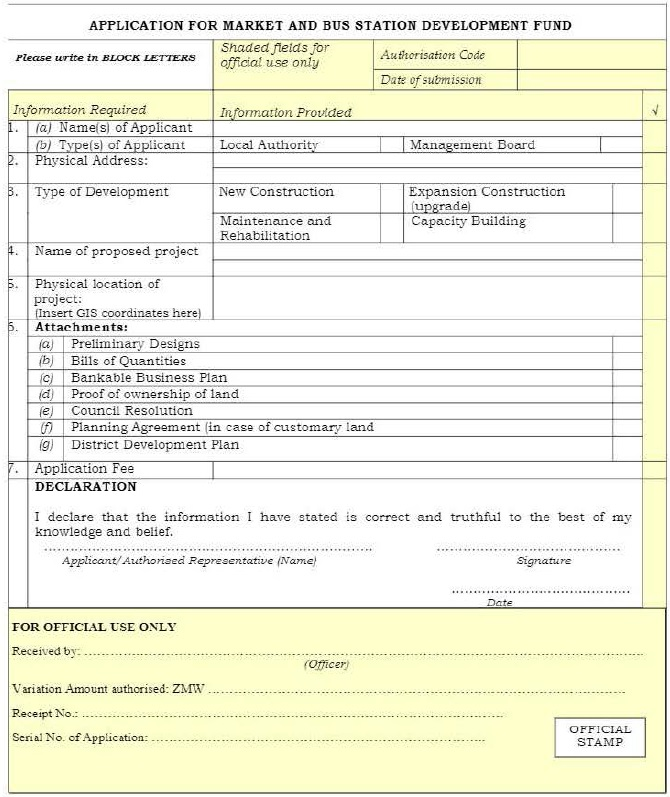
Form II
[Regulation 18(3)]
|
|
|
REPUBLIC OF ZAMBIA |
|
The Markets and Bus Stations Act, 2007 |
|
National Market and Bus Station Development Fund Regulations, 2020 |
|
NOTICE OF APPROVAL OF APPLICATION |
|
|
(1) Here insert the full names and addresses of applicant |
To (1) ………………………………………………………………………………………. IN THE MATTER OF (2) …………………………….. you are hereby notified that your application for (3) ……………………………………………….. has been approved. |
|
|
Dated this ………….. day of ………………… 20…… |
|
(4) Signature of Secretary |
|
|
(4) …………………………………….. |
Form III
[Regulation 18(4)]
|
|
|
REPUBLIC OF ZAMBIA |
|
The Markets and Bus Stations Act, 2007 |
|
The National Market and Bus Station Development Fund Regulations, 2020 |
|
NOTICE OF REJECTION OF APPLICATION |
|
|
(1) Here insert the full names and addresses of applicant |
To (1) ……………………………………………………………………………………………….. |
|
……………………………………………………………………………………………………….. |
|
|
IN THE MATTER OF (2) …………………………………… you are hereby notified that your application for (3) …………………………………………. has been rejected on the following reasons: |
|
|
(a) ………………………………………………………………………………………………….. |
|
|
|
(b) ………………………………………………………………………………………………….. |
|
|
(c) ………………………………………………………………………………………………….. |
|
|
(d) ………………………………………………………………………………………………….. |
|
|
|
|
|
Dated this ……….. day of ……………………. 20…… |
|
(4) Signature of Secretary |
|
|
(4) …………………………………….. |
Form IV
[Regulation 20(1)]
(To be completed in triplicate)
|
|
|
REPUBLIC OF ZAMBIA |
|
The Markets and Bus Stations Act, 2007 |
|
The National Market and Bus Station Development Fund Regulations, 2020 |
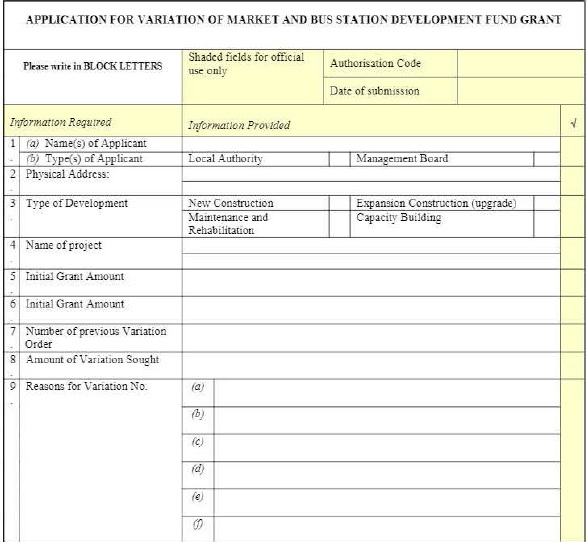
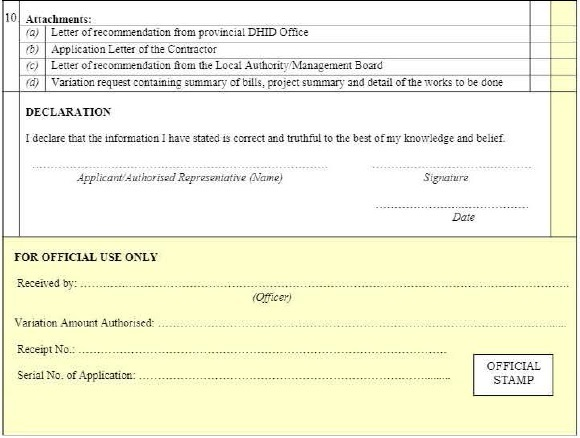
Form V
[Regulation 20(4) and (5)]
|
|
|
REPUBLIC OF ZAMBIA |
|
The Markets and Bus Stations Act, 2007 |
|
The National Market and Bus Station Development Fund Regulations, 2020 |
|
NOTICE OF APPROVAL/REJECTION OF VARIATION |
|
|
(1) Here insert the full names and address of applicant |
To (1) ……………………………………………………………………………………… |
|
………………………………………………………………………………………………. |
|
|
(2) Here insert the reference No. of the application |
IN THE MATTER OF (2) …………………………………………………………. you |
|
are hereby notified that your application for (3) …………………………………… |
|
|
(3) Here insert the type of application |
………………………………………………………… has been approved/rejected |
|
|
|
|
|
Dated this …………. day of …………………… 20…… |
|
(4) Signature of the Secretary |
|
|
(4) …………………………………………………… |